
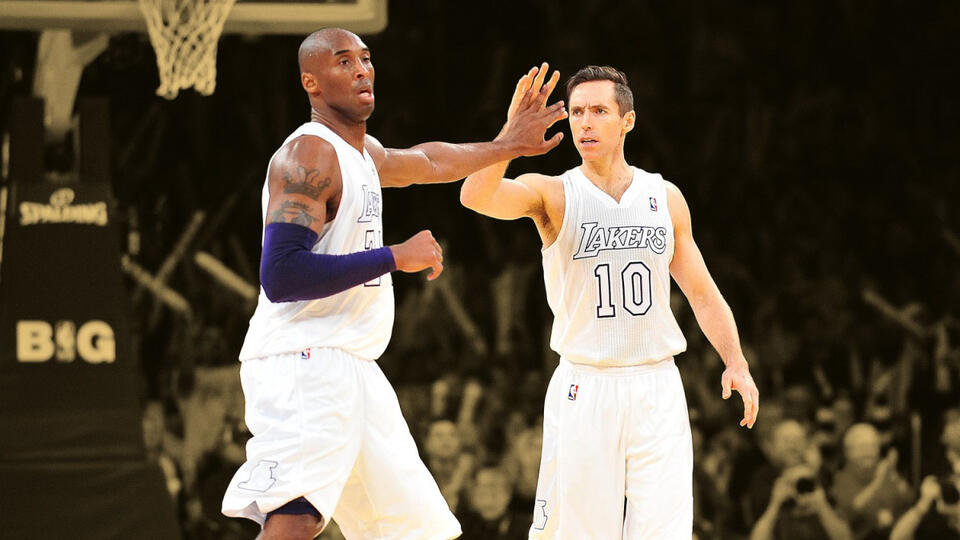

The 2012 Los Angeles Lakers arrived with the hype that makes headlines and sells tickets.
Kobe Bryant, Dwight Howard, Pau Gasol and Steve Nash together felt like a guaranteed championship team. But the reality behind the scenes told a different story.
Nash wasn’t shy about his feelings after his first year. Speaking to prominent NBA media personality Zach Lowe, the two-time MVP said, “I think it’d be nice to find a middle ground where he does his thing but the ball still can move for great parts of the game. … But I knew it wasn’t going to be the same. When you play with Kobe Bryant, the ball is gonna be with him most of the time.”
That was less a subtle hint and more a blunt warning. Bryant, aging but still an all-world talent, ran the offense his way, and anyone expecting to handle the ball for extended periods quickly learned otherwise. Nash, one of the greatest table-setters in league history, wanted balance, but the reality was simple.
The ball stayed with No. 24 nearly all the time.
The illusion of a superteam
Much of the blame for the Lakers’ collapse has been pinned on Howard’s inability to fit into Mike D’Antoni’s system. But a Lakers insider tells a different story. Howard’s problem wasn’t with the offense itself but with a certain someone playing outside the system with zero accountability.
“He saw one particular player play outside that scheme with carte blanche, with no accountability,” the source said.
Howard wasn’t fragile or out of place. Los Angeles gave him everything he dreamed of: fame and the lifestyle.
“LA was everything Dwight wanted. To be celebrated. To be among stars. To be among women of this caliber. To live, basically, in one big reality TV show. This was a perfect setting for him,” the source said.
But the offense never gave him the room to shine. Bryant’s dominance meant the other stars had to fit in or fade away, and the balance Nash hoped for never came.
The cost of Kobe’s control
Nash’s feeling proved accurate. The Lakers stumbled through the season, missed the playoffs and lost Howard after just one year. Gasol’s role shrank, and Nash struggled in a system that did not match his style.
The team’s failure wasn’t just about injuries or talent. It was about how the face of the franchise’s grip on the offense left no room for others to lead or breathe. It fractured trust and created tension that the Lakers never overcame.
In a league where ball movement and teamwork win titles, the Lakers superteam failed because there were a bunch of moving parts and only one basketball. When you play with Bryant, a part of you must accept the ball stays in his hands most of the time.
That truth doomed the 2012 Lakers before they even took the court.