
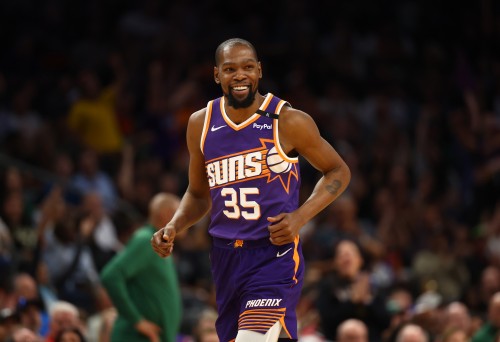
From the moment Kevin Durant was known to be available in trade from the Phoenix Suns, the questions started.
“You can’t trade for Durant without signing him to an extension, right?”
“Durant is going to demand the max on his next deal, right?”
“How much can you pay a guy who will 37 years old when the season starts, especially with his injury history?”
So, far the answers are:
The Rockets did…at least so far.
Doesn’t look like it.
That’s still to be determined.
What we’re going to do today is take a look at what the options are for Durant and the Houston Rockets, after they acquired him this offseason. We’ll do this is our standard way of looking at the maximum Houston can give Durant, the max another team can pay the superstar forward, and then trying to project what feels fair for all parties involved.
However, with Durant and the Rockets, there is a bit of context needed before we start talking numbers. This is all related to the questions we opened this piece with.
Despite the fair speculation about Durant needing an extension as part of a trade, that hasn’t been the case. In fact, recent reporting is that Houston and Durant aren’t in any kind of rush to lock into a new deal. That’s huge for the Rockets, because it allows them some flexibility as they map out their future.
As for the second question: Durant doesn’t seem to be demanding a max deal. There are reports that the veteran forward isn’t looking to pull every penny that he can on his next contract. Again, that’s big for the Rockets, who are starting to get a little expensive.
When it comes to the last question, it’s exceedingly fair to ask how much you can lock into for an older player who has missed considerable time. Here are Durant’s games played per season since tearing his Achilles’ tendon during the 2019 NBA Finals:
2019-20: 0
2020-21: 35
2021-22: 55
2022-23: 47
2023-24: 75
2024-25: 62
That’s a lot of missed time, even when accounting for some of those being shortened seasons. Durant isn’t likely to get any healthier as he moves into his late 30s, either. His next deal has to factor in that there will be some missed time to account for.
All of that having been said…we’re talking about Kevin Durant!
Despite his advanced age, Durant remains one of the league’s best scorers. Since missing the 2019-20 season, Durant has averaged 27.9 points on 53/42/88 shooting splits. He’s also grabbed 6.7 rebounds, dished out 5.2 assists and blocked 1.2 shots per game over the last five seasons. He’s not slowing down very much.
Durant remains incredibly productive and continues to play at an All-NBA level each season. That’s going to see him paid quite handsomely on his next contract. Let’s take a look at what that might look like!
The Over-38 Rule
Before we dive into the numbers, a quick note on the Over-38 rule. Durant will trigger that starting with the 2026-27 season, which will be the first year on his next contract. (Side note: Durant only triggers the Over-38 rule in 2026-27 by two days. The Over-38 rule considers October 1 as the start of a new season. Durant was born on September 29, putting him just outside missing the Over-38 rule for another season entirely.)
To keep things simple, we’re going to limit out analysis here to two- and three-year deal structures. The Over-38 rule only applies to contract that are four or five years in length. Because it’s complicated, and hard to fit in the salary for player on a near-max deal (as Durant will be), on a four- or five-year contract, we’re going to assume shorter-term agreements in our analysis.
Extending with the Rockets
Kevin Durant is extension eligible with Houston and will be all the way through June 30, because he’s on an expiring contract. That means that at any point this year, the Rockets and Durant can agree to a contract extension.
Because extensions are added to what is left on a current deal, Durant is functionally limited to a two-year extension. That will avoid any Over-38 rule complications. Here’s what a two-year maximum extension projects to look like for Durant:
2025-26: $54,708,609 (final season of current contract)
2026-27: $57,915,200
2027-28: $62,548,416
Total: three years, $175,172,225
Total extension: two years, $120,463,616
This is a two-year extension that starts at 35% of the cap in 2026-27. It’s likely that the second year of the extension would include a player option, as Durant will want to evaluate things on a year-to-year basis at that point.
Re-signing with the Rockets
If Durant lets his contract expire, he can re-sign with Houston as a free agent in the 2026 offseason. The Rockets will have full Bird rights for Durant, which allows them to offer him a full max deal. Again, to avoid Over-38 complications, we’re going to limit this to a deal that is three seasons in length. Here’s what that max contract projects to look like:
2026-27: $57,915,200
2027-28: $62,548,416
2028-29: $67,181,632
Total: three years, $187,645,248
This is a three-year deal that starts at 35% of the cap. Like with the extension we covered above, Durant would probably get a player option on the final season.
Re-signing with the Rockets on a 1+1 contract
It’s been widely reported that Durant and Houston have been talking about two-year deals, which would likely be of the “1+1” variety. That allows Durant to go year-to-year with his contracts. A two-year max deal would look exactly like what Durant would add in an extension:
2026-27: $57,915,200
2027-28: $62,548,416
Total: two years, $120,463,616
That’s again 35% of the cap, and the second season would likely be a player option for Durant.
Signing with another team in free agency
We’ve seen Kevin Durant leave a pretty good situation in the past, when he left the Golden State Warriors for the Brooklyn Nets. It’s not necessarily what we expect to happen with the Rockets, but if it does, he’d likely be landing a max or near-max deal. Here’s what that could look like:
2026-27: $57,915,200
2027-28: $60,810,960
2028-29: $63,706,720
Total: three years, $182,432,880
In this case, Durant still would start at 35% of the cap, but he gets 5% raises instead of 8%. All total, that would cost Durant about $5.2 million over the course of a three-year deal.
Signing with another team in free agency on a 1+1 contract
Let’s say Durant leaves Houston, but is going the mercenary route and playing things out year-to-year. Here’s what a “1+1” deal would look like:
2026-27: $57,915,200
2027-28: $60,810,960
Total: two years, $118,726,160
This one sees Durant give up about $1.7 million, which is a relatively small amount when we’re talking max deals.
Finding common ground with the Rockets
To this point, we’ve laid out what all of the max deals could look like for Kevin Durant on an extension, re-signing with Houston or leaving for another team. But let’s go back to where we started this analysis.
Durant doesn’t seem to be pushing for a full max deal with the Rockets. That’s massive for Houston, because they’ve got a decent chunk of money on their books already for the next few seasons. Alperen Sengun and Jabari Smith Jr. are signed to long-term extension that see them making a combined $59 to $63 million from 2026-27 through 2028-29.
Now, that combined figure for Sengun and Smith is exceedingly fair. Both players are good bets to return terrific value on their non-max deal. Because Sengun and Smith are on team-friendly contracts, Houston has pretty good flexibility moving forward. That’s important because the team wants to keep Tari Eason (who is extension eligible now) and Amen Thompson (extension eligible in the summer of 2026) on long-term deals.
For Durant, his main priorities seem to be winning and being where he wants to be. By not maxing out on his next deal, Durant can increase the likelihood of both of those things coming to fruition. Here’s a pretty fair compromise for Durant and the Rockets on a new deal, either via an extension or a new contract next summer:
2026-27: $50,000,000
2027-28: $50,000,000 (player option)
Total: two years, $100,000,000
This contract lops off roughly $20.5 million from the max Durant could get from the Rockets. By keeping the contract flat (unfortunately, the salary in an option year can’t be lower than the year preceding it), this gives Houston good flexibility in the summer of 2027, assuming Durant opts in.
That summer, the Rockets will already have about $152 million on the books (assuming a max or near-max deal for Thompson). With Durant at $50 million, that would leave Houston roughly $18 million under the first apron. If Durant was willing to take even less, that would further increase the Rockets flexibility. If Durant opted out, Houston could potentially be a cap space team.
Kevin Durant doesn’t seem to be demanding a max deal on his next contract. But he’s not likely to take a massive discount either. A contract that comes in at roughly $50 million per season is good middle ground for both Durant and the Houston Rockets.