
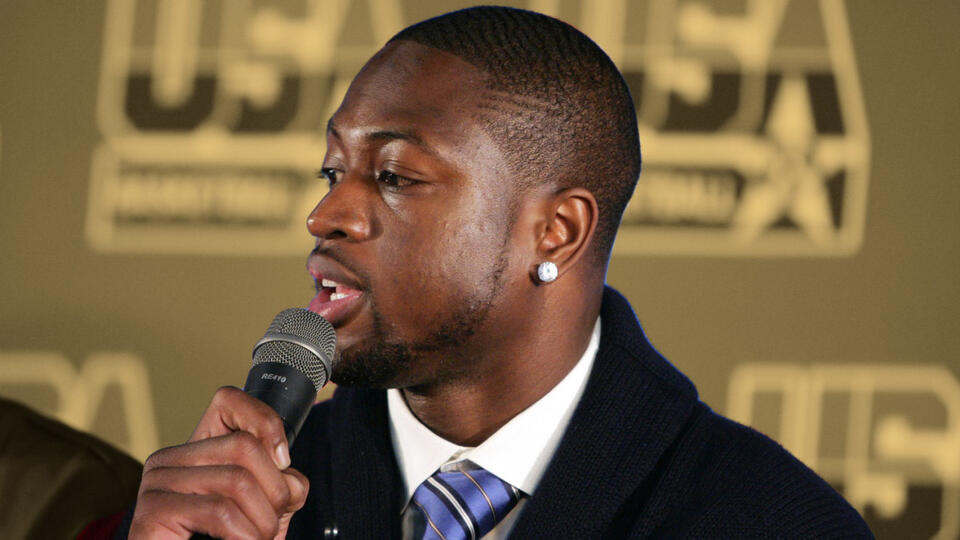
When the Miami Heat formed the “Big Three” of LeBron James, Chris Bosh, and Dwyane Wade, most viewed it as a short-term strategy to win championships. Wade felt the hate, admitting that they were seen more as villains than as basketball players who wanted to win NBA titles.
Wade found the shabby treatment unfair. He reasoned that people didn’t know him that well personally, nor his costars, LeBron James and Chris Bosh.
“We know, as the people and the individuals that we are, they don’t know us well enough to really, really not root for us as humans,” Wade quipped to the Washington Post.
Wade made those comments after the Heat lost to the Dallas Mavericks in the 2011 Finals, 4-2. He added, knowing that people were rooting against them, especially the ones who frowned on the formation of the Heat’s big three.
“That’s just the way it is. I don’t think it’s anything personal,” Wade said about the team’s critics.
The bright side of being villains
Wade knew that the villain tag would be something they would have to live with for some time. Rather than object to it, the 2006 Finals MVP tried to look at it differently.
“If it makes for people tuning in, watching our games, if it makes for bigger story lines and it just makes our game better and exciting, we’re fine with that,” Wade declared.
Most fans deemed the trio of Wade, James and Bosh overkill, a super team that would be hard to beat. But seeing how they fell to the Mavs in the 2011 Finals, that belief was scorned. It wasn’t just about talent but an assembly of players who could function fluidly as a unit that won championships.
After that loss, fans and critics took turns bashing the Heat for falling short of winning a title. However, forming a super team in year one and winning a title is a tall order. Although Wade, James and Bosh were friends, they still needed to develop chemistry to truly unleash what they could do.
Spoelstra barks back at critics
Aside from Wade, another person who couldn’t understand the criticism the Heat got was head coach Erik Spoelstra. He couldn’t figure out why many made a fuss about it, pointing out that any NBA team could have done the same if they had the chance.
“Every single franchise in this league, if they had the opportunity to sign three players the way we were able to, they would have without any hesitation. So everything else that everybody is saying, at first, it was hard for us to understand. But that’s how this team is going to be viewed,” Spoelstra reasoned.
Wade doubled up on that point made by Spoelstra. He pointed out how previous teams such as the Bulls, Celtics and Lakers had their versions of big threes but never got the same scrutiny they got.
For the Bulls, it was Michael Jordan, Scottie Pippen and Dennis Rodman (1995 to 1998). The Celtics had Larry Bird, Kevin McHale and Robert Parish leading the way back in the 80s. The same held for the Lakers, who were led by Kareem Abdul-Jabbar, Magic Johnson and James Worthy in that same era.
For Wade, the criticism may have stemmed from the dawn of social media. Information dissemination and the ability to speak out were different compared to the time of MJ, Bird and Magic.
“I think we did it in the time of social media and in a time that normally, from what it looked like from afar, organizations were the ones making the trades and the moves to bring these superteams together,” Wade stated.
Wade and the Heat saw that villain tag fade in the following years, especially after making four straight finals appearances and winning two championships in 2012 and 2013.
To this day, teams continue to adopt the same strategy and form their own big threes. However, after seeing the teams that stood out in the 2025 playoffs, it appears there will be a new approach by teams moving forward. It is no longer about having multiple talents but more about putting together a cost-efficient team of individuals with chemistry, whose roles are defined.