
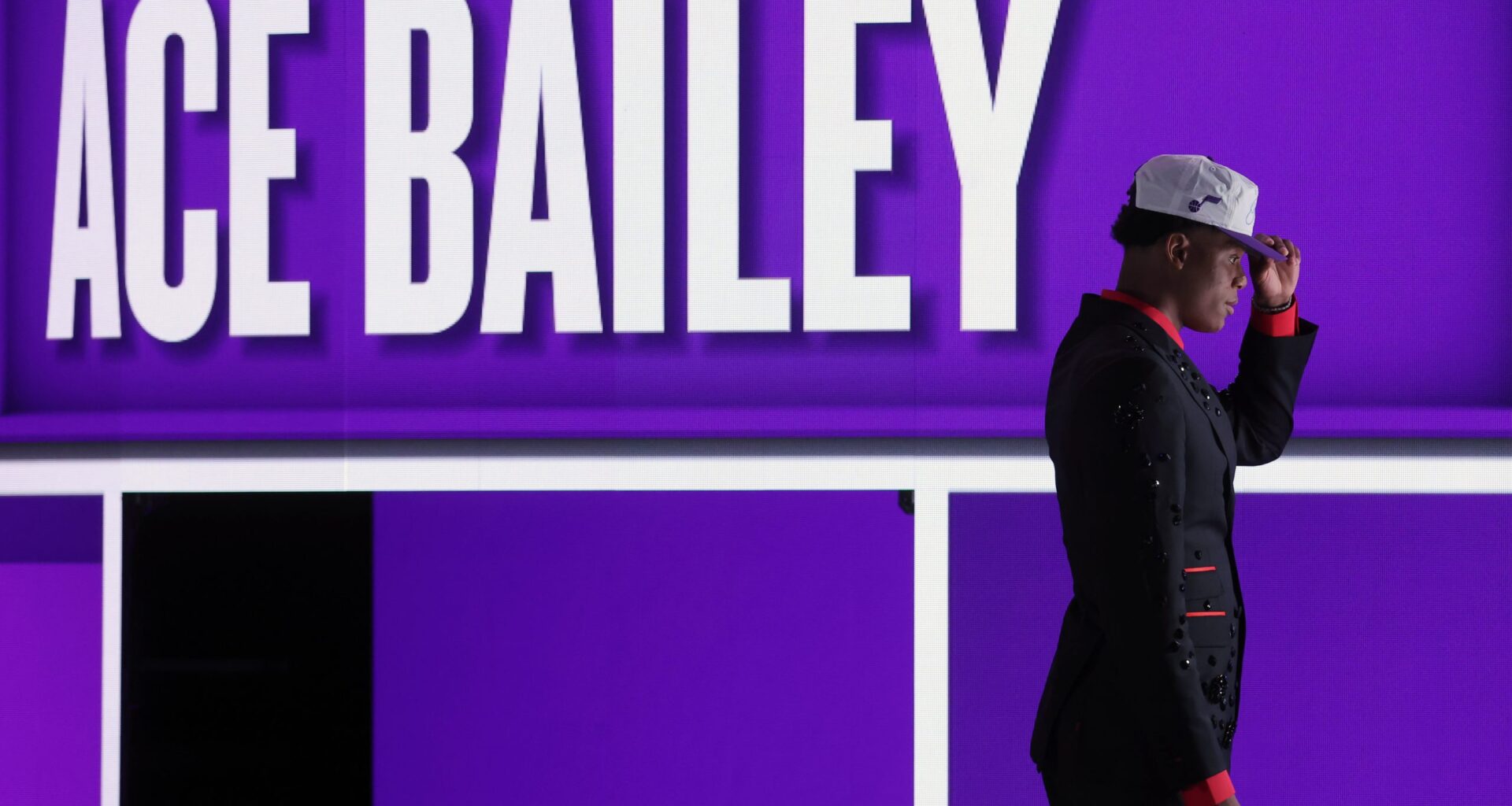
For years, the Utah Jazz have built a reputation for maximizing their roster, but establishing and hanging onto homegrown stars has proven difficult as of late.
Donovan Mitchell and Rudy Gobert, both acquired at the beginning of their careers, became All-Stars in Salt Lake City before the franchise opted to reset through major trades.
The arrival of Ace Bailey presents a chance to change that pattern. With Danny Ainge in the front office and Will Hardy on the sideline, the Jazz are betting on a patient build: draft wisely, develop well, and hold on to their young talent. The Spurs of the past and Thunder of the present have turned that blueprint into sustained success. Now Utah will find out if it can do the same, and if Ace Bailey can become part of the franchise’s identity.
Jazz’s New Era Begins with Ace Bailey
In the 2025 NBA Draft, the Jazz made a clear bet on upside. They selected Ace Bailey with the No. 5 pick.
𝘸𝘪𝘵𝘩 𝘵𝘩𝘦 5𝘵𝘩 𝘱𝘪𝘤𝘬 𝘪𝘯 𝘵𝘩𝘦 2025 𝘕𝘉𝘈 𝘋𝘳𝘢𝘧𝘵, the Utah Jazz select 🏔️ 𝐀𝐂𝐄 𝐁𝐀𝐈𝐋𝐄𝐘 🏔️#TakeNote pic.twitter.com/l3Flt2qPHX
— Utah Jazz (@utahjazz) June 26, 2025
He is one of the most highly touted high school prospects in years. More than raw talent, Bailey represents a potential shift in Utah’s identity.
Listed at 6-foot-9, the forward offers rare two-way potential and brings the kind of athleticism and motor that has drawn comparisons to Paul George. Bleacher Report’s Jonathan Wasserman described him as a “big-wing shot maker with defensive tools,” adding that “even a worst-case outcome for Bailey looks appealing.” Utah may finally have a chance to build a star in-house.
But Bailey is not Utah’s only young asset. Sophomore guard Keyonte George has shown potential in both scoring touch and playmaking ability after his rookie season, and Taylor Hendricks has impressed with his defensive potential and floor spacing.
Together, they hint at an emerging “homegrown core.”
Learning From the League’s Best Developers
Looking across the league, Utah’s emerging strategy comes into sharper focus.
The San Antonio Spurs built a dynasty on long-term player development, producing stars such as Tim Duncan and Kawhi Leonard; they’re currently working on Victor Wembanyama.
The Duncan-Leonard era alone delivered five NBA championships.
The Oklahoma City Thunder have taken a similar route, rebuilding around homegrown standouts Shai Gilgeous-Alexander, Chet Holmgren, and Jalen Williams.
These organizations do more than draft well. They invest deeply in development and patience.
The Jazz appear to be following a similar plan under Ainge’s direction. During his time running the Boston Celtics, he built rosters that lasted by avoiding panic moves and keeping with the long-term view. In Utah, he has applied the same patience — expanding the G League affiliate (Salt Lake City Stars), adding to the player development staff, and sticking to a plan that values steady growth over quick fixes.
In today’s NBA, that approach is the exception, not the rule.
The Most Viable Path for a Small-Market Team
For a small-market team like Utah, signing a superstar free agent is virtually impossible. That makes internal player development the most realistic path to championship contention. Turning Bailey’s ceiling into a reality might be the franchise’s best route to a title.
The offloading of John Collins, Collin Sexton and Jordan Clarkson signals that the Jazz front office is now primarily focused on paving a runway for their young stars. They have built for the future by collecting draft picks and keeping the team’s salary cap flexible. All that remains is time and talent worth waiting for.
Developing a franchise player like Ace Bailey in Jazz colors would mark a turning point for the team.
Ace Bailey’s Road to a Homegrown Star
The Jazz have long turned to outside acquisitions for star power, but that approach may be shifting. With a young core and a renewed focus on development, Utah is now intent on building its next cornerstone from within.
Ace Bailey can be that player. If this talent translates, he has the potential to define the franchise’s next era and prove the Jazz can build and keep a franchise cornerstone.