
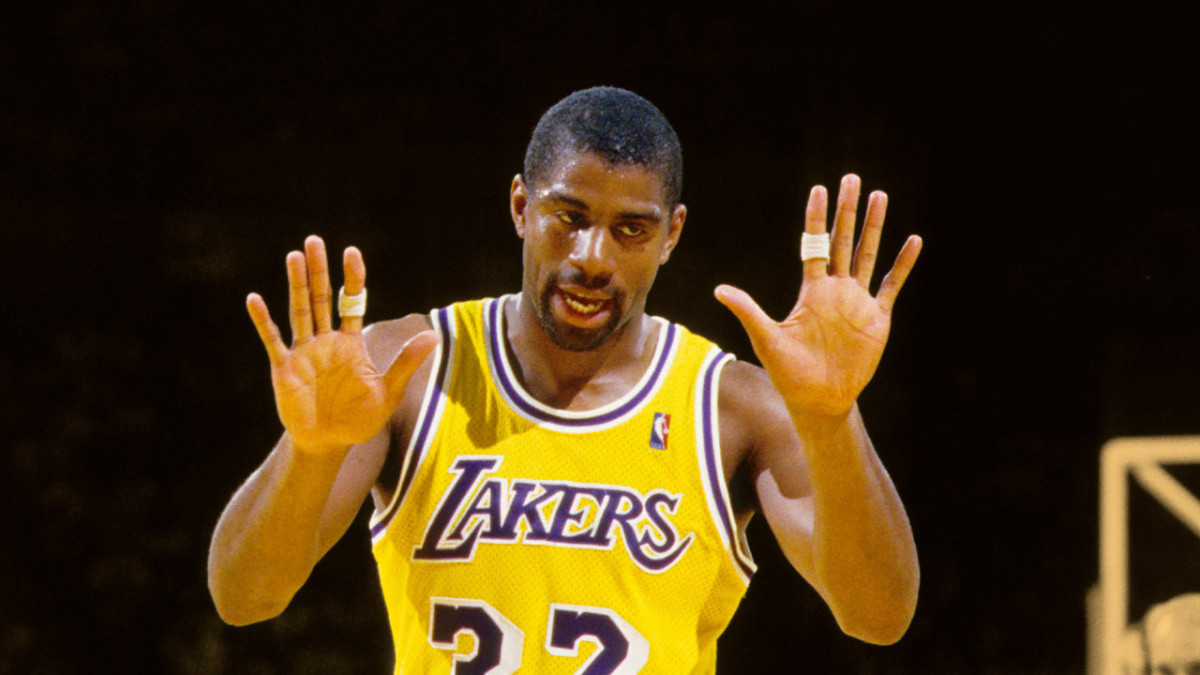
When Earvin “Magic” Johnson returned to active duty in 1996, it seemed like brighter days were ahead for the Los Angeles Lakers. LA did just that in the regular season, snagging the top seed in the Western Conference. However, he knew that battles are different in the postseason and the three-time MVP was a bit concerned about their chances.
Facing the Houston Rockets in the first round, the Lakers were in a precarious situation. They were staring at elimination heading into Game 4 and Johnson didn’t sound confident about LA’s chances.
Advertisement
“Houston has those warriors and maybe we don’t know how to be like them yet, because this team hasn’t been that far. I can tell them what it’s like, and they can listen, but you can know what to do. But do you know how to do it? It’s that experience that the Rockets have and if we lose, that will be the reason why,” Johnson said ahead of Game 4 via the Washington Post.
The big story of that series was the Lakers’ loss in Game 1, 87-85, at The Forum. Following the 2-2-1 format, the Purple and Gold had to win at least one game at The Summit. It never happened.
The Rockets took Game 4, 102-94, to wrap up the series and advance to the next round. Magic managed to contribute only 8 points, 5 rebounds and 5 assists in 30 minutes of action.
Advertisement
Despite falling short, Johnson initially said he contemplated returning for the 1996-97 season. But in the end, he opted for retirement, stressing that he was ending his career this time on his terms.
The new breed of Lakers disappointed Magic
Being in his mid-30s when he returned in 1996, there was no doubt that Magic remained one of the top players in the league. However, with a lesser and different role, Johnson was no longer enjoying his time on the floor.
Advertisement
Looking back at how he played before that HIV announcement in 1991, the 12-time All-Star was used to playing the point to make his teammates look good. He also had the respect of his teammates, which was why most players played their hearts out when the Lakers took the floor.
But joining a new breed of Lakers, Magic joined a group that hardly met his standards in terms of commitment and focus. These were essential for him and two players hardly met that criteria – Van Exel and Cedric Ceballos.
Van Exel was an excellent player, someone who could orchestrate and deliver the points. However, the only problem with Nick was his temper. He had a short fuse and failed to consider the consequences it would have on the team.
Advertisement
An unforgettable incident was when Van Exel argued a call with game official Ron Garretson. That drew a technical foul and Nick made it worse by shoving the referee, resulting in heftier sanctions. For Magic, Nick should have considered the repercussions of his actions.
“No matter how mad or frustrated you get, you don’t do it. He will hurt himself and hurt the team,” Johnson said.
As far as team commitment, there was the case of Cedric Ceballos. The 1992 NBA Slam Dunk champion mysteriously disappeared at some point in the 1995-96 season, allegedly because he was trying to resolve a family problem. It got controversial after reports surfaced that he was spotted waterskiing and dancing at a resort.
Advertisement
The stress of playing wasn’t worth it
The cases of Van Exel and Ceballos were just some of the things that left Johnson disappointed with his return in 1996. It was understandably a new era and Magic needed to adjust if they wanted to play on.
Hence, the decision to retire after that short return appeared to be the wise choice. It would have been a waste of time for Johnson to continue while surrounded by teammates who didn’t seem as focused on winning it all.
Advertisement
This story was originally reported by Basketball Network on Aug 22, 2025, where it first appeared in the Old School section. Add Basketball Network as a Preferred Source by clicking here.