
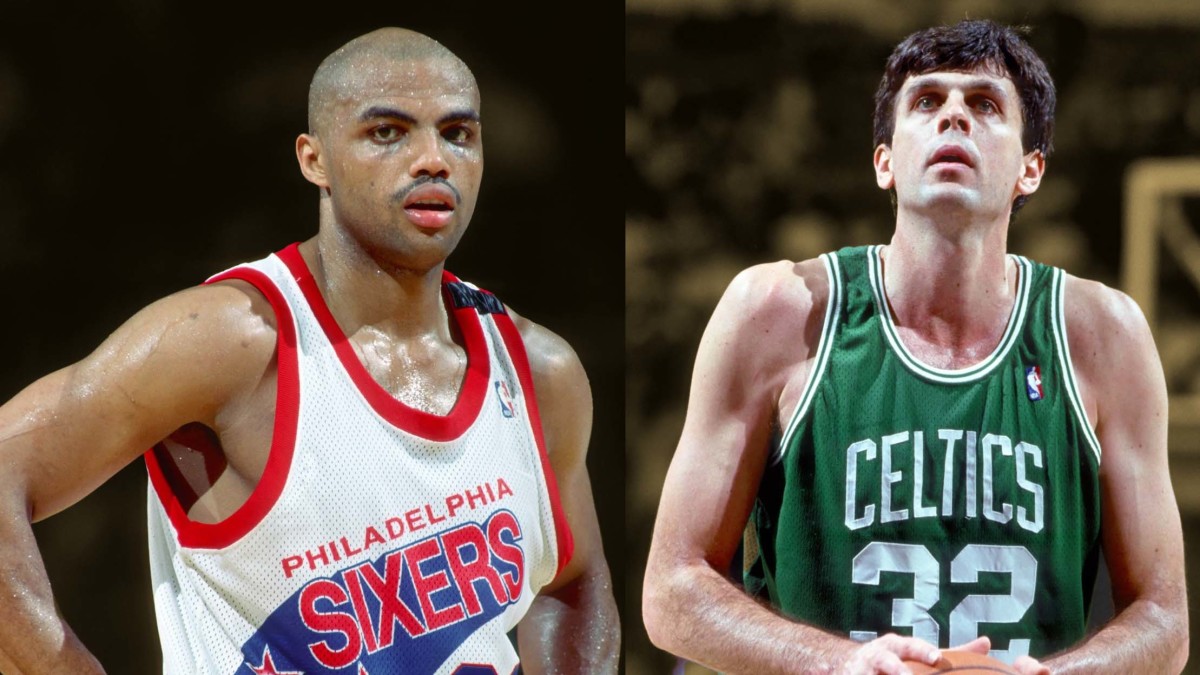
Playing in the NBA during the 1980s and 1990s meant competing in an era dominated by brute physicality, where taller and more imposing big men consistently dictated the style of the game. In such a landscape, only forwards with strong builds and considerable height — such as Larry Bird, Kevin McHale, or Karl Malone — were able to leave a lasting impression.
Yet, defining that conventional perception, Charles Barkley was a rare power forward who achieved dominance despite being 6’6″. In fact, Kevin McHale once explained how Sir Charles was even shorter than listed to amplify the significance of his legendary numbers.
Advertisement
McHale on Barkley’s height
Statistically, Chuck’s averages spoke volumes about his talent. He averaged a career scoring average of 22.1 points per game, even higher than Julius Erving, who was considered one of the first players to have a complete offensive game as a forward.
Perhaps even more impressive was Barkley’s dominance on the glass, where he averaged 11.7 rebounds per game over his career. Interestingly, that number was also higher than the averages posted by Kareem Abdul-Jabbar and Hakeem Olajuwon — two legendary centers tasked to dominate the boards in every game.
Advertisement
To make this feat seem more praiseworthy, McHale once shed light on how Barkley seemed even shorter than 6’6″ in casual attire, to shed an actual light on how he bossed around the opposition day in and day out despite being one of the shortest players expected to grab a rebound.
“You know, when you saw him in his uniform, he thought he was 6’8″, 6’9″, just when you know when you step on the floor with him,” McHale recalled. “Then you’d see him in street clothes and go, ‘Man, this guy’s not that big.'”
Chuck was no ordinary forward
Furthermore, the comparison with his contemporaries only highlights Barkley’s unique greatness. For instance, while McHale was reckoned as one of that generation’s most versatile and consistent forwards, the Celtics legend never registered a single season averaging a double-double throughout his career.
Advertisement
Similarly, Karl Malone, who, too, is celebrated as one of the greatest power forwards ever, managed 10 double-double seasons across his 19-year tenure. Conversely, Barkley achieved a double-double in every season of his career after his rookie campaign, demonstrating remarkable consistency and resilience.
That being said, this was exactly why players who competed against “The Round Mound of Rebound” often kept him in a tier that most modern-day fans would never understand. His resume may have lacked a much-deserved Larry O’Brien trophy, but his influence and dedication were known to all.
This is perhaps why, despite having fewer All-Star and All-NBA nods than some of the more accomplished forwards in the game, Barkley is often mentioned when discussing the five greatest players in his position.
Advertisement
His battles with weight issues might be known to all. Still, those who shared the court with him truly felt his dedication and ability to relentlessly dominate.
This story was originally reported by Basketball Network on Aug 22, 2025, where it first appeared in the Off The Court section. Add Basketball Network as a Preferred Source by clicking here.