
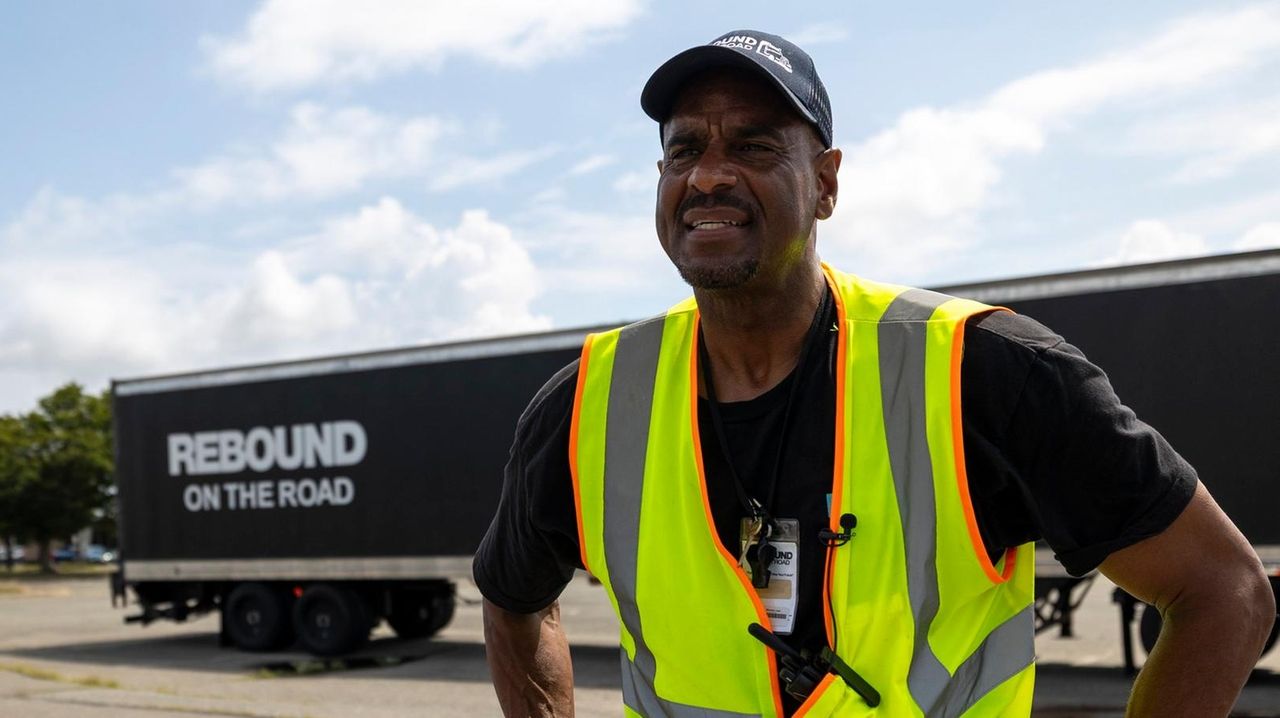
The sun hadn’t even risen, and Jayson Williams was reporting for practice.
Not shooting, dribbling and passing like he did as an NBA All-Star — and not practicing his own skills.
Williams, 57, was helping his “teammates,” as he calls them — students with past histories of substance use, homelessness, criminal records or other troubles — master the art of driving tractor trailers in a program he founded this year in partnership with Nassau County and Nassau Community College.
The eight-week program, called Rebound on the Road, provides students with professional instruction to help them pass commercial driver’s license tests, setting them up for annual salaries that can start in the low $70,000s and quickly reach six figures with overtime.
WHAT NEWSDAY FOUNDFormer NBA star Jayson Williams, in partnership with Nassau County and Nassau Community College, has launched a free job-training course for people with past histories of substance use, homelessness, criminal records or other troubles.The eight-week program, called Rebound on the Road, provides students with professional instruction to help them pass commercial driver’s license tests.All graduates have earned their CDL licenses, and they have all been offered jobs as truck drivers, Williams said.
“They’re all ready,” the 6-foot-10 Williams said on a recent morning, clad in a neon yellow reflective vest, T-shirt, long pants and sneakers as students driving tractor trailers in a college parking lot practiced making tight turns, reversing without letting the trailer swerve to the side and parallel parking a 70-foot-long beast of a vehicle.
The tuition-free course is funded in part by a $200,000 one-year grant from Nassau County’s opioid settlement fund — recently extended to $800,000 over four years, county officials said — and in part by Williams, who said he has spent about $600,000 of his own money buying, leasing and maintaining eight trucks and hiring a psychiatrist, therapist, driving instructors and other staff.
The program offers mental health counseling, psychiatric treatment and extensive help with job searching, along with team-building activities that include barbecues, gardening, go-kart racing and — for the bravest students — skydiving.
The next session will begin in September, with a dozen students. Candidates have been referred by Nassau County probation officers and drug courts, as well as clergy and family members, Williams said. Prospective students undergo multiple interviews, including a 6 a.m. meeting with Williams.
Students must be “serious about changing their life,” he said. “I never want a company to call me and say, ‘Jay, you didn’t send me a professional.'”
Rebuilding self-worth and finding focus
There is an urgent need for more treatment programs for people recovering from substance use or criminal justice involvement, said Jeffrey Reynolds, president and chief executive of Family & Children’s Association.
“Anything we can do to expand programs that create better pathways for people and create more meaning in their lives, I think is a good thing,” Reynolds said.
Roughly 17% of American teens and adults needed treatment for unhealthy use of alcohol or drugs in 2023, up from about 8% a decade earlier, research published in January in the Journal of the American Medical Association showed. Of those who needed substance use disorder treatment, only about 15% received it, for reasons that included “reluctance to stop substance use, insufficient health care coverage, lack of awareness about treatment programs, and negative impacts on employment and community perceptions,” researchers wrote.
The unemployment rate for people with criminal records is around 30%, according to the U.S. Chamber of Commerce. Those who are able to find and keep a job are about three times less likely to commit another crime compared to those who cannot maintain employment, the organization said.
Employment is a “critical” aspect of recovery programs, said Reynolds, whose Garden City social services agency provides substance use recovery and post-incarceration re-entry programs for about 12,000 people a year.
A job “helps rebuild your self-worth, and it gives you a focus and gives you an income and gets you back into the swing of things,” Reynolds said.
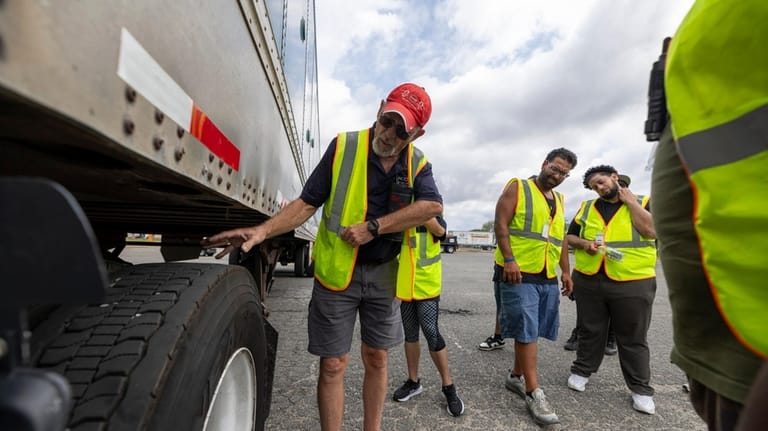
Instructor Ray Thornberry works with Rebound on the Road students in Garden City. Credit: Newsday/Howard Schnapp
All of the Rebound on the Road graduates have earned their CDLs, and they have all been offered jobs as truck drivers, Williams said.
The program held its first graduation ceremony this month for 10 graduates of the first two cohorts in the program. The event drew more than two dozen family members and friends along with Nassau County Executive Bruce Blakeman and the college’s chief administrative officer, Maria Conzatti.
Rebound on the Road, Williams told those gathered in a glass-enclosed room for the ceremony, aims “to give people purpose and not a job, because the best social program is not a job, it’s a career.”
Not all the students have had law enforcement troubles, but for those who have, their convictions range from low-level theft to a 2008 manslaughter. Many of the students “need not a second chance, because we’ve been through our second chance, but another chance,” Williams said.
Seeking redemption, and recovery
Williams knows all about needing another chance. He served more than 2 years in prison after pleading guilty to aggravated assault for the 2002 accidental shooting death of his limousine driver, Costas Christofi, and admitting he was driving drunk in 2010 when he slammed his vehicle into a tree in Manhattan.
“I work as hard as I can serving others,” he said, sitting at a picnic table near the college parking lot earlier this month. “I am deflecting everything by working 16, 17 hours a day,” he said, to avoid “remembering all the pain I’ve caused.”
He has experienced pain of his own, as well. When he was 7 years old, he was given alcohol and raped, he said. He lost two sisters to AIDS.
Williams, who once had an $86 million, six-year contract with the New Jersey Nets before suffering a career-ending leg fracture during a game in 1999, said his own recovery has included mental health counseling, Alcoholics Anonymous and Bible study.
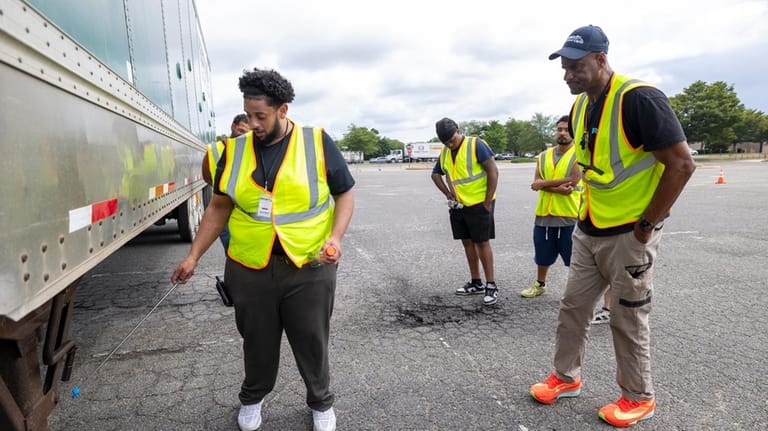
Williams, right, routinely arrived early and left late in the night to help run the program. Credit: Newsday/Howard Schnapp
Running rehabilitation programs is now the primary focus of his life, he said. A decade ago, after two friends ordered him to go to rehab, he co-founded a program in Florida called Rebound, which provides outdoor adventures including skydiving and paddleboarding, along with mental health treatment and other addiction recovery services.
Many people with histories of substance use disorder have experienced trauma and mental health challenges such as depression and anxiety, said Dr. Manassa Hany, director of addiction psychiatry at Northwell Health.
“You would need, in order to address substance use disorder properly, to also address the psychiatric issues,” he said. “Those with encounters with the criminal justice system are even much more vulnerable.”
It helps when patients can “change their environment” to get away from the circumstances that contributed to their problems, he said.
In some cases, it also can help when those running programs or providing treatment have overcome troubles of their own, Hany said. Some people who have recovered from addiction “want to provide some kind of help to those who might be on a similar track, and try to kind of warn them, [and]…give people hope, because one of the biggest problems with substance use disorder is hopelessness,” he said.
At the graduation event at Nassau Community College, Blakeman said of Williams, “We know the life that he had and how he turned that around into something that’s intrinsically good, something that helps the community.”
Blakeman said after the ceremony that the idea for Rebound on the Road came about after the county’s deputy parks commissioner, Frank Alagia — who played basketball as a student at St. John’s University in the 1970s — told Blakeman about the Florida program and arranged a meeting between the two men.
Blakeman said he told Williams, “Look, if you want to try it here in Nassau County, we’ll run a pilot program to see how it works.”
Participants, Blakeman said, are “going to become productive members of society, and it’s going to make for a safer Nassau County and a safer region.”
‘Everyone really cares about each other’
Williams said he moved from Florida to Long Beach to run the program. For its duration, he steered his Lincoln Navigator every morning onto the cracked pavement of a sprawling parking lot at the Garden City college.
Instead of the sound of shoes squeaking and basketballs hitting backboards, the retired player heard the rumble of truck engines and the sound of air brakes sneezing as they release excess pressure.
Williams’ father taught him to drive trucks, he said. At St. John’s and even when he played in the NBA, he said, he would drive trucks and work on construction sites in the mornings and compete in basketball games later in the day, with traces of cement still on his arms.
Williams was one of four instructors in the program’s most recent cohort. Students said Williams routinely arrived at 5 a.m., stayed late into the night and taught extra driving lessons on weekends. He led the students in washing, maintaining and repairing the trucks, took them on mock delivery runs and extended the eight-week program for an additional month to offer on-the-job training.
Clarone Garner, 24, of Uniondale, said the program has kept him moving in the right direction. Garner said he aims to start off as a sanitation truck driver and eventually drive car transporters for high-end vehicle shows and dealerships.
The students “all want to see each other do good,” he said. “Everyone really cares about each other.”
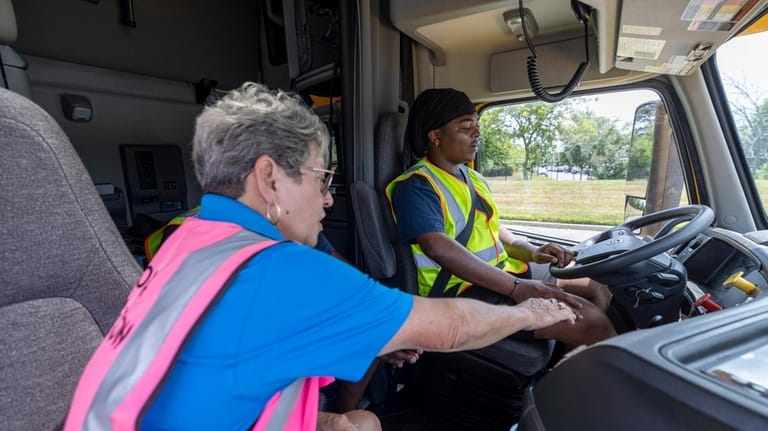
Instructor Lisa Thornberry works with Clarone Garner, who is behind the wheel. Credit: Newsday/Howard Schnapp
At Rebound on the Road, each day begins with a “word of the day” that gives students a chance to air their thoughts and emotions, and ends with a gathering to discuss what they’ve learned.
Sometimes the sessions are lighthearted, with Williams joking and telling stories about his family and his life in the NBA.
Other times they’re more serious.
One afternoon Kim L. Jenkins, 63, said she knew train drivers who don’t always get the mental health support they need after a full day of coping with stressful situations.
“You might not know how wired you are and how much you’re carrying,” said Jenkins, who does not have a criminal record. If a therapist is not available, the Freeport woman urged her fellow students, “Talk to your pastor, talk to your friend, call somebody and kind of decompress.”
The students can lean on each other, and on him, Williams told them.
“I want you to be able, for the rest of your lives, to be able to count on each other, right?” he said. “Our loyalty to each other makes us family.”

Maura McDermott covers education. Since joining Newsday in 2012, she also has worked on the investigations team and covered real estate and the business of health care.