
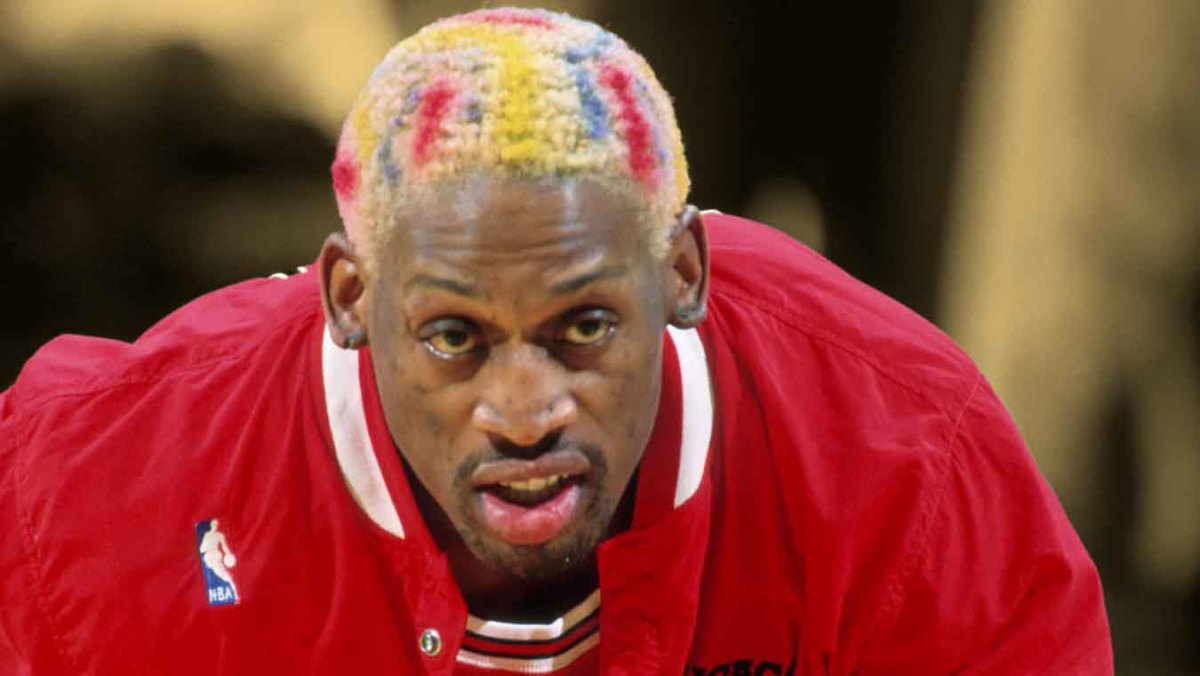
Dennis Rodman was a significant addition to the Chicago Bulls’ roster in 1995, bringing considerable improvement to the defense and rebounding. Aside from that, “The Worm” was the type of player who could raise the Bulls’ energy level when needed, even if it meant coming off the bench.
At his introduction, Rodman was aware of the team’s expectations of him. He was confident he could help out, giving Bulls’ fans something to look forward to in the 1995-96 season.
Advertisement
“I’m going to go out and kick (butt) every night,” Rodman said at his introductory press conference via UPI. “I’m the enforcer. I’m not the biggest guy in the world, but I’ll bring that type of energy to this team,” the two-time Defensive Player of the Year added.
Rodman was expected to take on the role that Horace Grant once held with the Bulls from 1991 to 1993. Although Dennis lacked the offense that Grant had with the Bulls during his six-season stint, the Southeastern Oklahoma State product more than made up for it with his monster rebounding averages.
Rodman had been averaging close to 17 rebounds per game in his past seasons, way better than Grant’s 8.6 boards in the six seasons he was with the Windy City squad. Also, his lack of offense wasn’t a big deal since Michael Jordan, Scottie Pippen, and Toni Kukoc had that covered.
Advertisement
MJ, Scottie adjusted and accepted Rodman
Given their history, the big question when Rodman arrived was whether Jordan and Pippen could co-exist with the controversial forward. Aside from their battles back when Dennis was still with the Detroit Pistons, the 6-foot-7 player had been embroiled in many controversies.
Jordan was okay with Rodman’s eccentric behavior as long as he worked hard every game. He knew Dennis was a good defender and rebounder, and all MJ cared about was whether Rodman’s efforts would benefit the Bulls.
Advertisement
“Sure, he’s gonna go whacko every now and then, but we’ve come to live with that, we’ve come to accept that. But you can’t find another player on the basketball court that works just as hard as Dennis Rodman,” Jordan said.
It was practically the same with Pippen, who knew there would be days when Rodman would display uncanny behavior. But being an adult, Scottie was confident that everything would be fine.
“Dennis was a little weird, but he was good when he got between those lines and that was all we really cared about,” the Central Arkansas standout said.
Advertisement
Bulls tolerated Rodman’s bad-boy image
Rodman hardly changed his off-court antics and made headlines for all the wrong reasons. Most of that was because of Dennis’ wild nights out, Vegas disappearances, and dress-wearing appearances, just to name a few. Although they were distractions to the Bulls’ title aspirations, the most crucial thing mattered – Rodman doing what he does best on the court.
To his credit, Dennis performed what was expected of him. He defended and got to the heads of opponents and controlled the rebounds. In his first season with the Bulls, Rodman averaged 14.9 rebounds and 5.5 points per game.
Advertisement
Most importantly, he was a key figure for the Bulls in the 1996 Finals against the Seattle Supersonics. Sonics coach George Karl believed “The Worm” was the real Finals MVP of that series because of his scrappy plays, dominant defense, and offensive rebounding.
The Bulls worked with Rodman despite his uncanny ways. He was a vital cog in the Bulls’ second three-peat, the last memorable days of the many-time champion. His following teams failed to figure him out, and Dennis just went out of control and fell out of the league by 2000.
This story was originally reported by Basketball Network on Aug 24, 2025, where it first appeared in the Old School section. Add Basketball Network as a Preferred Source by clicking here.