
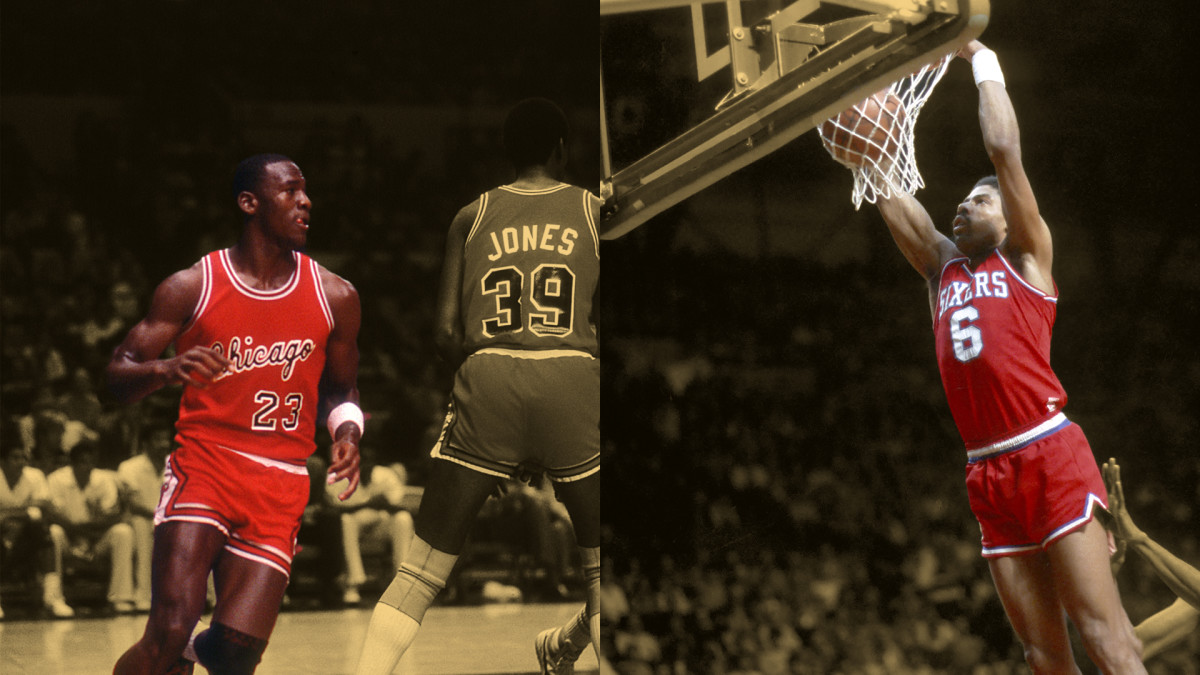
The moment Michael Jordan stepped onto an NBA court in 1984, there was a sense that the league was about to shift. But in those early days, the stars were still Julius Erving, Larry Bird and Magic Johnson. Jordan was a rising comet, fast and fearless, but the sky already had its constellations.
Erving was one of them — a living legend and one of Jordan’s mentors, still flying high in the twilight of his Hall of Fame career. And yet, even in those rare years when their careers overlapped, the Chicago icon didn’t hesitate to show he was coming for the throne.
Jordan’s trash talk
Erving didn’t forget. In fact, he remembered it vividly. A young, lean Jordan flying down the court with a hunger only a few had ever shown.
Advertisement
“I remember he came down and he dunked on like the whole team and then I went down, dunked on his team,” Erving said in a podcast appearance. “Whatever I do to him, he was doing to me. And he’s looking at me and he was like, ‘I could do it again.”
That moment, soaked in sweat and defiance, wasn’t just a display of Jordan’s athleticism but showed his audacity. Trash-talking Erving was a signal that he wasn’t waiting for permission to belong. Their matchup never became a rivalry, there was too little overlap — but their on-court exchanges were fireworks.
The 1984-85 season, Jordan’s rookie year, saw the Bulls face the Philadelphia 76ers six times. Philly won in five. But Jordan averaged 27.1 points, 6.3 assists and 6.2 rebounds per game that season — warning shots of what was to come. For Erving, who was still averaging 20.0 points a night at 34, it was clear that the kid could back his talk.
Advertisement
Creating a legacy
In 1985, Jordan was electric but raw. The Bulls were a struggling franchise, coming off years of mediocrity. Meanwhile, the 76ers were just two years removed from their 1983 championship and still packed with veteran experience — Moses Malone, Maurice Cheeks, Charles Barkley and Erving. Jordan’s scoring was a lifeline for Chicago, but it wasn’t enough to turn the tide on his own.
“Those years when we overlapped, we kind of — I caught him before he really hit his stride,” Erving said. “In those first three years, he was trying to fight. He was scoring a lot of points, but he was trying to find himself, find the right mix of teammates and whatever.”
Advertisement
That search defined Jordan’s early seasons. He dropped 63 points on the Boston Celtics in the 1986 playoffs and still lost. He averaged over 35 points per game in his third season and watched the Bulls exit early. It wasn’t until Scottie Pippen emerged and Phil Jackson took the reins that the dynasty took shape.
Erving, having navigated the ABA and became NBA champion by 1983, recognized the path. There was pain in growth. And Jordan, for all his fire, had to walk it. Their final game against each other came in Erving’s final season — 1986-87. By then, the former University of North Carolina star was averaging 37.1 points per game, the highest in his career.
The Bulls were still a few years from greatness, but his path was no longer theoretical. Jordan would go on to play 15 seasons, winning six NBA championships, earning five MVP awards and redefined modern athletic stardom.