
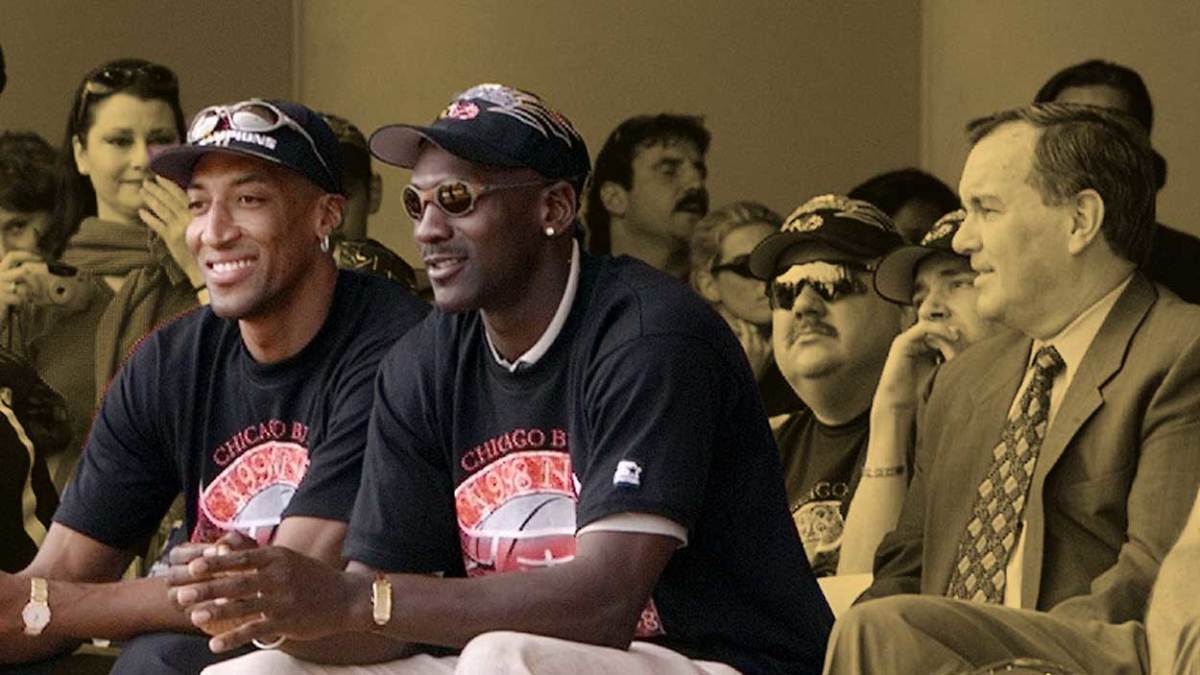
Scottie Pippen was thrust into a superstar and leadership role in 1993 upon Michael Jordan’s first retirement. From being regarded as a sidekick, the small forward had become the Chicago Bulls’ franchise player and was tasked to continue the team’s winning legacy. Pressure mounted on Pippen to behave like Jordan or even surpass his stature.
The comparisons became inevitable. He and Jordan were regarded as the Bulls’ twin leaders. They perfectly complemented each other — Jordan was the tough one, while Pip was the kind-hearted soul. Upon MJ’s departure, analysts deemed Pip had to embrace dual roles — a suggestion that Scottie rejected.
Advertisement
“I never wanted to be Michael Jordan, although I would like to trade bank accounts,” Pip said, via the Chicago Tribune. “I’m comfortable with who I am. I came in during an era of legends–Michael, Charles (Barkley), Karl (Malone), David (Robinson)–players the league promoted. I was not one of those players, and I got where I am by playing. I’m proud of that.”
Money problems?
Questions on Pippen’s playstyle and leadership were just one of the points of controversy during MJ’s absence. People also bugged Scottie about his salary negotiations and a rumored rift with Bulls forward Toni Kukoc.
Advertisement
The defensive ace dismissed such rumors, noting he kept his mouth shut and remained professional through the entire ordeal. He just played on and fulfilled his duties for the franchise.
“I never complained about my salary,” says Pippen, “but they always said when Michael was here, the best player would be paid the most. That didn’t happen when he left. Toni being here never bothered me. I just always was speaking out about the situation.”
MJ to the rescue
Pip guided the Bulls to a respectable 55-27 record in the Jordan-less 1993-94 NBA season. He even won the All-Star Game MVP and finished third in league MVP voting. It was a great season for Pip, but it was still considered a failure as the Bulls were eliminated in the 1994 NBA Playoffs.
Advertisement
Though he was not part of the team, Jordan kept his tabs on the Bulls, particularly his good buddy Scottie. He noticed he had a difficult time navigating through his new role and the pressures that came along with it. MJ announced his return in 1995, citing his undying love for the game. Years later, MJ admitted his return was also influenced by his deep relations with Pippen. He just wanted to help him.
“Scottie was definitely one of the reasons I came back,” Jordan said in the spring of ’97, via the Chicago Tribune. “I sat in the locker room (the season after Jordan retired) and asked him how it was, how he felt, and he was suffering. He was taking the brunt of the rebuilding process and he shouldn’t have been. I could feel he wanted me back basketball-wise, and as a friend. And I missed him, too.”
After MJ came back, it was more of the same — another three-peat, more banners hanging in the rafters, and cementing their status as one of the greatest dynasties the sport has ever seen.
Advertisement
This story was originally reported by Basketball Network on Aug 26, 2025, where it first appeared in the Old School section. Add Basketball Network as a Preferred Source by clicking here.