

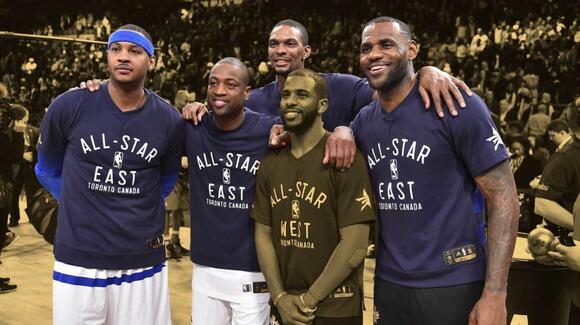
Throughout his 19-year career in the NBA, Carmelo Anthony was often associated with LeBron James, Dwyane Wade and Chris Bosh. It wasn’t just because he had personal relationships with the trio, but also because they entered the NBA Draft together in 2003.
What separated Anthony from his peers was that he wasn’t part of the superteam they formed on the Miami Heat, which was why it felt like he got left by the train.
Still, Melo has never spoken ill of his peers’ intentions of forming a big three in order to win a championship. If anything, the 10-time All-Star has long defended the Heatles — especially LeBron James, who has long been scrutinized for starting superteams by joining the Heat in 2010.
“I think people fail to realize that teams and organizations have been stacking teams since way back in the day,” he started. “The Lakers had the Showtime era. Boston had six hall of famers on one team.”
You had Detroit, the New York Knicks, and now the Miami Heat. They were stacking their teams back then, it just fell off over the years and now it picked back up,” said Anthony via GQ Magazine. “So you can’t get mad at Miami for doing what they did. A lot of people don’t agree on how they did it, or how LeBron did it.”
Melo doesn’t even think Miami was a superteam
Anthony, who was happily employed with the Denver Nuggets when the Heatles formed, also reiterated that he’s been competing with superteams way before James, Wade, and Bosh joined forces.
He gave the example of facing the 2003-2004 Los Angeles Lakers roster, which had the likes of Shaquille O’Neal, Kobe Bryant, Karl Malone, Gary Payton, and Rick Fox on the team, four of whom are now considered Hall of Famers.
The NBA legend also mentioned that there have been teams formed in the past that were way more stacked than the Heatles, which is why he didn’t really consider them a superteam.
“Like the USA was a superteam,” Melo said. “Those were superteams. The ’04 Lakers was a superteam, even though it didn’t pan out but they was a superteam, on paper – Shaq, Kob, Gary Payton, Karl Malone, like that’s a superteam.”
“Boston was a superteam. It wasn’t any Big 3, like, they were a superteam – Paul Pierce, KG, Ray Allen, Rondo,” Anthony added. “Anything more than three is a superteam. Miami didn’t have a superteam. They had a Big 3 and a great team.”
The definition of a superteam is obviously subjective, and while Anthony believes that the Heat were not one, that doesn’t mean the consensus feels the same way.
The Heat Big Three — who made it to four NBA Finals and two championships while they were together — were not only viewed as a superteam but also as the villains of their era, which they will always be known for until the end of time.
Why Melo didn’t join the Big Three
Fortunately for the South Florida team, they ended up winning two championships, so forming a big three despite all the scrutiny they received is considered worth it. Unfortunately for some who took the higher and arguably the more respectable route like Anthony did, he never won a ring.
He admitted that he could’ve formed a big three with James and Wade back in 2010, but opted not to because he thought he was in a more successful position in Denver with the right contract offer.
“Out of all of us at that moment, I felt the most comfortable and the most confident in my situation in Denver. We were winning. We were having somewhat some success, and we were building off previous years. So I did not want to sign a three-year deal with an option. I want to be here long term. This is my organization, this is my city. I want to be here long term, and that was my thinking at that point,” Melo explained on the “WOJ pod”.
Not joining forces with James and Wade may look like a missed opportunity in hindsight, but in 2010, Melo’s priority was to build something in Denver. Years later, his own attempt at a Big Three in OKC fell short, but his stance never changed. Just like he refuses to call Miami a superteam, Anthony stays firm in owning the choices he made.