
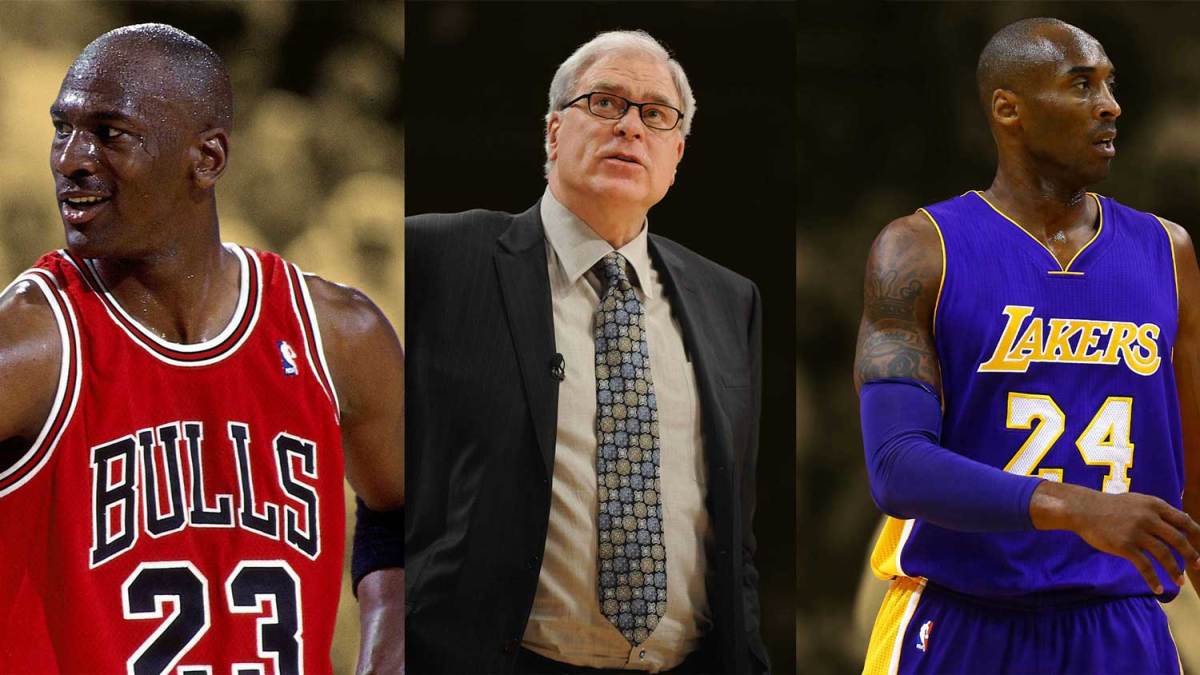
When Phil Jackson arrived as the head coach for the Chicago Bulls in 1989, he brought with him a structured vision that would forever change the way basketball was played at the highest level. The Triangle Offense would become the foundation of two of the NBA’s most dominant dynasties.
First with Michael Jordan‘s Bulls, then with Kobe Bryant‘s Los Angeles Lakers. However, years after guiding both legends to multiple championships, Jackson offered a subtle but striking distinction between the two.
Bryant refined game
“Zen Master” saw firsthand the evolution of the Triangle Offense through two vastly different eras. With Jordan, it was implemented into a team already on the rise, one with which MJ had long been the epicenter of attention, piling up scoring titles and MVP awards before Jackson ever stepped into the locker room.
Advertisement
But Bryant was different. He grew into the Triangle as it evolved, adapting to the shifts in modern NBA defenses and learning how to weaponize every layer of it.
“He was the focal point and that was easy for him to get him involved in that,” Jackson said of Bryant. “And he feasted on it and has always been a proponent of it. But we had to use a variety of actions that created opportunities because the game changed.”
The Triangle was more than isolations or flashy one-on-one plays. It demanded trust, timing, and a cerebral commitment to movement without the ball. While Jordan revolutionized scoring with style and efficiency, in Jackson’s eyes, Bryant brought the system to life with a purer sense of collective flow.
Advertisement
When the Lakers were deep in the playoff trenches in the early 2000s, “The Black Mamba” thrived inside the Triangle. Unlike “Mr. Air,” who entered the offense with a fully-formed superstar identity, Bryant’s relationship with it was crafted through patience and adaptability.
The league had changed since the ’90s. Defensive three-second violations had reshaped the paint. Zone schemes and help defense made one-on-one dominance harder to sustain. “Vino” leaned into those challenges. Where the Bulls legend conquered with brute brilliance, the Lakers icon dissected defenses with anticipation, often drawing doubles just to swing the ball cleanly and find the open man.
In the Bulls’ golden years, Jordan led Chicago to six titles in six trips to the NBA Finals. However, he did so within a league still grappling with the isolation-heavy offenses of the ’80s.
Before Jackson’s tenure, MJ was already averaging 37.1 points per game in 1987 and winning scoring titles with almost mechanical ease. Yet when the Triangle came in, it took time for him to surrender just enough control to make the offense sing.
Advertisement
By contrast, Bryant was raised within Jackson’s system. He matured under its principles. And after some turbulent early years with Shaquille O’Neal, he became its most relentless student.
A key to the offense
For Jackson, what made the five-time champ so irreplaceable was not just his talent but his intuitive control of the Triangle’s deeper mechanics. Even as the game advanced and the rules changed, he was still one of the most formidable scorers.
“We still had an ability to manipulate the offense in a way that he could be feature, and so that was the success of that team,” Jackson said. “It was successful, and it takes a lot of coaching and a lot of skill training and a lot of teaching players.”
Advertisement
The Lakers won five championships between 2000 and 2010 and relied heavily on Bryant’s ability to stretch and contract defenses by playing both within and outside of the structure. His average of 5.4 assists per game during the three-peat years wasn’t accidental but the result of a system that encouraged spacing and smart reads, not just isolation.
In the 2008–2010 seasons, Bryant’s Lakers mastered the Triangle’s flow under Jackson’s second run as coach. With Pau Gasol, Lamar Odom, and Andrew Bynum rotating through the post, the one-time MVP operated as the offensive engine — scoring 27.0 points per game over that span — but did so in a way that rarely broke the offense’s rhythm.
Where MJ’s brilliance often pulled the system toward him, Bryant let the system guide him. His commitment to the Triangle’s structure helped extend his career and lift role players around him.