
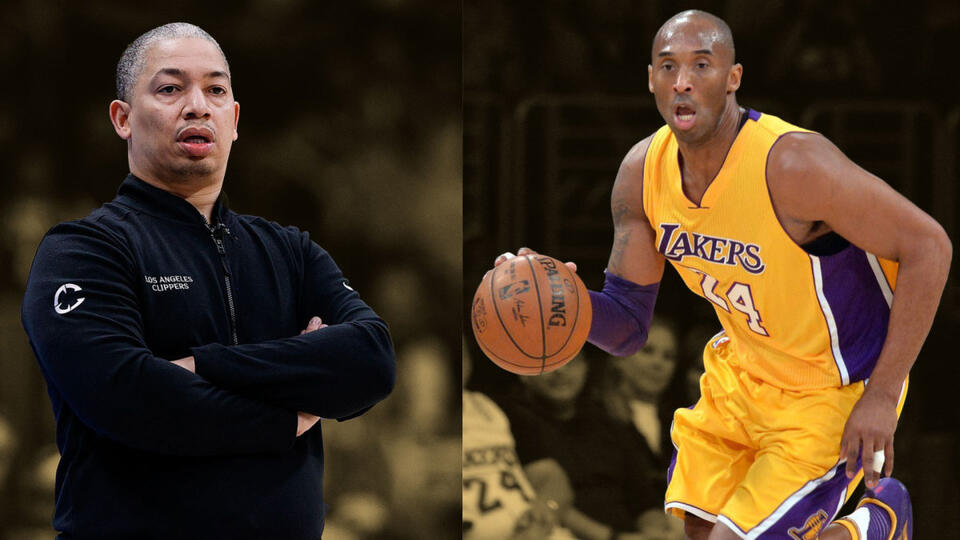
When discussing what made the late, great Los Angeles Lakers icon Kobe Bryant great, it was never just one thing. Some could point to his mastery of basketball fundamentals, which allowed him to pull off spectacular plays with ease. Others may cite how obsessed he was with the sport, electing to eschew a night out in Miami because he still had a training session early in the morning.
But if anyone asked his former teammate, Ty Lue, what it was that made the Black Mamba great, he would imply it was his fearlessness in the moment he was in — something he showed to everyone early in his career.
The courage to take crucial shots in the playoffs as a rookie
Kobe’s rookie season is often overshadowed by all the sensational moments he had in his later years. As phenomenal as he was coming out of high school and jumping to the pros, his first year in the league was rough, as he averaged only 7.6 points and shot a dismal 41 percent from the field.
Despite his subpar numbers, he gained the trust of then-Lakers coach Del Harris, who kept him on the floor in Game 5 of the 1997 Western Conference Semifinals against the Utah Jazz. However, the 18-year-old couldn’t deliver as he shot four airballs late in that game, resulting in a season-ending 98-93 loss.
As criticized as he was for failing miserably in those moments, Lue argued that his willingness to have the ball in his hands at age 18 showed his confidence and fearlessness. Kobe wanted all the smoke — win, lose or draw.
“Not factoring in the air balls. But factor in that he took those shots,” Lue told Shannon Sharpe on his podcast. “The mentality. You know what I’m saying? The mentality to take those shots.”
“‘Cause a lot of times, people shy away from that. They don’t want it. They don’t want it, you know, and I’ve seen that,” he added. “And so, at 17, 18 years old, to have the mentality to take those shots and shoot the air balls…”
He was all about the game
The NBA consistently reminds fans that, at its core, it operates as a multibillion-dollar business, seamlessly blending passion with profit. Whether it’s a trade that involves a megastar like Luka Doncic or the sale of a legendary franchise like the Lakers, the business aspect of the league is always a topic of discussion.
However, Lue shared that for Kobe, it was never about the money. Sure, his representatives had numbers in mind, but his sole focus was always on the game.
“The thing about Kobe that was different — you never heard him talk about money. Not about how much money he made or how much money he wanted,” Lue claimed.
Bean was focused on becoming the best player he could be. Although he had very few flaws in his game, he always found something to work on and eventually perfect.
“It was always about wanting to be the greatest. ‘I want to be the best.’ And to see the work he put in every single day, you could tell that’s what he wanted to do,” Ty shared. “From being there at 5:00 in the morning, being the first guy there, working on his body. What 17-year-old guy do you know working on their body? Getting the soft tissue stuff, eating right, mature way beyond his youth. Nobody’s doing that.”
“So, to see all the stuff that he did at that age, it was just phenomenal,” he concluded.
Kobe was a fierce competitor who hated to lose. But more than his disdain for losses, it was his willingness to be in the moment. He would rather take the shot and be held accountable for the result, rather than run to the safety of passing it off to someone else. There was a certain fearlessness in Kobe that inspired those around him to feel they were going to be fine when crunch time came.