
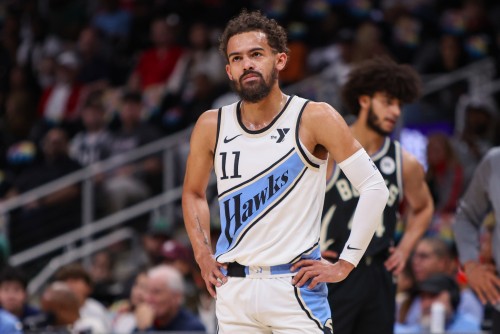
In the summer of 2021, the Atlanta Hawks were flying high. The team was coming off an unexpected run to the Eastern Conference Finals. The team’s young core was coming together nicely. The future was bright.
That offseason saw Atlanta ink Trae Young to a Designated Rookie Extension, despite the guard having yet to make an All-NBA team. But with Young’s and the team’s stars on the collective rise, no one really blinked.
Young was named to the All-NBA Third Team for the 2021-22 season, which meant his extension bumped up to 30% of the cap starting with the 2022-23 season. It’s that contract that Young is nearing the end of now.
Starting with 2021-22, things got a little sideways for Atlanta. They were unable to build on the success of the prior season and bowed out in five games in the first round. The next season saw a similar result. The last two campaigns? The Hawks haven’t even made it to the playoffs, falling in the Play-In Tournament each season.
As for Young, he hasn’t made another All-NBA team. The star guard is now coming off his worst shooting and scoring season since his rookie year. However, that’s not to suggest that Young has been bad. Not by any means. He’s just set the bar fairly high for himself.
In fact, Young has improved his assists per game in each of his first seven NBA seasons. That culminated in leading the league with 11.6 assists per game last season. For context, that’s the 23rd-most assists per game in NBA history. And Young did it while also averaging 24.2 points and carrying a pretty middling Hawks offense, especially after Jalen Johnson went down for the season.
In addition, last season was probably the best Young has ever played defensively. No one would suggest he was close to winning accolades, but Young showed real effort on defense. For the Hawks to get to where they want to go, they need that version of Young to be there every night on the defensive end.
For Atlanta to become a contender, they also need to smartly manage the cap sheet. That’s where Young’s next contract comes in. And it’s a trickier one than many seem to realize.
On one hand, Young is an established All-Star. He’s made four All-Star teams, including in three of the last four seasons. He’s one of the best playmakers in the NBA. Despite having a down shooting season last year, Young is still deadly from deep, in combined volume and efficiency.
On the other hand, Young is small guard who will get picked on defensively, despite the improved effort. The Hawks have had one good playoff run with Young leading the way. And Atlanta has to be wary of locking in too many players and seeing their cap sheet return to being bloated. In addition to Young, Dyson Daniels and Kristaps Porzingis are also due for new deals. There’s a lot the front office has to do over the next year or so.
As of this writing, reporting has been that the Hawks have no real desire to engage in deep extension negotiations with Young. They want to see how he looks with a much-improved roster around him this season. Given that Young has two years left on his current deal, but with a looming player option for 2026-27, that could be a risky strategy.
Here are some of the different contract options for Young, both now and next summer. We’ll explain the math, plus some of the considerations that come with each one. Then we’ll close by suggesting something that might work for both Young and the Hawks.
The Veteran Extension
Young is eligible right now to sign a standard veteran extension. We’re going to assume that he’d decline his player option for 2026-27 to start the extension as soon as possible. That deal projects to look like this:
2026-27: $49,641,600
2027-28: $53,612,928
2028-29: $57,584,256
2029-30: $61,555,584 (player option)
Total: four years, $222,394,368
This extension starts at 30% of the cap and has 8% raises. Players of Young’s stature can almost always command a player option, so we tacked one onto the final season. It’s important to note that this extension would be limited to four years, because it’s a standard veteran extension. Only a designated veteran extension could add five new years to a contract. Young isn’t eligible a designated veteran extension as he hasn’t made All-NBA recently enough to sign that type of contract now.
Will Trae Young make All-NBA?
Let’s pause our contract analysis to discuss if Trae Young is an All-NBA candidate. Here’s where Young finished in each of the last three years, since he made the 2022 All-NBA Third Team:
2022-23: 1 point (80 points from last Third-Team spot)
2023-24: 0 points (70 points from last Third-Team spot)
2024-25: 3 points (65 points from last Third-Team spot)
As you can see above, Young hasn’t been particularly close to make All-NBA in any of the last three seasons. That’s not really surprise, as his teams have struggled, despite his good individual stats.
But it’s also important to add some helpful context for Young’s All-NBA possibilities moving forward. First, the Hawks should be a good team this year. If they are, Young will be a driving factor. That will improve his All-NBA candidacy in a major way.
Next, with the games-played rules in place for All-NBA selections, some worthy candidates won’t be eligible. That helps a guy like Young, who rarely misses more than a handful of games.
Lastly, Young will be motivated to have a strong season. He’ll be pushing for that next big contract, assuming he doesn’t extend. That’s because he could still cash in big-time on a designated veteran contract. Let’s take a look at that now.
The Designated Veteran Contract (Supermax)
Let’s say Young and the Hawks can’t reach an agreement on an extension. The lead guard can still cash in on a so-called Supermax deal. If Young makes All-NBA (or wins MVP or DPOY, which are both unlikely), he’ll be eligible for the same deal he could have gotten in a designated veteran extension. It’ll just be as a new deal. Here’s what that would look like:
2026-27: $57,915,200
2027-28: $62,548,416
2028-29: $67,181,632
2029-30: $71,814,848
2020-31: $76,448,064 (player option)
Total: five years, $335,908,160
That’s a 35% of the cap max in Year 1 with 8% raises. Same player option on the final season. But here’s the kicker, and it’s a big one: Because this would be a new contract, Young would be eligible to get an elusive No-Trade Clause. He’d have the required eight years of service, with at least four with the Hawks. You can’t get an NTC in an extension, unless it exists in the current deal. But since this would be a new contract, Young could push for an NTC. (Keep this is mind, because we’ll come back to it later.)
Re-signing with the Hawks in 2026
As with our above examples, we’re assuming that Young is going to opt out for next season. In that case, he’ll be an unrestricted free agent in the summer of 2026. For this example, let’s say Young has a good season, but doesn’t make All-NBA. Here’s the projected max deal the Hawks could sign him to:
2026-27: $49,641,600
2027-28: $53,612,928
2028-29: $57,584,256
2029-30: $61,555,584
2020-31: $65,526,912 (player option)
Total: five years, $287,921,280
That’s a 30% of the cap max in Year 1 with 8% raises. As you can see, it’s about $48 million less than the designated veteran contract. But if Young doesn’t qualify, there isn’t anything that can be done on that front. This would be the most he could possibly get as a free agent. As with the designated veteran contract, Young would be eligible for an NTC, as this would be a new deal.
Signing with another team in 2026
If things go sideways for Young and the Hawks, he’ll have all kinds of options as an unrestricted free agent next summer. He’ll arguably be the best available free agent, as so few players actually reach free agency these days. Here’s what the projected max Young could get from another team in free agency looks like:
2026-27: $49,641,600
2027-28: $52,123,680
2028-29: $54,605,760
2029-30: $57,087,840 (player option)
Total: four years, $213,458,880
This contract would start at the same 30% of the cap max for next season. However, when changing teams, contracts are limited to 5% raises and four years. Clearly, that gives the Hawks a fairly large advantage on re-signing Young vs him moving to a new team.
A Workable Compromise
It would be going too far to say that the Atlanta Hawks don’t want to give Trae Young a max extension, either standard or designated. They may be ok to do that, just not today. The Hawks seem to be very focused on managing their cap sheet, while evaluating how their star player looks with an improved roster.
The slight issue with this approach is that there’s a very real clock on it. And that clock has already started ticking…kind of.
Atlanta and Young have until the final day of the offseason (October 20) to sign an extension. But it’s crucial to note that date only holds if Young picks up his player option for the 2026-27 season. If Young declines that option, his contract becomes an expiring one, and he’s extension-eligible through June 30.
So, the clock is ticking, but there’s a long way to go before time will actually run out. That means that Atlanta and Young can evaluate things into the season and can figure out where they are at all the way up to the start of the 2026 offseason.
There are a couple of ways the Hawks and Young can find common ground. If Atlanta is committed to keeping the cap sheet in a manageable range, they might stick on including any kind of Designated Player language in a deal. If Young isn’t insistent on getting the so-called supermax, then coming to terms on a standard veteran extension makes a lot of sense.
Young is a no-brainer 30% of the cap max player, even if you have some concerns about the weak points in his game. He’s one of the best offensive players in the league. Offense gets paid more than defense, so suggesting Young isn’t a 30% of the cap max guy is underrating him.
On a standard veteran extension, Young wouldn’t start at a salary much higher than the player option he’d be declining for 2026-27. The following years will likely grow faster than the cap, keeping Young in the 30-32% of the cap range every year, but that’s not the end of the world. Again, he’s a max player. This shouldn’t keep Atlanta from doing what they need to with the rest of the roster.
If the Hawks are stuck on not doing any kind of extension with Young, then a large chunk of the risk transfers to them. It’s not very likely Young would play so poorly that another team wouldn’t be willing to max him out in free agency. That means that the potential risk for Atlanta is that Young leaves town. Or, Young makes All-NBA and can command a designated veteran contract. At that point, he’d be making 35% of the cap and any savings the Hawks could have found will have evaporated.
Let’s say there is no extension, the Hawks have a good season, and Young is really solid, but not at an All-NBA level. Both sides want to stay together, but a full max deal isn’t on the table. This is where a compromise could make sense.
When Luka Doncic (who will forever be linked with Young due to the draft night trade involving both players) extended with the Los Angeles Lakers, he wasn’t eligible for a supermax extension. (A player can only get a Designated Extension or Contract from the team who drafted them or from a team that acquired the player while they were still on their rookie scale contract.) What Doncic and the Lakers did (similar to Donovan Mitchell and the Cleveland Cavaliers a year prior) was to sign a three-year, 30% of the cap max extension with a player option on Year 3. That will allow Doncic to opt out in 2028-29, when he’ll have 10 years of service and will be eligible for a 35% of the cap max.
Young is in a different situation than Doncic or Mitchell because he hasn’t been traded, but a similar structure (with a twist!) could work for him and the Hawks.
Let’s say the Hawks are insistent on a non-max deal in terms of years, then Young could wait until this summer and sign a deal that looks like this:
2026-27: $49,641,600
2027-28: $53,612,928
2028-29: $57,584,256 (player option)
Total: three years, $160,838,784
That’s a 30% of the cap max, but only a three-year deal. Like Doncic, Young could opt out in 2028 when he has 10 years of service. He could than cash in for 35% of the cap at that time.
Here’s the twist: After this season, Young will have eight years of service and he’ll have spent all eight of them with the Hawks. That means Young will be eligible for a No-Trade Clause. In this kind of compromise. Atlanta should give it to him.
I’m sure you flinched at reading that, given the way things went sideways with Bradley Beal’s NTC, but this would be a bit different. If the Hawks are re-signing Young, then Year 1 isn’t really a consideration for trade purposes. At that point, there would be two years left and the final year is a player option. Because this is a shorter-term contract, and one for a younger player, the presence of the NTC isn’t nearly as worrisome as it would be on a four- or five-year deal. But it will give Young some measure of control, while on a short-term contract.
Giving a player a NTC isn’t something a team should do lightly. It can cause a lot of headaches down the line. However, if the Hawks aren’t willing to commit to Young on a full max extension (Designated Player or otherwise), this could be a workable compromise to keep moving forward together, while not taking any long-term options off the table.