
Mike Shearer
| Hoops Hype
New season, new situations, new expectations. Much of the excitement surrounding summer discourse is trying to project who will pop off (and we’ll be doing that in this space next week), but Serious Basketball People know that understanding who might decline is at least as necessary to prognosticating how the year will unfold.
We’re not in the icky business of injury prediction, but there are plenty of reasons that healthy players could have a (relatively) down year. Statistical regression, a changing role or new team, fresh teammates, or the natural encroachment of age-related diminishment are all reasons why certain players may take a step back.
Inclusion on this list does not mean I hate a player or that I expect a player to be bad. Most of the players below are, and should remain, quite good! But changing circumstances could result in lower-than-expected production (which, in some cases, might actually benefit the team).
Without further ado, here are six players who could take a statistical step back this year.
Cam Johnson (Denver)
Johnson is a good player who has become both overrated defensively and underrated offensively. But will he put up 19 points per game on 63 percent true shooting again?
The efficiency could be there; Johnson has shot at least 39 percent from deep in four of his five NBA seasons, and he’s always been an elite finisher with serious vertical bounce:
Role players with Johnson’s skill set typically thrive next to Nikola Jokic.
Perhaps a lighter offensive load will help Johnson regain his defensive mojo, which has slipped in recent seasons.Regardless, people are overlooking the real way in which Johnson might provide some help to the Nuggets: Pairing up with Jamal Murray to carry a Denver bench that has been the albatross on Jokic’s neck for years. I went deeper on Johnson and his underrated fit with Denver here.
But in a crunch-time lineup that includes the former MVP, Jamal Murray, Aaron Gordon, and Christian Braun, there will be nights where Johnson is a fourth or fifth option, instead of first and second like he was by the end of his Nets tenure. There are too many mouths to feed for him to replicate last year’s box score success.
Johnson may well emerge at the end of the 2025-26 season as a better overall player, even as his individual statistics suffer.
Kristaps Porzingis (Atlanta)
The Atlanta Hawks obtained Porzingis in an excellent buy-low trade with the Celtics, who were desperate to escape an eyeball-exploding luxury tax bill. Porzingis brings a consistent 3-and-D-and-a-little-more element to the center position that Atlanta had only seen glimpses of with Onyeka Okongwu (and never with the departed Clint Capela).
Porzingis’ ability to space the floor should do wonders for the shaky-shooting but critical Dyson Daniels (more on him shortly) and Jalen Johnson. His ability to pop or roll off a pick should bring a new element to Trae Young’s game, too.
But an excellent offseason has suddenly put serious expectations on the Atlanta Hawks, and they’ll need to manage the season with an eye toward the playoffs.
Porzingis’ health has been a question mark his entire career. The team may want to limit his minutes (and perhaps even his starting opportunities?) in favor of the younger Okongwu. Okongwu seemingly had a breakthrough when he took over the lead role from Capela, averaging 15 and 10 on a whopping 65 percent true shooting in 40 games as a starter.
At his best, Porzingis is better than Okongwu, and I still expect him to start most games. They could even play together quite a bit in jumbo lineups. But for the Hawks to be at their best, they’ll need Porzingis upright, which could mean something closer to 25 minutes per night rather than last year’s 29.
Jalen Brunson (New York)
Like Porzingis, Brunson should rest a little more often with Tom Thibodeau out of the picture (although Mike Brown also tends to ride his best horses hard, so perhaps not). But minutes aren’t the real driver for Brunson’s inclusion on this list. Thibodeau’s offense all too often defaulted to pressing the “Jalen Brunson, do something” button. Brown prefers a more egalitarian, Golden State-inspired movement system, something that will aim to involve players like Mikal Bridges, OG Anunoby, and especially Karl-Anthony Towns more often – likely at Brunson’s expense.
De’Aaron Fox’s usage rates under Brown weren’t all that different from Brunson’s, truthfully, but the Kings also had far less supporting offensive talent during the Brown era. Brunson’s still-tremendous box score stats already took a slight dip with the arrival of Towns and Bridges last season. I’d expect another modest downturn this year.
That can only be a good thing, in my opinion. A more varied offensive attack is exactly what the Knicks are hoping for after replacing Thibodeau despite an Eastern Conference Finals appearance.
Malik Beasley
Beasley is no longer a “target” of a federal gambling investigation, but he’s still a “subject” who could be charged with a crime. The legalese is beyond me, but even if Beasley is free to join a team without any suspension (possible, if Terry Rozier is any indication), all the suddenly-public details of his derailed personal life have to weigh heavily on him.
Leaving aside the off-court stink, Beasley would be hard-pressed to replicate his incredible 2024-25 shooting campaign. Only one other man has shot 41.6 percent or better on more than nine attempts per game: Steph Curry (five times). You couldn’t flip on a Pistons game without seeing the Beasley shimmy:
Do we think that Beasley can repeat something that only he and the greatest shooter of all time have ever done? I doubt it, particularly since it’s not even clear where Beasley will end up (the Pistons replaced him with Duncan Robinson, so even if he returns there, he won’t have the same opportunities as before).
Between the sheer unlikeliness of Beasley spending six straight months on fire again and his personal issues, he’s one of the most obvious candidates for a down year.
DeMar DeRozan (Sacramento)
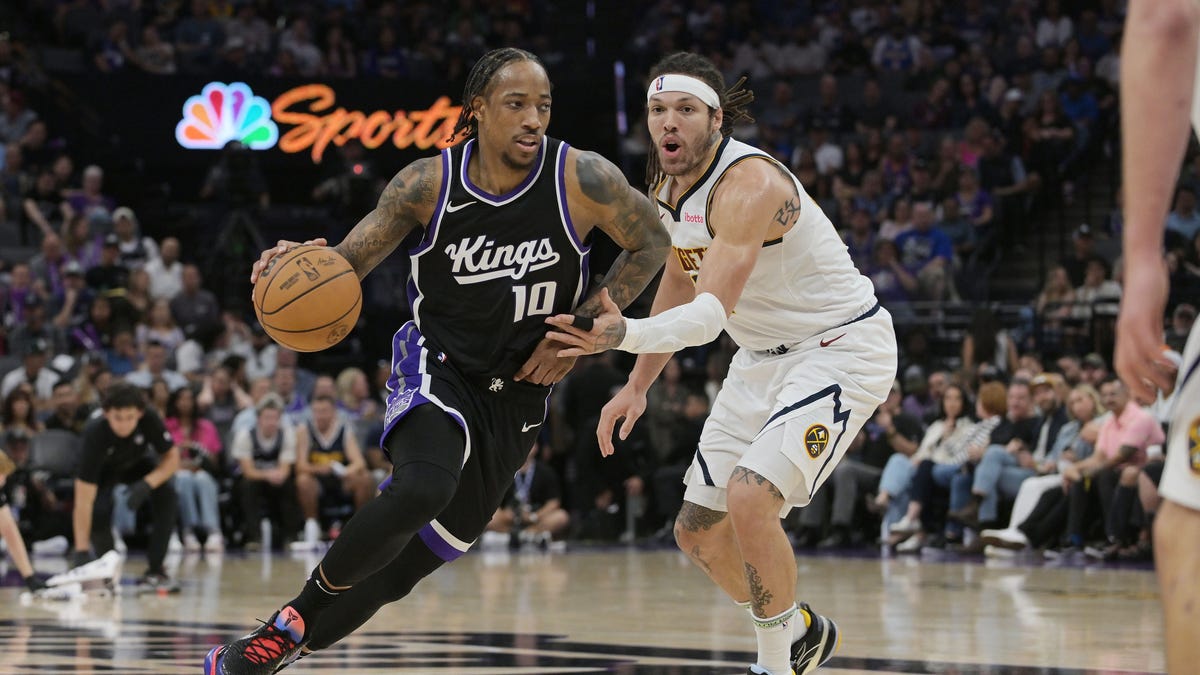
DeRozan’s efficiency as a scorer has remained remarkably consistent over his 16 years in the NBA, even as he’s evolved from a skywalking marvel to a groundbound midrange maestro. But there are signs that, entering his age-36 year, DeRozan might finally be teetering on the edge of a steep decline.
The most startling statistic from DeRozan’s season last year: a minuscule 11 percent of his FGAs came at the rim. That number was 25 percent just the year before, his last in Chicago.
It didn’t kill his field goal percentages, as DeRozan remained an elite basket-converter from everywhere inside the two-point line. But the inability to get to the bucket (plus a related decrease in free throws) suggests that DeRozan has reached a point where he can no longer manipulate defenders like a puppeteer:
If DeRozan can only operate in the midrange (he’s never been a threat from deep) and continues to decline defensively (he posted his lowest Defensive EPM since his San Antonio days), how much value does he bring to a team? Particularly to the Kings, who center their offense around non-shooting big man Domantas Sabonis?
People assume that DeRozan will make nearly 50 percent of his midranges forever, but when the ancillary parts of his game start to diminish, defenses will have even fewer things to worry about. And if the middie starts to slip even a little bit, he’ll quickly become unplayable.
DeRozan has aged as gracefully as could be imagined, and he’ll go down as one of the greatest scorers of his generation. But if you look in the right places, you can see that the end of his time as an impact player might be approaching a lot faster than the box score would suggest.
Dyson Daniels (Atlanta)
Two Hawks on the same list? Please don’t take that to mean that I’m down on Atlanta’s potential, as I’m quite the hopeful birdwatcher. Rather, it’s a compliment to the roster that there are so many talented rotation players that nobody outside of Young will be relied upon to put up crazy numbers night in and night out.
Daniels’ wildest achievement, of course, was averaging 3.0 steals, the first to do so in decades. Sheer statistical gravity suggests that 2024-25 will be an outlier performance. But a closer look at the roster hints that Daniels’ playing time may suffer some next season, too, as Nickeil Alexander-Walker can come in with similar (albeit worse) defensive chops and a much more threatening outside shot. It’s more than possible that Alexander-Walker closes as many games as Daniels does.
Daniels showed improvements on offense, too, and he’ll be the starter. But with NAW, Porzingis, a healthy Jalen Johnson, and the addition of sharpshooter Luke Kennard, it’s unclear whether Daniels will have the runway to show off any further refinements.
For more from Mike Shearer, check out Basketball Poetry for good NBA analysis and bad jokes.