
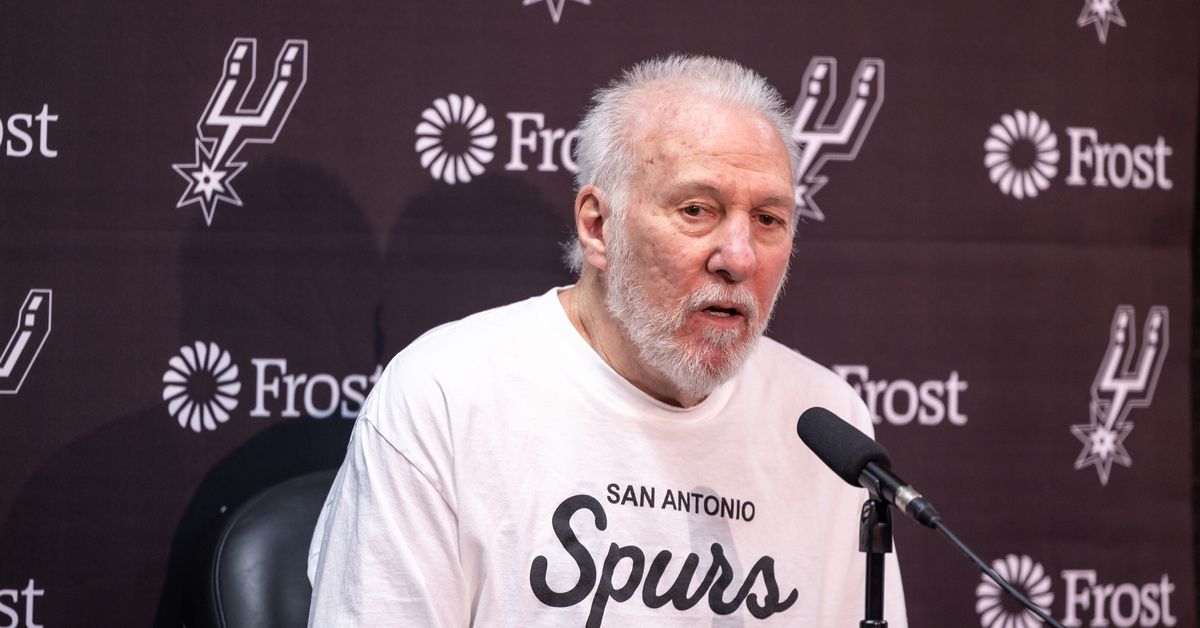
Gregg Popovich had a health scare recently, as he fainted in a restaurant and had to be hospitalized. The episode comes months after he suffered a stroke that sidelined him for most of the 2024-25 season.
Fortunately, the latest incident was minor, and he’s recovering at home, according to reports. But the news pushed to the forefront an extremely uncomfortable discussion that can’t be avoided or downplayed any longer: Is Popovich capable of coaching the Spurs in the upcoming season, and if not, what’s the alternative plan?
The first thing that needs to be clear is that we don’t know Gregg Popovich. We are not his friends, and our opinions don’t matter. While it’s impossible to avoid developing some level of a parasocial relationship with a figure we’ve been watching, rooting for (and critiquing/second-guessing) for literally decades, we have no idea what he’s thinking about right now. Similarly, we don’t know what his doctors have told him. We know he suffered a stroke and he recently fainted, but we don’t know whether the two are related. We know he’s the oldest NBA coach ever, but his age by itself wasn’t an impediment before. The point is, it’s fine to worry about Pop’s well-being, but if he does return to coaching, it would be foolish to criticize his decision by claiming concerns about someone’s health and energy when we have neither insight into their thought process nor access to all the relevant information.
If a return does happen and Pop only misses a handful of games, there’s a very clear case to make about it being a net positive. Continuity has been something the Spurs have valued greatly. When changes eventually have to be made, it’s normally better to ease into them to prevent a shock to the system when things are going well, and that’s the case in San Antonio. Despite the disruption caused by Popovich’s stroke and the unfortunate health issue that sidelined Victor Wembanyama, the Silver and Black won more games than last year and were within reach of the play-in for most of the season. With the upgrade at point guard after the De’Aaron Fox trade and an offseason addition or two, the playoffs should be within grasp. Having Pop as a stabilizing force for the near future would allow the rebuild to be completed and afford the team more time to work on a plan of succession.
The problem with that option is that it only works under the best-case scenario. If Pop misses extended time, especially at unpredictable times, the franchise would face an even worse level of disruption than just a coaching change would cause. Having more time to figure out a succession plan would be a nice luxury, but there are plenty of worthwhile candidates available this offseason that might be employed by someone else soon. If a decision has already been made that Mitch Johnson is his successor, Pop could maintain his position and provide him with another year of mentoring. Even then, it could be argued that giving Johnson the official title of head coach, even if Pop is heavily involved with the day-to-day decision-making, could be a better way of projecting a sense of stability going forward.
The concerns go beyond this upcoming year. There is a chance Popovich could coach for a few more seasons, but at some point soon, he’ll have to step aside. It’s inevitable. If we leave sentimentality aside, which is understandably hard to do in this situation, it’s clear that the Popovich era is close to its end. He’s earned the privilege to go out on his own terms, which complicates things, but even if he decides to return, a succession plan has to be in place. Not discussed tentatively, but decided. If Pop suffers another setback during the season, what’s the next step? If he retires now or in six months or a year, who’s taking over? The team cannot be in limbo again simply because it’s uncomfortable to talk about an admittedly sensitive topic.
The only way that hoping for the best is currently acceptable is if the franchise thoroughly prepares for the worst as well. Maybe that’s already happened, but those discussions will take a while — and given how tight-lipped the Spurs organization is, we’re unlikely to ever hear a peep about them. Pop deserves the time to figure out what he wants and is actually able to do, but on top of being a living legend, he seems like a pragmatic person that would not be insulted by the organization setting up contingency plans and asking him about a timeline and roadmap for the final stage of his career.
Loyalty is a virtue that San Antonio exalts and represents more than the majority of franchises, but it’s hard to imagine the Spurs tiptoeing around a major factor like the future of the head coach position. In any case, things shouldn’t get ugly. If Pop can come back and coach, he’ll get the chance to do so. It’s the outcome everyone should hope for.
However, every era eventually ends, and if the post-Tim Duncan years taught the franchise anything, it’s this: having a clear direction in the middle of a transition, and knowing the weight of this moment, is paramount. The Spurs should be prepared for life after Pop, whenever that is.