
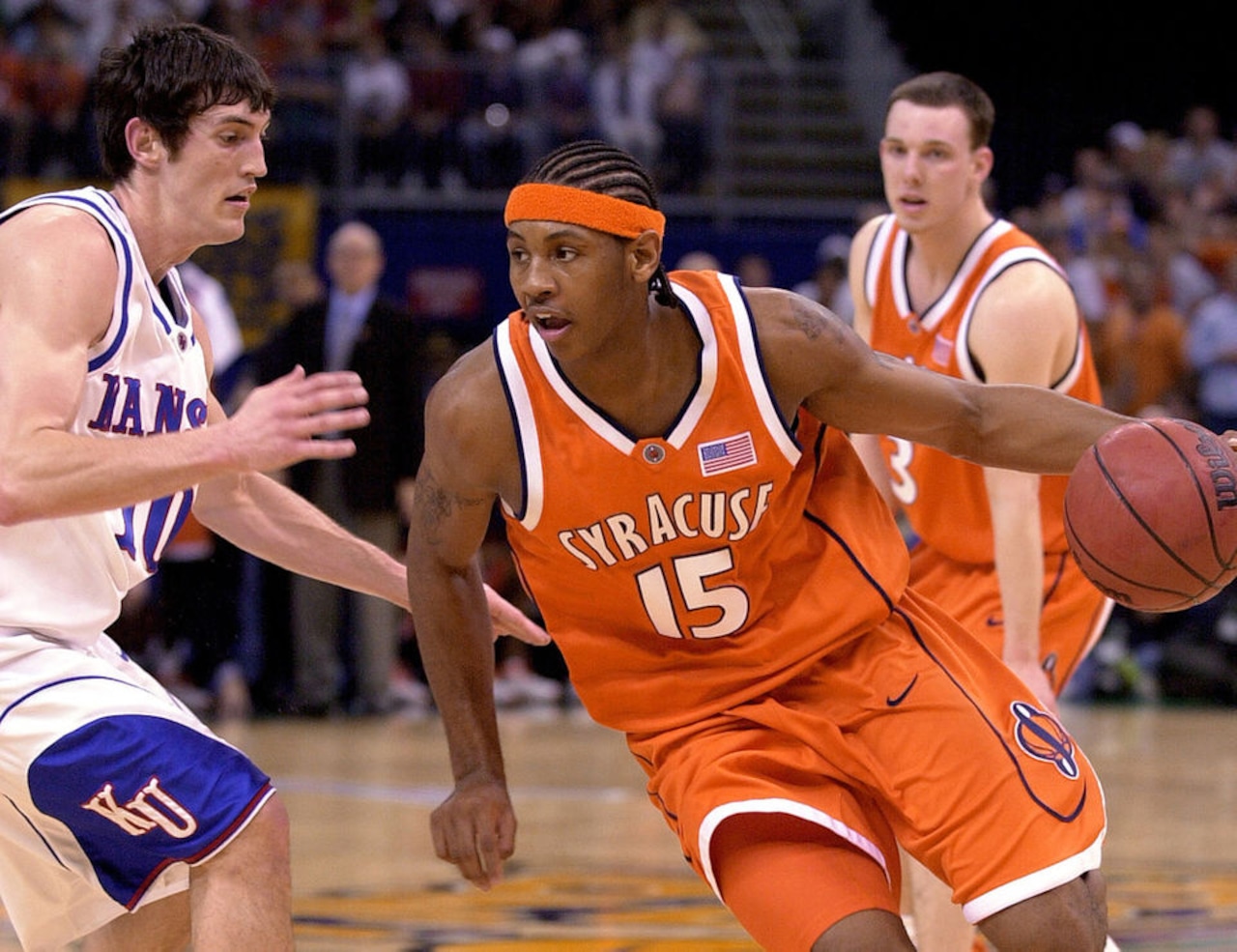
Syracuse, N.Y. – He played basketball at Syracuse University for one season, staying in the city for a span of barely nine months.
But more than 20 years later, Carmelo Anthony’s impact is still felt here, in the school’s basketball program and in the city of Syracuse. His name resonates like no one else’s aside from that of his former coach, Jim Boeheim.
In 2003, Anthony, a baby-faced freshman with a million-dollar smile, carried Syracuse to the NCAA championship. Then he departed, at Boeheim’s urging, to the NBA and a 19-year pro career.
On Saturday, Anthony will carry the Orange’s banner onto the national stage once again as he is inducted into the Naismith Basketball Hall of Fame in Springfield, Massachusetts.
Anthony will become just the third former Syracuse player to enter the Hall along with Vic Hanson (1926) and Dave Bing (1966). Boeheim is also a member of the Hall of Fame having been inducted as a coach in 2005.
“To see Carmelo get in, he’s meant a lot to Syracuse and he still means a lot to Syracuse,” Boeheim said in a recent conversation. “He’s had a lasting impact on Syracuse and continues to support stuff in Syracuse.
“That can’t be overstated, really.’’
Maybe it can’t be overstated, but let’s try to put Anthony’s impact into perspective.
The 2003 championship
Let’s start with the obvious. The 2003 championship remains the only NCAA title for SU’s men’s basketball program in the 100-year plus history of hoops at the school.
While the 2002-03 team’s roster included future NBA forward Hakim Warrick, Syracuse legend Gerry McNamara and quality role players like Kueth Duany, Billy Edelin and Josh Pace, there was no doubt that the Orange would only go as far as Anthony could carry them that season.
He was a tour de force.
Anthony averaged 22.2 points per game, still the record for a Syracuse freshman. His 10.0 rebounds per game is another SU freshman record.
Anthony became just the second freshman at the time to receive the Final Four’s Most Outstanding Player award with a 33-point virtuoso performance in a semifinal win against Texas and then a 20-point, 10-rebound double-double in the championship game against Kansas.
“What really galvanized that team was his competitive spirit,” said former SU assistant Troy Weaver, now the vice president of the NBA’s New Orleans Pelicans. “They felt how competitive he was and it just raised everybody’s level.”
The Melo Center
Anthony was just six years into his NBA career when he pledged $3 million to kick-start a fund-raising campaign for Syracuse’s new basketball practice facility. The project would end up costing $19 million.
Anthony’s gift represented one of the largest individual donations to SU’s athletic department at the time and was also believed to be one of the largest by a current professional athlete to the school they attended.
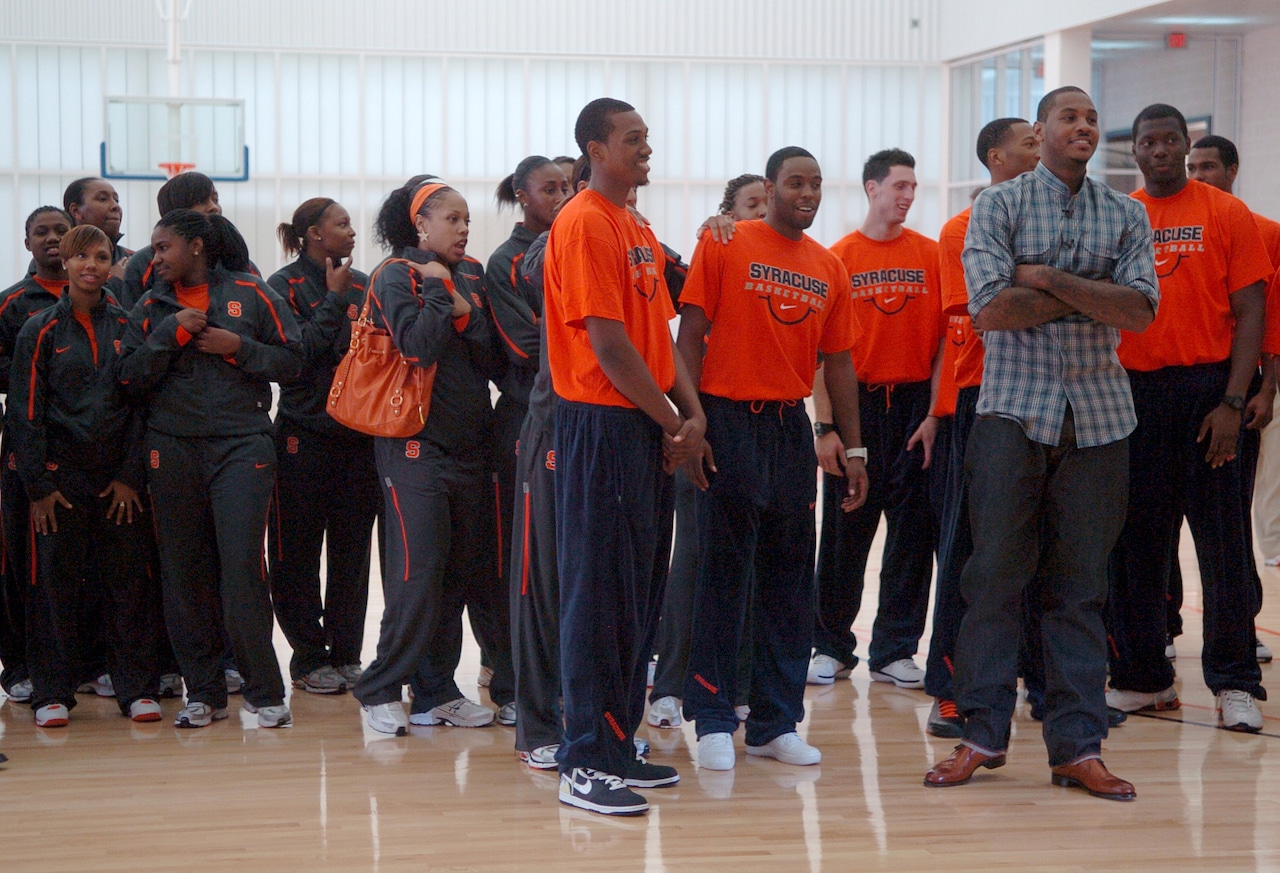 Carmelo Anthony stands with the Syracuse University men’s and women’s basketball teams inside the Carmelo K. Anthony Basketball Center after a ribbon-cutting ceremony on September 24, 2009. Michelle Gabel/The Post-StandardMichelle Gabel/The Post-Standard
University officials acknowledged Anthony’s role in SU’s hoops history and his importance in getting the project started by naming the complex after him.
The Carmelo K. Anthony Basketball Center, known familiarly as the Melo Center, opened on Sept. 24, 2009. Anthony made the ceremonial first basket.
“I would never in a million years think I would be sitting here today six or seven years after winning a national championship, doing the ribbon cutting for my building,” Anthony said during the ribbon-cutting ceremony.
Recruiting
It’s impossible to accurately measure just how much Anthony has helped Syracuse in recruiting.
Syracuse has mined the Washington, D.C. area for recruits dating back to the days of Dave Bing, but Anthony kept those recruits coming from the DMV.
In the years since Anthony wore Orange, Syracuse has recruited the likes of Donte Greene, C.J. Fair, Jerami Grant, Kris Joseph, Frank Howard, Arinze Onuaku, Benny Williams and Judah Mintz.
As a senior, Anthony played at Oak Hill Academy, and SU later pulled Eric Devendorf and Baye Mossa Keita from the Virginia prep powerhouse.
As Anthony became one of the best players in the NBA, who knows how many players came to Syracuse in part because he played here?
Impacting the city
Anthony hasn’t just helped Syracuse University and its basketball program. His presence is felt throughout the city.
Anthony partnered with the Jim & Juli Boeheim Foundation’s Courts 4 Kids effort to build and/or refurbish basketball courts and playgrounds in urban areas.
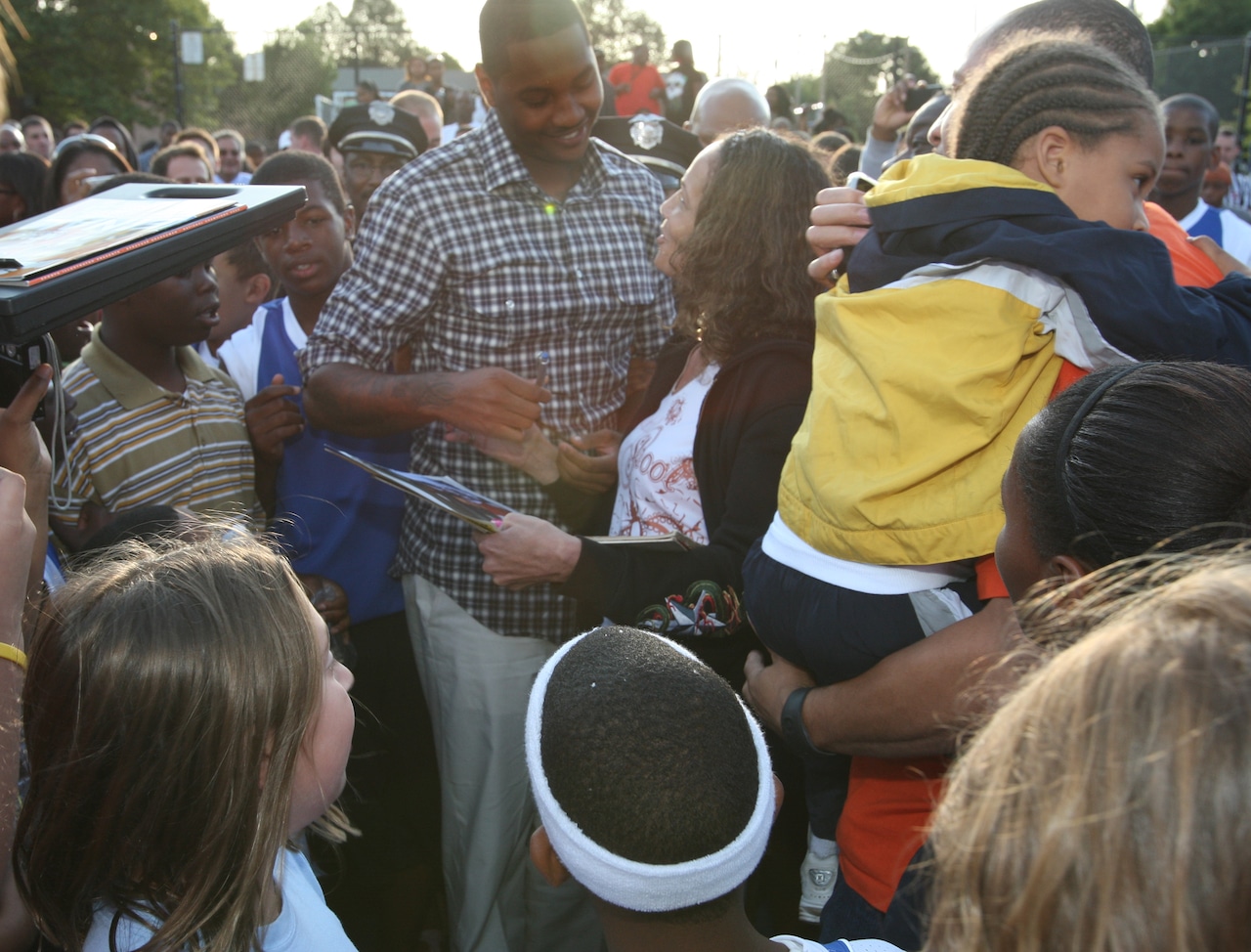 Carmelo Anthony is surrounded by fans at Wilson Park in Syracuse on Sept. 24, 2009. Anthony, Dorsey Levins and SU coach Jim Boeheim were hosting a youth basketball tournament to celebrate renovations to courts at the city playground.
Gloria Wright / The Post-StandardGloria Wright / The Post-Standard
Anthony has done similar projects in his hometown of Baltimore and his late father’s home in Puerto Rico. In Syracuse, Anthony renovated courts in Wilson, Schiller and Skiddy parks.
“First of all, I want to say, ‘Thank you,’ to all of the Syracuse community for being a part of everything that I have going on, from my Syracuse days to right now,” said Anthony during the Wilson Park court dedication ceremony in 2009. “Me being able to put this court together, right here in the middle of — should I say? — the ‘hood where it really needs to be rather than being way out … I couldn’t have picked a better place than to do it right here.”
The 2003 title changed history
While Anthony remains a well-known legend, there requires some historical perspective to fully appreciate his impact on the SU program.
The 2003 NCAA championship significantly altered the perception of Syracuse basketball between Final Four appearances in 1996 and 2013.
Syracuse won six NCAA Tournament games on its way to the 2003 title. The path included wins over two No. 1 seeds (Oklahoma and Texas) and a No. 2 seed (Kansas).
In the six years prior to Anthony’s arrival, Syracuse had won a total of five NCAA Tournament games and failed to earn a tournament bid twice.
In the five years following Anthony’s departure to the NBA, Syracuse would win just two NCAA Tournament games. Both came in the very next year’s tournament. Syracuse lost first round games in 2005 and 2006 and then missed out on the tournament in 2007 and 2008.
Without Anthony, it’s possible Syracuse would have won seven NCAA Tournament games in a 12-year span.
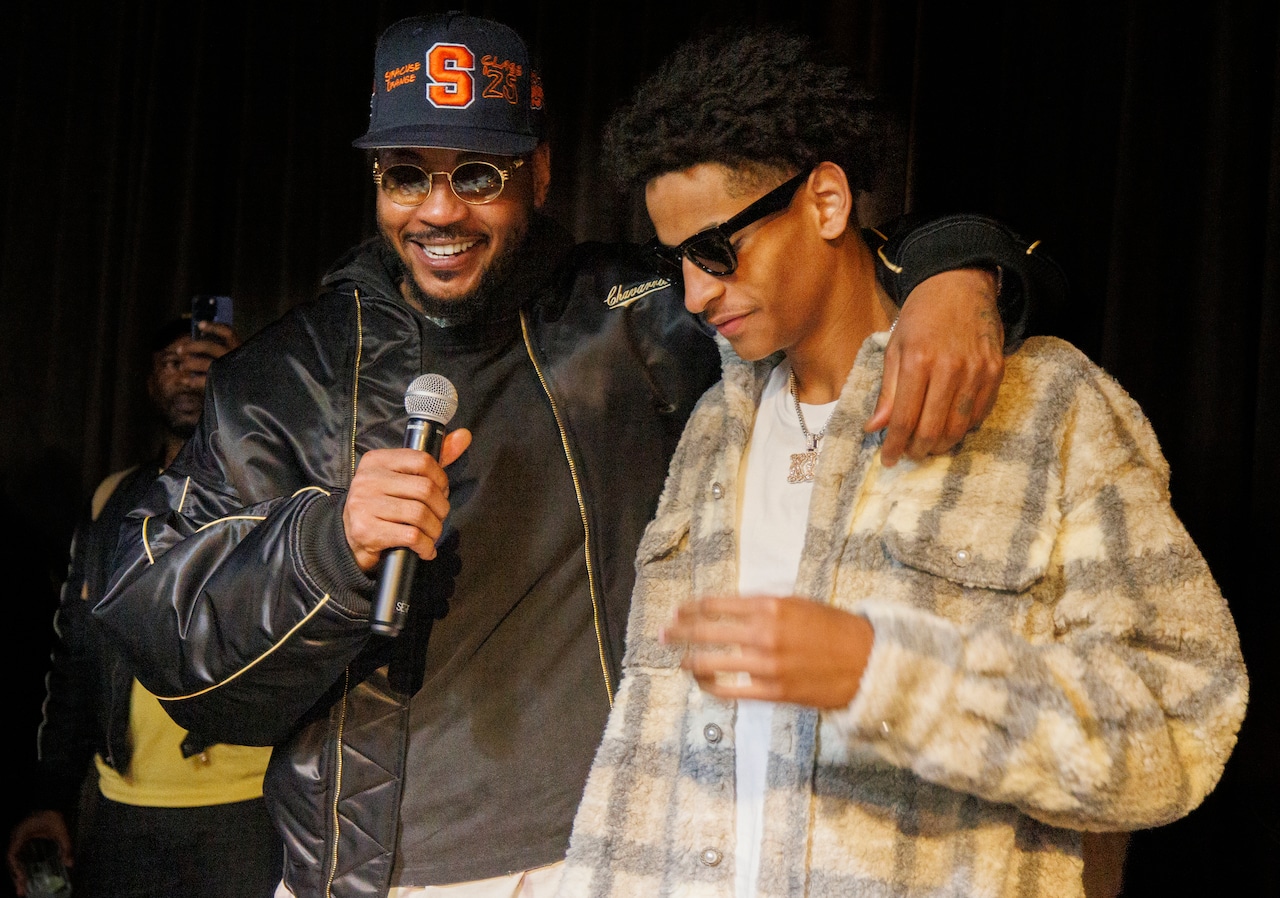 Carmelo Anthony and his son, Kiyan Anthony, who announced his intention to play basketball for Syracuse University at a private event in the Red Hook neighborhood in Brooklyn Friday, November 15, 2024. (N. Scott Trimble | strimble@syracuse.com)N. Scott Trimble | strimble@syracuse.comLegacy
As if Anthony’s own legacy at Syracuse wasn’t enough, there’s a new Anthony in town.
Kiyan Anthony, Carmelo’s only son, is a freshman on the SU basketball team. The younger Anthony is a 6-foot-5 guard who was rated as a top-50 prospect in the 2025 recruiting class.
Despite his ties to the school, the Syracuse coaches still had to beat out Southern California and Auburn along with several other schools.
At his son’s commitment celebration, Carmelo said he intended to be more involved in SU basketball. He planned on attending as many games as he could. He wanted to help the program’s NIL efforts.
Syracuse needs to improve its connection to its basketball alumni. The legends were regulars when things were going good, but SU coach Adrian Autry and his staff could use the boost now as they try to end a four-year NCAA Tournament drought.
As he did in 2003, Anthony could lead the way.
Contact Mike Waters anytime: Email|Twitter
If you purchase a product or register for an account through a link on our site, we may receive compensation. By using this site, you consent to our User Agreement and agree that your clicks, interactions, and personal information may be collected, recorded, and/or stored by us and social media and other third-party partners in accordance with our Privacy Policy.