
Last week, we looked at a handful of players who could take a step back this season. But as promised, this week we’re singing a more hopeful tune. Here are seven players who could be in line for a breakout, starting with the league’s highest flier.
Shaedon Sharpe (Portland)
Sharpe averaged 18.5 points per game last season, so it’s fair to wonder how much better he can be. He pairs a level of athleticism matched only by the Thompson twins (who are too obvious candidates to be worth including in this list) with a silky-looking jump shot:
Despite the clip above, I say looking because it hasn’t fallen at particularly high rates – Sharpe’s three-point percentage has actually decreased over his three years of experience. But Sharpe’s shot is mechanically sound, and he’s a good free-throw shooter. He spent last season adding notably more craft to his game, taking better care of the ball and finishing stronger at the rim. If the three-ball starts splashing the way it should (and his defense improves enough that Chauncey Billups doesn’t have to keep benching him), Sharpe still has borderline All-Star potential.
Sharpe’s fourth season will be an important one as he plays for a contract extension. The Blazers have reasonable roster continuity, but the replacement of Anfernee Simons (far too redundant with Sharpe for comfort) with Jrue Holiday as a mentor and table-setter could help bolster Sharpe’s effectiveness on both sides of the ball.
The Portland wing is far from a sure bet to break out, but if he does, it will be spectacular viewing.
Bennedict Mathurin and Andrew Nembhard (Indiana)
Sigh. I’m not far removed from writing a piece about why Tyrese Haliburton is a Top 5 player in the NBA, and now, we’re looking at the devastation left behind in the wake of his injury. But the Pacers won’t sink to the bottom of the conference, thanks to two different guards with a chance to break out in a major way.
For the first time in his career, Mathurin enters training camp as the unquestioned Day One starter. He’s due an extension, and the Pacers brass will be watching carefully to see if he has improved his off-ball defense and decision-making. Putting the ball in the bucket has never been a problem for Mathurin, but he’ll have the opportunity to show that he’s colored in the rest of his game.
Nembhard will take over point guard duties. We’ve seen him rise to the occasion before, most notably when Haliburton missed Games 3 and 4 against the Boston Celtics in the 2024 Eastern Conference Finals. Nembhard dropped 56 points on efficient shooting splits despite being guarded by Holiday, Derrick White, and Jaylen Brown. He looked like a different player, blasting through defenders like the Kool-Aid Man:
While I don’t expect Nembhard to average 28 points per game this season, his ability to scale up on offense without sacrificing his excellent defense will be a pivotal part of Indiana’s attempts to remain competitive without Haliburton and the departed Myles Turner.
Sam Hauser (Boston)
No Jayson Tatum. No Kristaps Porzingis. No Jrue Holiday (it’s wild how often he’s been mentioned in this piece, huh?). A ramshackle center rotation (even if I have high hopes for Neemias Queta!).
The Celtics are losing a whole lot of their most familiar and productive faces next season. Someone will need to replace all those points. We know Jaylen Brown is itching like he’s wearing a wool sweater to show what he can do as the unquestioned alpha, and Derrick White will be on a ceiling-finding mission.
But Hauser may soak up more minutes and usage than people expect, particularly if the Celtics end up trading Anfernee Simons. Hauser is the team’s most reliable remaining marksman in an offensive system that prizes three-point attempts more than any other. He should get up an eye-popping number of triples next season.
Hauser’s defense is stouter than the average shooting specialist, something that has endeared him to coach Joe Mazzulla in the past. If he truly wants to explode, however, he’ll need to expand upon the flashes of slow-steppin’ floor game he’s shown in the few times he’s been allowed to dribble the ball:
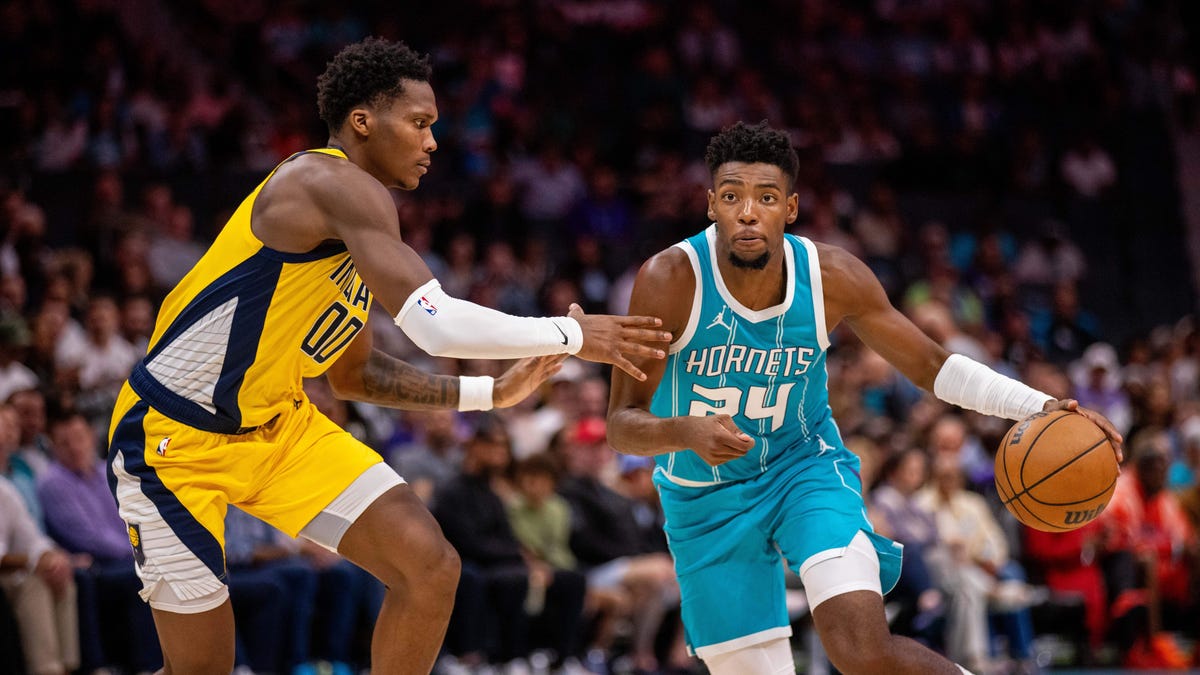
Brandon Miller (Charlotte)
It’s been a long time since we’ve seen Brandon Miller play basketball. He injured his shooting wrist early into last season, and the Hornets shut him down to ensure he had a healthy recuperation.
Entering his third year, however, Miller should have a real chance to make some noise. He’s always put up points, but efficiency has been a foreign language. Hopefully, a year spent learning on the sidelines can be Miller’s Duolingo. A better-shooting surrounding cast could make it a little easier for Miller to get to the cup (only 16 percent of his shot attempts came at the rim last year, a disappointingly low number that dragged down his percentages), and Charles Lee and his staff undoubtedly spent all last season in Miller’s ear about how to better play off-ball defense.
The Hornets are still a year or two away from generating playoff buzz (see what I did there?), but Miller’s development this season is critical to the team’s future direction. Miller is eligible for extension talks next summer, and as a dogged competitor, he should be eager to show how he’s improved – and why he’s worth the big bucks.
Jake LaRavia (LA Lakers)
LaRavia hasn’t exactly been a household name, playing just 136 games over his first three years in the league as he’s battled injuries. But the new Los Angeles Laker is in a prime position to feast playing next to LeBron James, Luka Doncic, and Austin Reaves.
LaRavia will likely slot in as a high-minutes backup wing who can play anything from the two to the four. That flexibility should help him earn plenty of court time for a Lakers team that’s still rather top-heavy.
LaRavia shot 42 percent from deep last season and posted career-best passing, rebounding, and defensive numbers on a per-possession basis. LaRavia should provide more ball-handling and secondary playmaking potential than the man he’s replacing, Dorian Finney-Smith. He’s usually a hiding spot for an opponent’s worst defender, but LaRavia is 6-foot-8. He’s capable of bullying if he has a size mismatch, and he’s a crafty off-ball mover:
LaRavia will have to adjust his game some. He’ll need to step up defensively and be more willing to launch catch-and-shoot threes. If he does, he could become the next in a long line of role players who have career years playing next to James and Doncic.
Terrence Shannon (Minnesota)
Shannon has been a star of two straight Summer Leagues, but he barely got a chance to show what he could do last season, clocking just a few hundred regular-season minutes on a deep and successful Minnesota team.
But the Wolves need Shannon this year. 3-and-D stud Nickeil Alexander-Walker became a casualty of the aprons, and Shannon is the most likely successor to his role as a high-minutes bench player.
Shannon is electric in transition and an active on-ball defender. The rangefinder is unproven, but he did go 10-for-26 from deep across just three games in Vegas this summer – the volume was as surprising as the accuracy.
His second Summer League also provided glimpses of tantalizing growth in other areas. Shannon had nine assists in his first game, showing heretofore-unseen willingness and ability to pass the rock. If Shannon can add some playmaking to his superior physical skills and remain defensively stout, the Wolves may not end up missing NAW much at all.
For four even deeper-cut breakout candidates, check out Mike Shearer’s work at Basketball Poetry.