
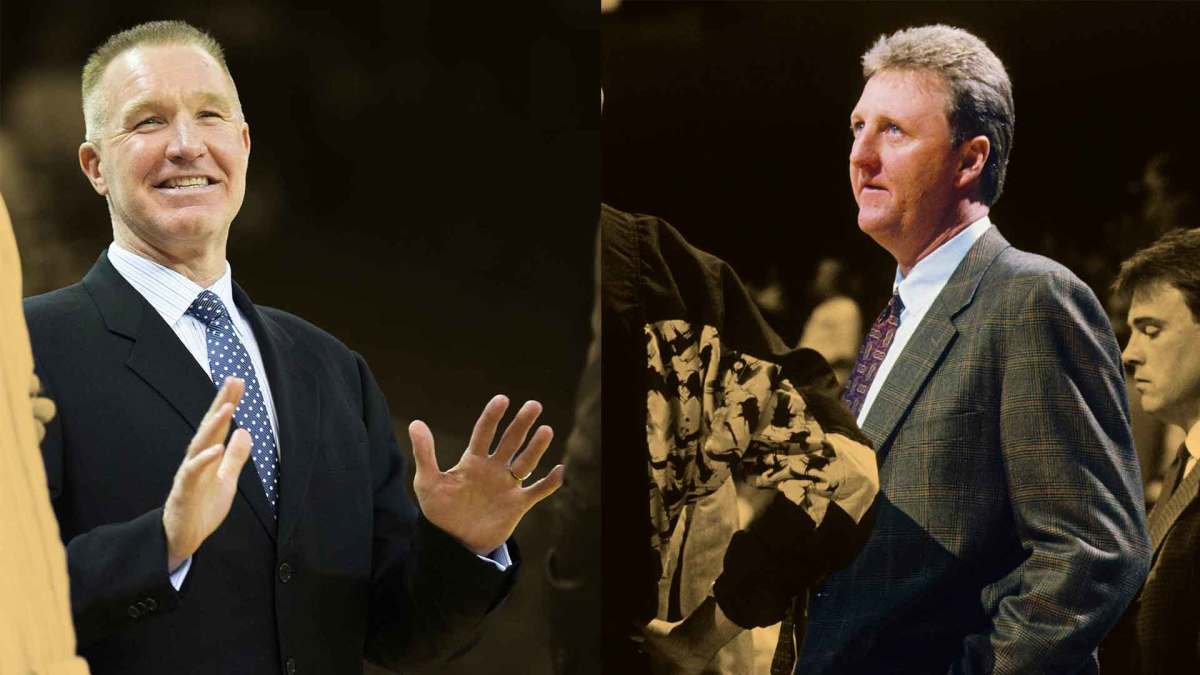
When Larry Bird took over the Indiana Pacers in 1997, finally fulfilling his wish to return to his home state, he promised he would stay for no longer than three years. Bird had a clear vision of what needed to be done — a man with his winning mentality didn’t make such statements unless he believed in success.
One of Bird’s first acquisitions was Chris Mullin, his rival from playing days and teammate from the legendary 1992 Dream Team. Even though Mullin was already on the decline, Bird knew he needed a proven veteran in the locker room, someone he could trust and someone who would be his extension on the court.
Advertisement
The impact Bird had on the Pacers was best shown by the fact that just a season earlier, they had missed the playoffs with a 39-43 record, only to finish 58-24 in his first year with the team, reaching the Eastern Conference finals and pushing the eventual champion Chicago Bulls to seven games.
What was Bird’s secret besides his all-time great basketball IQ? One thing was discipline, holding his players to a high standard and treating everyone the same.
On the All the Smoke podcast, Mullin shared a story that captured this perfectly.
Advertisement
“I was there three seasons, we had one guy late, one time, and that’s it,” the Hall of Famer said. “We’re playing preseason, Larry’s first year coaching. Leaving Indiana and going to Nashville, it’s like 10:58, everyone’s on the plane, David Craig comes up to Larry. ‘Travis [Best] and Dale [Davis], they’re in the jetway or whatever, what time is it?’ It’s 11. Wheels up. So the plane is taking off, Travis and Dale are running after the plane, we took off. After that day, no one was ever late again. That was preseason.”
Bird immediately lifted the Pacers
With the discipline Bird instilled from the very first moment he took the job, it’s no surprise he immediately lifted the Pacers to the top of the East. Things that may seem simple today, like being on time and having a professional attitude toward the team, were all part of the mindset change the Boston Celtics legend enforced.
Advertisement
That he was strictly business was clear when, after reaching the NBA Finals in 2000, where they lost to the Los Angeles Lakers, Bird stepped down exactly three seasons in, just as he had promised, despite delivering the best results in franchise history.
But that’s how Bird was. He never sugarcoated things, not on the court, not on the sidelines, not on the team plane.
“Halftime he’ll be like, ‘You f—ing stars don’t start playing in five minutes I’m gonna take your a— out,'” Mullin recalled. “I remember a game in Milwaukee, I’m like 4-for-9—you’re not playing great but not [terrible]. [Bird] said, ‘Mullin, come here, you gonna make a f—ing shot or what, man?’ Just keep it real simple.”
Advertisement
Special connection with Indiana
Bird’s style may have been old-fashioned, but he knew exactly how to get the most out of his players. He gave himself fully to the job in a city to which he always felt indebted, making it part of what defined him later in his great career.
He knew how passionate people in Indiana were about the game and never wanted to risk his team’s approach on the court, given the fanatical support from the stands. His winning DNA simply wouldn’t allow it.
Advertisement
And even though they never won the championship, Bird established the Pacers as an elite team during those years, earning himself the Coach of the Year award.
This story was originally reported by Basketball Network on Sep 8, 2025, where it first appeared in the Old School section. Add Basketball Network as a Preferred Source by clicking here.