
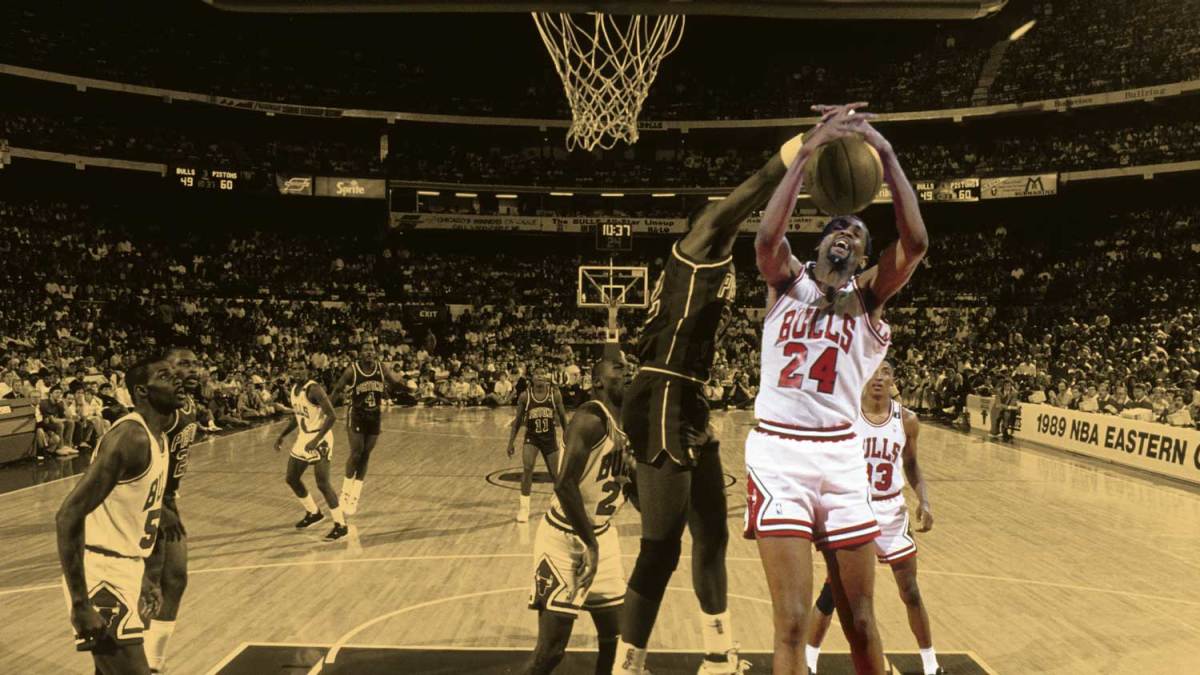
Most fans remember Bill Cartwright as the veteran center who played his role to perfection to help Michael Jordan and the Chicago Bulls achieve their first three-peat in the early 1990s. But unbeknownst to many, the 7’1″ center from California was an All-Star who anchored the New York Knicks in the middle during the late 1970s and early ’80s before Patrick Ewing arrived and took over the starting position.
The feisty big man recently looked back on his playing days and shared how he and other interior players had to be physically and mentally tough to survive in an era where only the strongest survived in the paint.
Advertisement
Opponents looked to knock people’s heads off
Today’s NBA fans may associate the center position with guys like Nikola Jokic and Joel Embiid, who blend power with grace on the hardwood floor. There’s no question how these two are more than able to bang bodies in the shaded lane. But at the same time, they’re also able to operate on the perimeter, displaying a skillset that centers of old would have never dreamed of possessing.
According to Cartwright, back in the ’70s and ’80s, being a center meant being a bruiser. The position was often filled by players who were tall and strong, with feisty temperaments to boot.
Advertisement
“I mean, the center position was aggressive,” he shared on the “Mike Check” podcast.
Anyone who dared to enter the realm of the tall trees was met with a forearm, an elbow, or anything that sent a clear message: they weren’t welcome there.
“You went to the lane, yeah. Guys like Kent Benson or Rick Robey, those guys — if you beat them, they’re just going to take you out,” Cartwright claimed. “So you just have to learn how to play. You have to learn to take care of yourself.”
Advertisement
A rough learning experience
Cartwright hit the ground running when he entered the NBA as the third-overall pick. He averaged 21.7 points and 8.9 rebounds a game and was named an All-Star during his rookie year. And while he could put the ball in the basket with the best of them, standing his ground took and getting used to the intense, physical nature of the NBA was more work than usual.
Advertisement
“So, it probably took me a half a season to learn how to guard. I could score, but I couldn’t stop anybody,” Cartwright explained. “So it took me a while to learn how to play position, get up on guys, but it was a good learning experience.”
One player that Cartwright taught the very same lessons to was Ewing, the Georgetown standout, who the Knicks picked first in the 1985 draft. While the veteran was sidelined during Ewing’s rookie season, he returned for the 1986-87 campaign and immediately let the young gun feel his presence.
“He came back the next year, so we practicing, and he elbowed me. I’m getting busted to lips and getting elbowed in the head,” Ewing shared in a talk with another Knicks legend, Mark Jackson. “I’m looking at him, I’m getting ready to fight him. Then I realized that he was just that. From how he played, he’s always flailing and stuff.”
Advertisement
Countless stories have been told regarding the relentless physical nature of the NBA in the 1970s and ’80s. It was a different time for the league, one that suited Cartwright well. With his flailing long arms and mean streak, he was more than capable of holding his own against the toughest centers of that era.
This story was originally reported by Basketball Network on Sep 9, 2025, where it first appeared in the Old School section. Add Basketball Network as a Preferred Source by clicking here.