
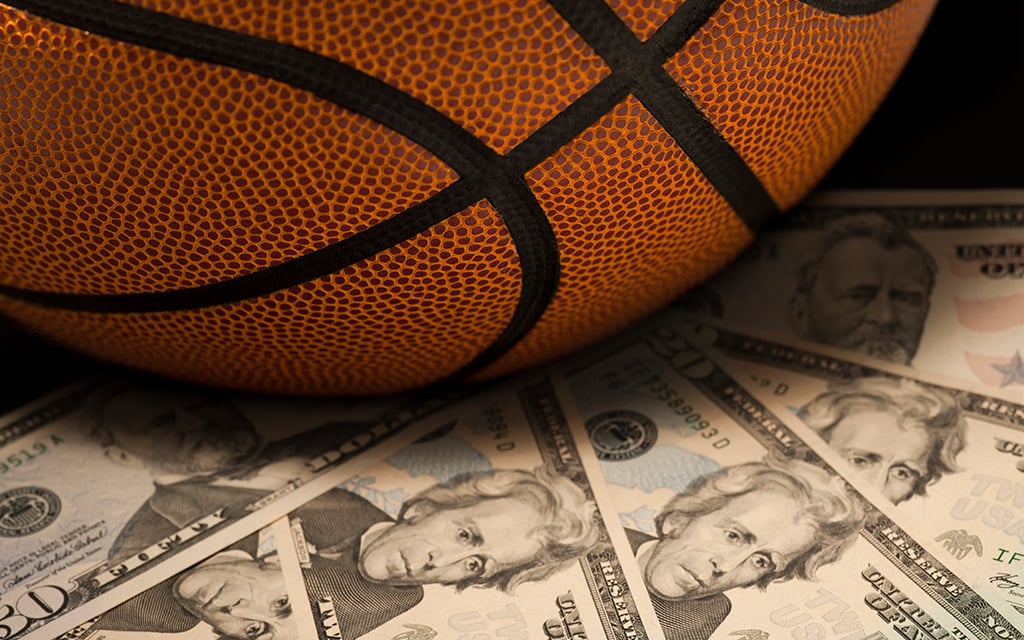
A former Arizona State men’s basketball player is among those the NCAA is investigation for violating sports betting rules and/or failure-to-cooperate violations. (Illustration by Pgiam/Getty Images)
PHOENIX – The NCAA enforcement staff is investigating a former Arizona State men’s basketball player for violating sports betting rules and/or failure-to-cooperate violations.
Also under investigation are players from Mississippi Valley, Eastern Michigan, Temple, North Carolina A&T and New Orleans, with the facts varying by school. The violations announced Thursday include sharing information with third parties for sports gambling, knowingly manipulating the outcomes of scores or games, betting on and against their own teams and/or failing to participate in the investigation by the enforcement staff.
Despite the NCAA’s decision to release the information, it was made clear that the names of the athletes will not be released until the infraction process is complete. None of the athletes are still competing at their respective universities.
Last February, guard BJ Freeman, who was the Sun Devils’ leading scorer at the time, departed the team in the back half of the season for conduct that was detrimental toward the team.
“It was one athlete that was involved,” ASU athletic director Graham Rossini said Thursday on Arizona Sports’ Burns & Gambo show. “We got word of it at some point over the summer after he had already been released from the team and so (we) cooperated with the investigation, a very quick process, minimal involvement on behalf of the university.”
The NCAA’s Committee on Infractions has already dealt with and resolved three cases involving sports betting and men’s basketball players. It also clarified that in these current investigations, the universities and their staffs are not alleged to be a part of the violations, and neither will be penalized for the actions of their former athletes.
“I am grateful for the NCAA enforcement team’s relentless work and for the schools’ cooperation in these matters,” NCAA President Charlie Baker said. “The rise of sports betting is creating more opportunity for athletes across sports to engage in this unacceptable behavior, and while legalized sports betting is here to stay, regulators and gaming companies can do more to reduce these integrity risks by eliminating prop bets and giving sports leagues a seat at the table when setting policies.”
Using an integrity monitoring program along with certain sources, the NCAA enforcement staff found some irregular betting activities during these teams’ regular-season games.
Moving forward on those findings, the staff found in specific cases through direct messages on social media, material evidence and text messages, that violations did occur.
“Arizona State University is aware of the NCAA investigation and outcome related to a former student-athlete who is no longer enrolled at ASU,” said a university spokesperson. “The university cooperated fully with all inquiries and was not implicated in any way.”
Drama and scrutiny over sports gambling isn’t new to ASU’s basketball program. During the 1993-94 season, the men’s team was involved in one of the most notorious point shaving scandals in NCAA history.
An entrepreneur, an ASU men’s basketball player and a student bookmaker combined to make millions of dollars through just a handful of wins on the Sun Devils’ schedule.
Standout ASU hooper Stevin “Hedake” Smith was in debt to Benny Silman, a bookmaker and student. With the opportunity to repay him through fixing games, the senior guard and student came together and were joined by an entrepreneur to help them level up their actions.
They decided that Smith would help ASU win, but do so while not covering the point spread. With this plan, the three made more than $2.5 million in just the first few days.
The profit flow eventually came to a halt when Sun Devils fans noted the fix, and began to bet their own money on ASU. When the Sun Devils played Washington, the traffic in the sportsbooks was so heavy that gambling officials took notice.
Smith, who went undrafted in 1994, was sentenced to a year in prison, with an $8,000 fine, and three years of probation, while being prohibited from gambling.
In hopes of preventing similar violations, the NCAA uses a gambling harm education program, which was recently extended, that was created in partnership with EPIC Global Solutions.
The program offers cost-free sessions for any NCAA school that helps teach the dangers of sports betting to college athletes. According to the association, the program has reached more than 100,000 athletes, administrators and coaches.
The association also launched its Draw the Line campaign in March 2024 which works to educate all who consume or are a part of college sports about gambling, while prioritizing NCAA athletes.