
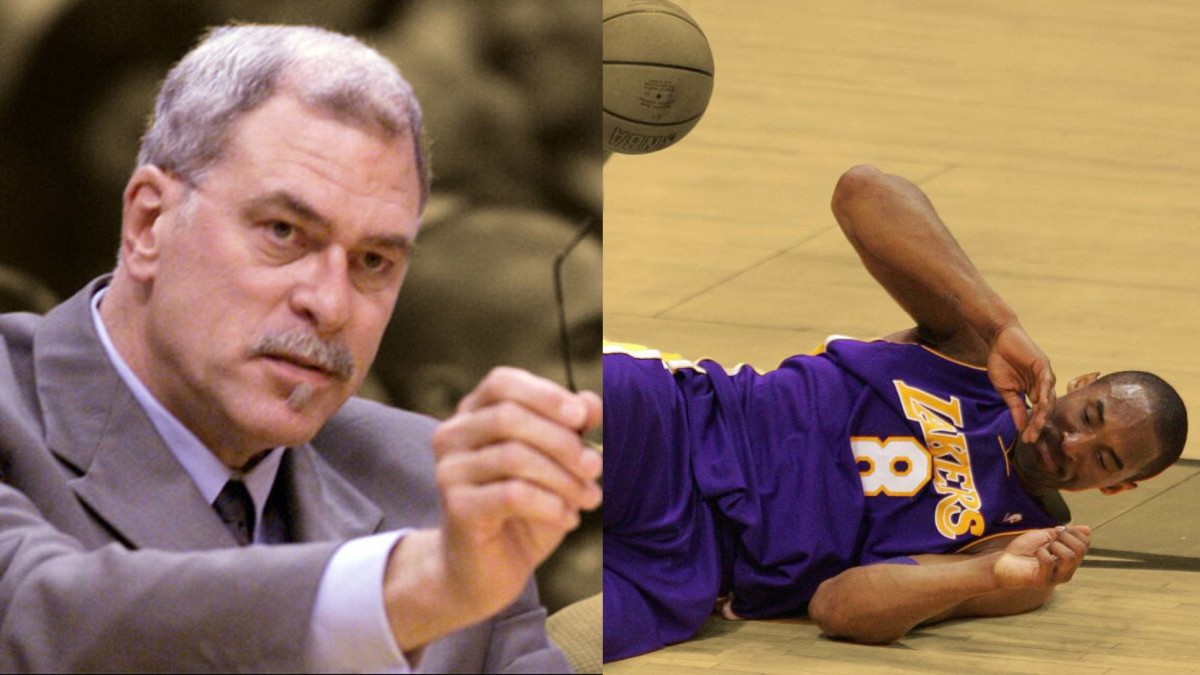
The 2005-06 NBA season was a mixed bag for Kobe Bryant and the Los Angeles Lakers. Bryant showcased his offensive talent through a 62-point explosion against the Dallas Mavericks, followed by an 81-point masterpiece against the Toronto Raptors a month later. The Black Mamba averaged a ridiculous 35.4 points per contest to claim his first scoring title.
Bryant’s stellar defensive exploits guided the Lakers to a subpar 45-37 record, which ranked seventh in the Western Conference. The franchise was still trying to build a contending roster. There were a few formidable players, but for the most part, the squad was filled with young prospects and journeymen. In other words, the team was very flimsy and nowhere near championship status. Kobe had to bring out all his offensive tricks just to keep his team’s head above water.
Advertisement
Reverse sweep
The Lakers’ inherent weaknesses were exposed in the 2006 NBA Playoffs. Up 3-1 against the Steve Nash-led Phoenix Suns, the Lakers saw their comfortable lead slip away game after game. The series reached a do-or-die Game 7 — Kobe and company’s last chance to complete the upset.
For some strange reason, Bryant — easily the most cold-blooded player of his generation — disappeared in the pivotal Game 7. Even though he scored 23 points in the first half, Kobe finished the game with 24 points. The ace shooting guard uncharacteristically shot three times in the second half and missed all of them. The Lakers lost the deciding game, 121-90.
Advertisement
Bryant’s lack of urgency on the offensive end puzzled many. For a second, even head coach Phil Jackson wondered what happened in the game, but reiterated that he firmly believed Kobe knew what he was doing.
“Did he score in the second half? I couldn’t remember him scoring,” Jackson said. “Obviously, the other guys had to come alive. I’m sure Kobe could have [mustered] up a 50-point game, but that wasn’t going to put us in the ballgame. I trust his judgment in that ballgame.”
Bryant was trying to distribute the ball instead of creating his own shots. The Lakers icon was playing within the system, but his teammates weren’t knocking down their jumpers. The Black Mamba shot a decent 50 percent from the field while the rest shot a horrendous 32 percent.
Advertisement
“If we were going to get back in this type of a game, we had to have everybody contributing,” Bryant said after the game.
Proving a point
Jimmy Jackson, who was on the Lakers bench watching Bryant pass up shots, believes he had a deeper reason behind his unusual performance. Kobe was trying to send a message to the coaching staff and probably the front office. It was his way of telling the executives that they needed to surround him with better players if they wanted to win.
Advertisement
“I think Kobe, at that time, and I don’t want to talk for him, was proving a point,” Jackson said. “You have to take this, and get on this, and stop the bleeding early. I was surprised that Phil let it fester just based on who I thought Phil was as a coach. That would be cut off right away. That’s what led up to it because Aaron McKie and I were sitting there on the bench like we didn’t realize it at first, then we was like ‘Hold up, he ain’t shoot, he ain’t even looking.'”
Indeed, Bryant’s Game 7 performance against the Suns in 2006 is a controversial topic. It didn’t feel right to see one of the game’s most prolific scorers pass up shots in a pivotal game. Whether he was proving a point or it was just an off game will forever remain a mystery. We just have to accept that once in his career, Kobe disappeared.
This story was originally reported by Basketball Network on Sep 11, 2025, where it first appeared in the Old School section. Add Basketball Network as a Preferred Source by clicking here.