
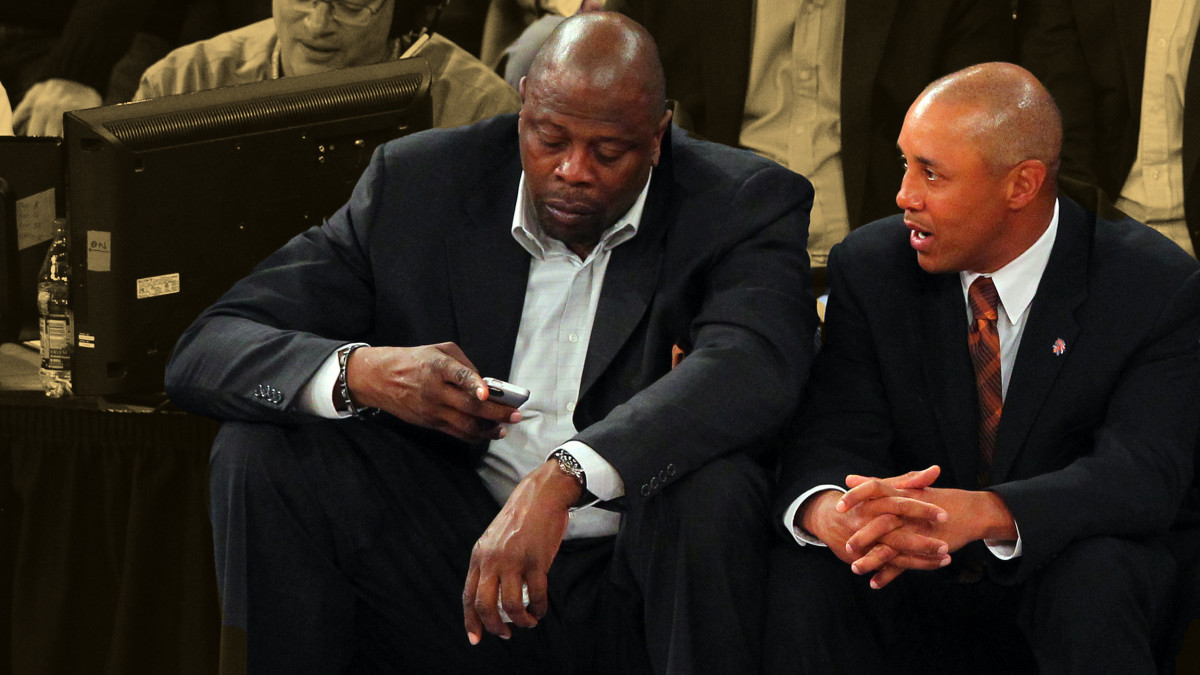
During his eight-year tenure with the New York Knicks, John Starks shared the court with several quality talents, such as Allan Houston, Xavier McDaniels, Charles Oakley and Larry Johnson, among others.
Yet for him, there was never any doubt that Patrick Ewing was the team’s undisputed leader.
Advertisement
Interestingly, what made this leadership undisputable wasn’t Ewing’s individual accolades or his towering seven-foot frame, but how Pat inspired every player to raise their gameplay by simply setting the tone regardless of the outcome.
Stark was impressed by Ewing’s work ethic
By the time Starks entered the Knicks, they had already become a perennial playoff contender. But for him, the first big example of how Ewing always led from the front on the court came in the 1992 playoffs when New York battled the Chicago Bulls in a grueling seven-game series in the second round.
Advertisement
Patrick rose to the occasion, averaging 22.1 points, 11.1 rebounds and 2.3 blocks per game, yet it came at a losing cost.
Then, in the following postseason, New York met Chicago once again, this time in the Eastern Conference finals.
Despite the Bulls’ being more aware of Ewing’s game, he still raised his production to 25.8 points, 11.2 rebounds and 1.8 blocks per game. But despite his best efforts, Ewing wasn’t able to make the Knicks progress further.
Advertisement
Then, in 1994, he led the Knicks into the Finals, wherein he went toe-to-toe against the reigning MVP Hakeem Olajuwon, averaging 18.9 points, 12.4 rebounds and 3.4 blocks per game.
Yet, in a hard-fought seven-game series, New York fell short again.
For Starks, this showcased the true character of Ewing’s leadership. Despite the latter giving his all for the team and watching them fail, he never sulked or blamed his teammates; rather, the next year he came better prepared to lead them to a better position, even if it meant working twice as hard on both ends of the court.
Advertisement
“We understood that he was our leader and when you got a guy like that who puts it out there on the floor every single night, you can’t help but listen to him,” Starks said in an interview. “As soon as he steps on the court, he’s going to be drenched with sweat.”
Lack of success downplays Ewing’s leadership
For many fans, success is often measured solely by a player’s ability to win championships. From that perspective, the Knicks’ inability to secure a title in the 1990s led some to question whether Ewing was truly the great leader he was often portrayed to be, especially when compared to dominant big men like Kareem Abdul-Jabbar or Hakeem, who guided their franchises to multiple titles during their respective eras.
Advertisement
Perhaps this perception placed an unfair shadow on Ewing’s legacy, reducing his contributions in the eyes of those who equate greatness only with ultimate team success.
However, for those players who shared the court with Ewing, they recognized wholeheartedly how the issue was never with Ewing’s lack of effort. Instead, if the team had another bonafide superstar who could guide them through when Ewing ran out of gas, things could’ve panned out differently.
This story was originally reported by Basketball Network on Sep 13, 2025, where it first appeared in the Old School section. Add Basketball Network as a Preferred Source by clicking here.