
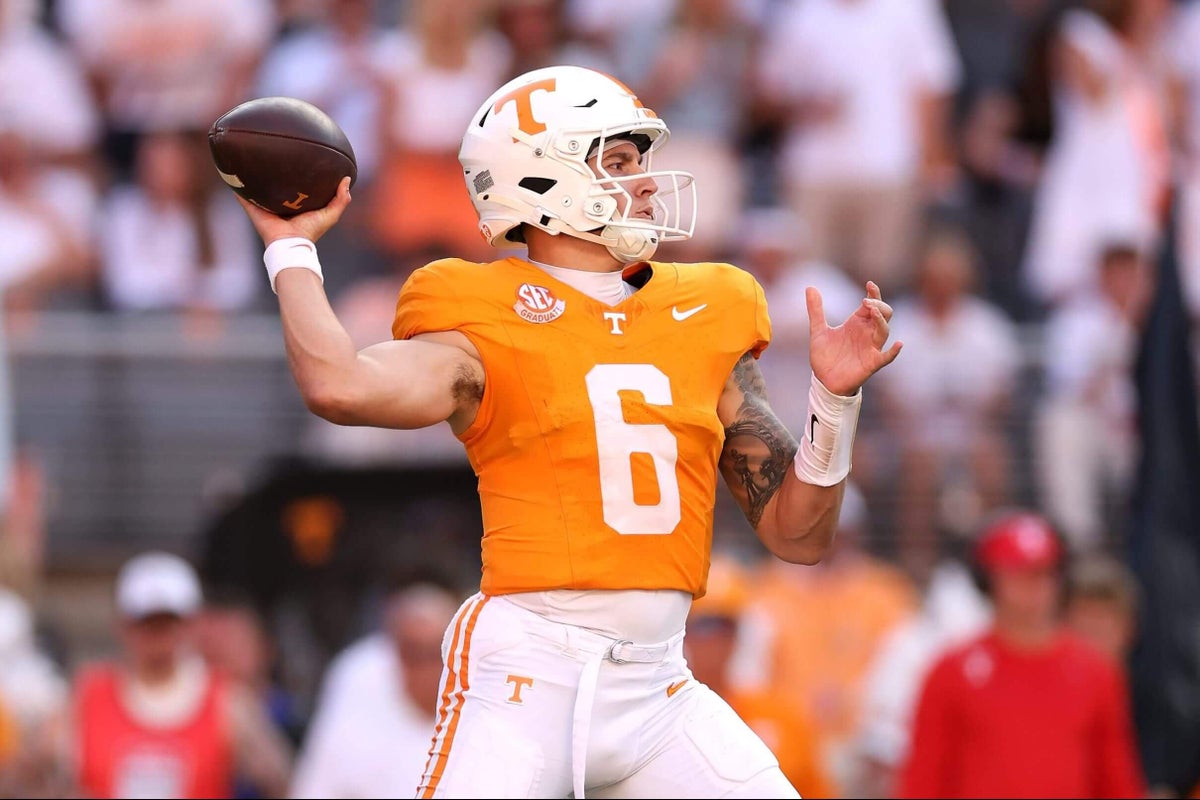
Tennessee quarterback Joey Aguilar took a long road before landing in the SEC spotlight — City College of San Francisco in 2019, Diablo (Calif.) Valley College in 2021, two years as Appalachian State’s starter and, finally, a mid-May arrival in Knoxville after Nico Iamaleava transferred to UCLA.
On Saturday, in a heartbreaking overtime loss to Georgia, Aguilar accounted for five touchdowns (four passing, one rushing) and threw for 371 yards (with two interceptions). Has the 24-year-old QB done enough to pique the NFL’s interest? We asked our draft experts for their thoughts:
What is your initial reaction to how Aguilar played against Georgia?
Dane Brugler: My initial reaction? I’m eager to go back and study more of Tennessee WR Chris Brazzell, who was Aguilar’s best friend against Georgia with three touchdown grabs. He made the quarterback right with his body control and focus on the deep ball.
However, Aguilar has surpassed expectations throughout his seven-year college career, including with his performance Saturday. The scouting report on him entering the season was “average tools, marginal decision-maker.” And though his mobility and arm don’t necessarily jump off the screen, both certainly could be labeled “good enough.”
Aguilar did a nice job distributing the football and limiting mistakes, although his miss on his first pass in overtime was costly. Still, accounting for 371 passing yards and five total touchdowns against Georgia is impressive.
Nick Baumgardner: It was impossible to ignore how quickly Aguilar got Tennessee moving early in this game — almost no one puts up 200 yards in the opening quarter against Kirby Smart.
Aguilar seems to be a perfect fit for everything Josh Heupel and Tennessee do offensively. He has played with quick tempo in the past, never holds onto the ball long and generally understands where to go early in a progression. He’s a lot like Hendon Hooker, including the fact he’s already 24.
I also think a big part of Aguilar’s hot start was that Georgia’s defense is young with a number of new faces on the field, and it took the Bulldogs a solid quarter to catch their bearings. That said, Aguilar’s best trait — beyond his ability to read and play quickly — is his fearlessness down the field, especially over the middle. Roughly 17 percent of all Aguilar’s throws at Appalachian State were intermediate shots between the numbers, and that’s a place that tends to give quarterbacks pause.
BACK IN FRONT.
📺 ABC
📲 https://t.co/Vq6FJOLBZB pic.twitter.com/UdeJppIwVJ
— Tennessee Football (@Vol_Football) September 13, 2025
Does Aguilar have any upside as a potential NFL QB? Could he emerge as a draftable prospect?
Dane Brugler: It’s still September, so let’s keep an open mind on all these prospects — particularly the quarterbacks.
Does Aguilar’s performance against Georgia definitely make him draftable now? No, but it will force NFL scouts to take a longer look at him, especially if he continues to stack positive performances. As an older player, he has a veteran presence to his game, flashes anticipation as a passer and has enough tools to get his chance in an NFL training camp, whether he’s drafted or not.
Nick Baumgardner: One of the biggest drawbacks with Aguilar tends to be his spotty ball placement — he’s streaky and will take unnecessary chances. Another is the same thing we discuss about every quarterback who plays in Heupel’s offense: Almost none of this stuff translates to the next level. The reads are much more difficult in the NFL, so it requires an awful lot of squinting on QBs who are good, but not overwhelming prospects.
He’s a very confident deep ball thrower and probably will put up really nice numbers in this offense. It might not be scout-friendly, but the scheme sure works well, and nobody runs it better than Heupel. If Aguilar can keep his turnovers down and put together a full season of more consistent ball placement, we could be having a Kurtis Rourke-type conversation about him come draft time.
How will Aguilar’s scouting report be impacted by how past QBs from the Heupel system have fared?
Dane Brugler: Heupel’s offense has been criticized for being so systematic that it hurts the development of skill players once they get to the NFL. There is absolutely some truth to that, because the offense simplifies reads and routes and spreads out the defense, creating vulnerable matchups.
However, it still takes athletes to make plays and a quarterback who understands where to attack and execute throws. Joe Milton and Hooker both had flaws as prospects, so it isn’t surprising that neither is pushing for playing time in the NFL. The No. 1 rule, though, is never “helmet scout” — don’t discount a quarterback just because of the decal on his helmet or the system he played in college — but some situations do make it tougher than others to fully figure out the player.
Nick Baumgardner: The veer-and-shoot/deep choice (whatever we want to call it) was truly designed to be a college offense. Tennessee’s scheme is designed to take advantage of the wider hashes in college, stretching into alignment to create larger-than-normal throwing windows for quarterbacks. That makes for easier reads while giving the QB more margin for error, both in accuracy and how quickly they make the throw.
Still, Hooker was as good as we’ve ever seen in that offense, and Detroit just cut him after he was unable to win a backup job over two seasons. His struggles were two-fold: He wasn’t consistently accurate enough, and his reads in an NFL scheme weren’t fast enough. That’s not to say it’ll be the same for Aguilar, but it makes scouting his tape quite a bit more difficult, because you don’t see many situations that are translatable to what he’ll experience in an NFL offense.
(Photo: Andy Lyons / Getty Images)