
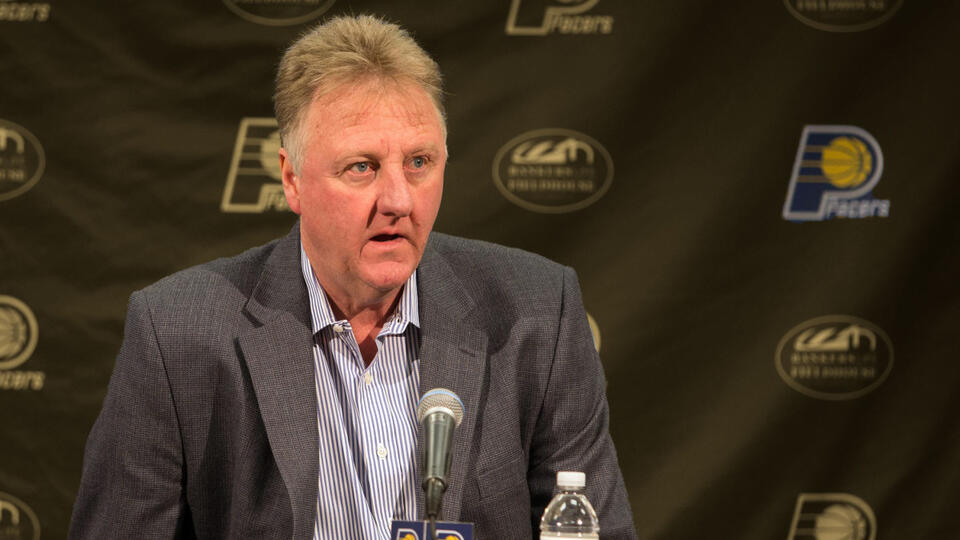

Larry Bird‘s ability to talk trash at the height of his physical powers is as legendary as the man himself. However, as they say, old habits die hard. Bird never lost his gift of gab decades after hanging up his sneakers for good, even during the time he worked as an executive for the Indiana Pacers.
As the story went, Larry Legend was in the Pacers’ practice facility, picked up a ball and started hitting shot after shot. Paul George even talked about that moment in a podcast interview. Bird eventually stopped, unaware of the few individuals who had been watching him the whole time.
Larry’s answer was the typical words you’d expect from The Hick from French Lick.
“I didn’t notice (people were watching) until I quit and somebody said, ‘Why are you quitting?’ I said, ‘Well, why shoot if you’re making all of them?'” Bird told ESPN’s Baxter Holmes.
Bird worked out with a purpose
No basketball player ever gets to Bird’s level without working as hard as they can. Larry was known for his work ethic, even though his workout routine did not follow the norms.
In his words to the people who watched him test his marksman skills, he saw no point in shooting if he was making them all. That’s why he had to put that aspect of the game last in the priority list when working on his craft.
“It’s the way I worked out, too. I go out in the summers and I’d do everything I had to do before I shot last. If I got out there and I was making everything, I’d go, “Why am I doing this?” So I’d shoot 500 free throws,” Bird recalled.
According to the 2012 Executive of the Year, the only way he would attempt that many shots is if he’d notice a flaw in his shooting mechanics. That actually came often, as Larry had a bunch of broken joints, including a crooked right index finger, accumulated over years of playing the sport.
“If I come in and I could tell the ball was going a little bit left on me, I could be there for hours, trying to get it back. It’s unbelievable. When I missed consistently, it was always to the right, inside the lip of the basket,” said the three-time NBA champion.
“It could take me an hour to get it back. So when I went through slumps, when I would miss a shot, it would hit on the inside right and spin out or hit straight back. It never was long. It was always the same miss,” he added.
Larry helped PG with his shot
Bird had been around the Association for nearly five decades in various capacities. He started his career as the franchise-changing piece for the Boston Celtics in 1979, took on head coaching duties for the Pacers in 1997, and transitioned to a decision-making executive later.
In one of his best choices, Larry brought in George as the 10th overall pick in the 2010 draft. George developed into an All-Star caliber two-way athlete and a cornerstone. He then proceeded to build a team around PG, a squad that competed in back-to-back conference finals against the LeBron James-led Miami Heat.
Naturally, his wealth of experience proved to be very beneficial. Bird, who had already seen and done it all in the league, didn’t hesitate to offer feedback when he saw something off, even with George.
As Bird recalled, he gave PG a bit of guidance with his shot during their time together in Indiana.
“I said [to Paul George], “I see that you finally got the ball in the right space.” He said, “What do you mean?” I said, “Well, you’re starting to knock down shots because your hand’s in the right position when you’re following through. It’s not shooting off to the right,” Bird remembered, recounting his experience with his own shot.
“But I tell these guys — I don’t have all the answers, but I do have a lot of experience… That’s what happens when you get older. You watch all these practices and these games and you figure these guys out,” he said.
Even after his playing days were long behind him, Bird’s shooting touch, quick wit and sharp eye never faded. Whether he was casually knocking down jumpers at the practice facility or offering a few tips on an All-Star’s shooting form, Larry kept doing what came naturally.