
While the modern style seen today can be attributed to the 2010s Golden State Warriors engineering 3-point barrages and positionless flair, the 1990s Chicago Bulls were racking up titles by embracing a system that prioritized geometry, discipline, and unselfish basketball.
At its heart stood Phil Jackson, a former player-turned-coach whose tactical mind married perfectly with the cerebral mechanics of the Triangle Offense.
Advertisement
The Triangle was the scaffolding that held up one of the greatest dynasties in NBA history.
The mystery of the Triangle
Perhaps the notion that his offense is incompatible with modern basketball has stuck around like a bad narrative. However, according to Jackson, who won over a half-dozen titles under the strategy, the truth is far more layered.
“A lot of people say the Triangle doesn’t adhere to the 3-point shot, and that’s not true either,” Jackson said. “Because we prided ourselves with the fact that using all the different types of actions in basketball could be used and is facilitated by this offense.”
Advertisement
Built on the foundational philosophies of the University of South Carolina’s Hall of Fame coach Sam Barry and later refined by Tex Winter — who played under Barry in the late 1940s — the Triangle was no gimmick. It was a deliberate, structured way of reading the floor, one that demanded constant movement, intelligent spacing, and a deep understanding of timing.
When legendary coach arrived in Chicago and made the system the core of his offense, everything clicked. The Bulls won six championships from 1991 to 1998, with Michael Jordan and Scottie Pippen thriving in a setup that turned basketball into ballet.
The offense, which essentially creates a sideline triangle between the post, wing, and corner, allows for both inside dominance and perimeter play. While the Bulls didn’t lean on 3-point shooting like today’s teams, they still had capable shooters — Steve Kerr, John Paxson, Toni Kukoc — who benefited from the constant motion and the way defenses collapsed inside. In Jackson’s eyes, the Triangle never limited options; it expanded them.
Winter’s fingerprints were all over the strategy.
Advertisement
Tex was a coach whose basketball mind never slowed down, and he worked closely with Jackson throughout his championship runs. Together, they taught players to read and react rather than rely on set plays. Every possession was a string of possibilities triggered by how the defense shifted. That unpredictability made the system almost impossible to guard when executed correctly.
Coach Jackson’s style
As the league shifted into a pace-and-space era with a premium on 3s and transition buckets, fewer and fewer coaches dared deploy it. The discipline required, the time it took to master, the need for intelligent, unselfish stars.
Advertisement
All those things became rare commodities in a league obsessed with speed and instant results.
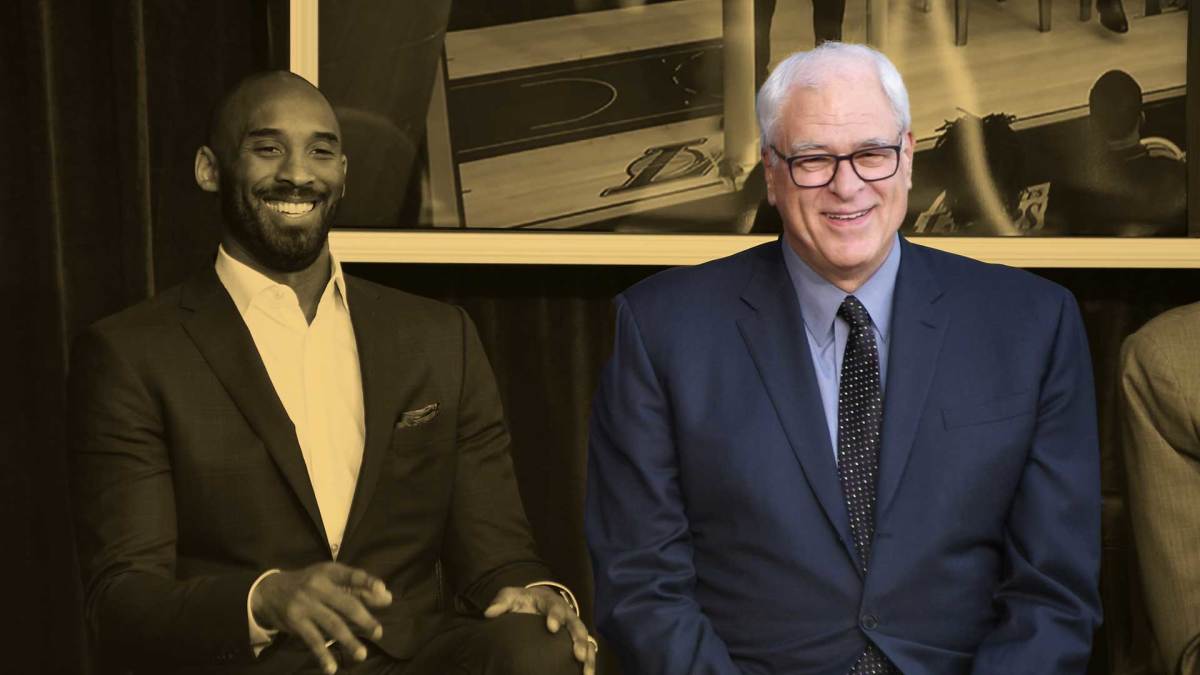
Jackson took the same approach to the Los Angeles Lakers and was lucky enough to have a Jordan-esque player in Kobe Bryant to run the offense.
When “Zen Master” left the Bulls and joined the Lakers in 1999, the Triangle traveled with him. And once again, it thrived. The Purple and Gold rattled off three straight championships from 2000 to 2002 and added two more in 2009 and 2010.
“It’s just basketball,” he said. “And we do it by overloading the floor. That’s just one of the things.
Bryant, like MJ before him, had the rare blend of scoring brilliance and basketball IQ to operate within its structure. The offense allowed him to isolate when needed but also encouraged him to trust teammates, read backdoor cuts, and control the tempo.
Advertisement
Jackson’s Lakers led the league in offensive efficiency multiple times during the early 2000s, proving that the Triangle still had bite in a changing NBA.
However, by the time “Zen Master” returned to coach the Knicks in a front-office capacity in 2014, the league had changed dramatically. The rise of analytics-driven strategies, the explosion of pace-and-space offenses, and the wave of stretch bigs altered how coaches viewed spacing and shot selection.
The Triangle, now viewed as too rigid or slow, struggled to find a foothold. The system crumbled under modern expectations. Today’s NBA is faster, more spread out, and heavily reliant on outside shooting. Teams average over 35 3-point attempts per game, a stark contrast to the mid-90s, when even 15 attempts was considered a high volume.
Ball movement still matters, but it’s often more about dribble penetration and kick-outs than orchestrated cuts and reading the defense from the post. The Triangle, built on five players moving as one, stands at odds with a game that now celebrates individual creation and quick-strike offense.