
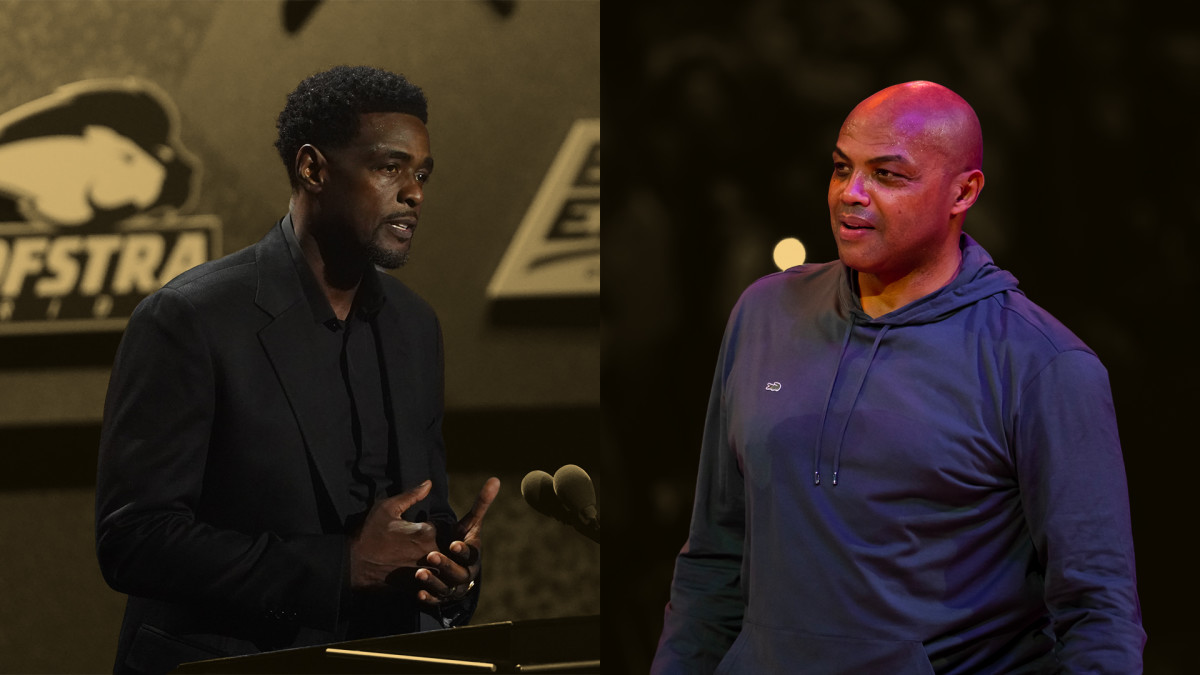
For many NBA fans, a player’s legacy as a game-impacting leader is often determined by his ability to deliver championship rings, but there are exceptions when we’re talking about guys like Chris Webber.
For instance, Larry Bird is credited for leading the Boston Celtics to three championships in his first six years, while Michael Jordan is hailed for the Chicago Bulls’ two separate three-peats in an eight-year span.
Advertisement
However, Charles Barkley feels that having a transformational impact wasn’t necessarily determined by attaining a ring; instead, he once praised Webber for bringing not one, not two, but three different franchises into the spotlight, which was worthy of widespread recognition.
Barkley wanted everyone to understand Webber’s influence
When Webber made his way into the NBA with the Golden State Warriors, he had an instant impact on the team. In his rookie campaign, he wasn’t just the team’s second-best scorer with 17.5 points per game, but led them in rebounding (9.1) and blocks (2.2) to make them win 50 games, when they didn’t even reach the 35-win mark in the previous campaign.
Advertisement
Then, when he joined the Washington Bullets, that was one of the most depressing teams in the Eastern Conference picture. Yet, in the 1996-97 season, Webber averaged 20.1 points and 10.3 rebounds to finally end their eight-year playoff drought. Though the Bullets did not advance far, C-Webb maximized that team.
Then, his most celebrated stint came with the Sacramento Kings.
Over a five-year period, he didn’t just consistently attain All-NBA Team nods but led them to the Western Conference finals for the first time in over two decades. More importantly, his ability to score, rebound, defend the rim and play at a high speed turned the Kings into one of the most exciting teams in the league.
Advertisement
This was exactly what Barkley wanted to highlight on an episode of NBA Open Court, reminding everyone how Webber’s true legacy should be determined by the examples of how he helped three times rise to prominence and attain their best ceiling, even if it was not to lift the Larry O’Brien trophy.
“He goes to Golden State, wins the Rookie of the Year; they win and make the playoffs,” Barkley said. “He goes to DC and they win. Then, he goes to Sacramento and then they really win. So, when you talk about impact on the game? Sacramento wasn’t any good until he went there, the Bullets never made the playoffs until he got there, nobody thought about the Warriors until he got there.”
Advertisement
Webber never had luck on his side
Unfortunately, Webber’s legacy has often been overshadowed by the injuries that hampered the latter half of his career.
Unlike some players who land on star-studded rosters where individual shortcomings can be hidden and championships can still be won, Webber never had that luxury. His absences at critical moments exposed his team’s reliance on him, and in turn, led many to downplay his career accomplishments.
Advertisement
But for those who view a player for his hard work and effect, like Barkley, he wholeheartedly recognized how Webber showed his potential while playing with different teammates in three completely different systems.
This story was originally reported by Basketball Network on Sep 14, 2025, where it first appeared in the Old School section. Add Basketball Network as a Preferred Source by clicking here.