
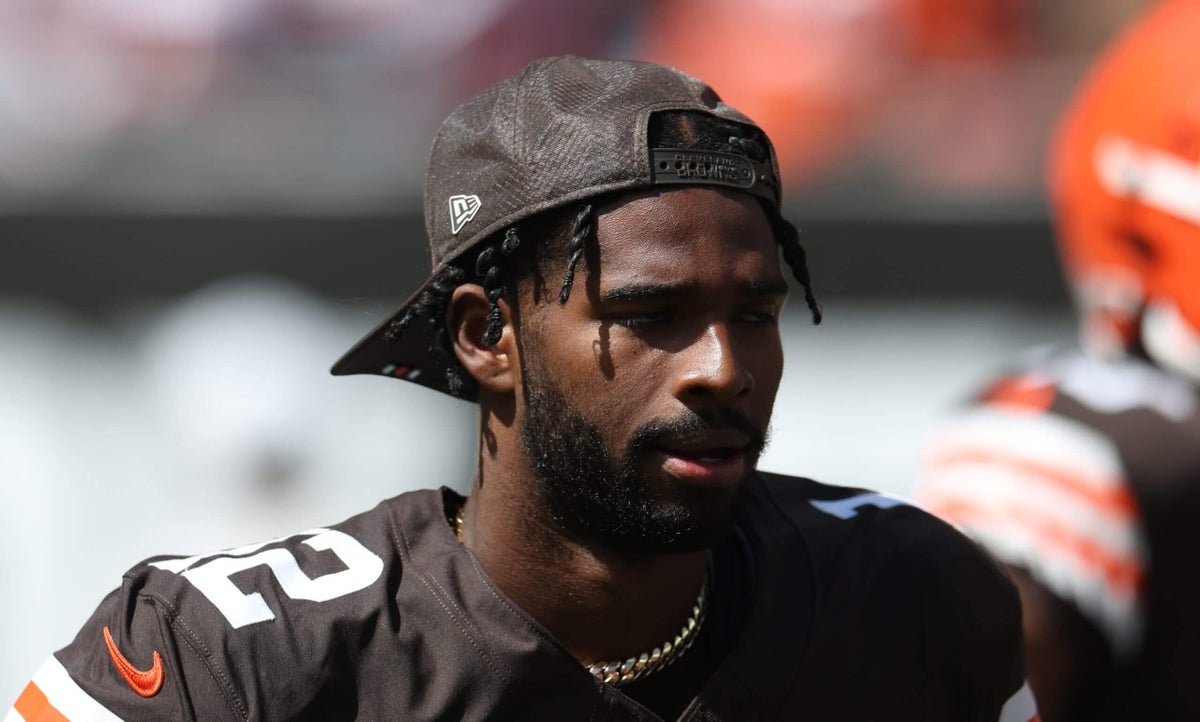
BALTIMORE — Shedeur Sanders is focused on the present. That’s what the Cleveland Browns’ No. 3 quarterback said in response to a question Sunday about an ESPN report that the Baltimore Ravens passed on drafting him in April after the team learned Sanders didn’t want to be stuck behind two-time MVP Lamar Jackson.
Baltimore planned on drafting Sanders — the son of Hall of Famer Deion Sanders, a former Raven — with the No. 141 pick, league sources confirmed Sunday. However, according to ESPN’s report, Baltimore was informed that Shedeur Sanders did not want to land there behind Jackson, the team’s franchise quarterback, and preferred to go to a franchise where he might play sooner. Instead, the Ravens drafted offensive tackle Carson Vinson at No. 141, and the Browns went on to pick Sanders at No. 144.
“My response is I’m focused on the now,” Sanders said when asked about the report following Cleveland’s 41-17 loss in Baltimore on Sunday. “I don’t really talk about anything in the past, and whatever happened in the past, it is what it is. I’m more focused on now, and I’m focused on this game we just had and figuring out how to move forward from that.”
When asked further if the sequence of events unfolded as reported, Sanders replied, “I don’t know.”
“You wouldn’t believe my memory don’t even go back that far,” he said. “I don’t remember anything (pre) draft. I remember I’m here, I go to practice every day, and there’s a 24-hour rule.”
The Ravens made an odd trade when they were on the clock with the No. 136 pick in the fourth round in April. They traded that pick, plus a sixth rounder (No. 183), to the Titans for Tennessee’s fifth-round pick (No. 141) and a sixth rounder (No. 178). It seemed odd at the time to move back five spots from the fourth to the fifth round in exchange for moving up five spots in the sixth.
Afterward, Ravens general manager Eric DeCosta called it an “analytics” thing and gave a long-winded explanation.
The actual reason?
The Ravens were buying time for themselves because they were trying to reach Sanders and see if he would be OK with them taking him. They weren’t going to take Sanders if he didn’t want to be there, and it would become a distraction.
Baltimore, which hadn’t prioritized using many assets to fill the backup quarterback role, signed veteran backup Cooper Rush in mid-March to a two-year, $6.2 million deal. However, they are always looking to add a young developmental quarterback into their program, and they had solid draft grades on Sanders.
They figured that at the very least, Sanders would be an inexpensive and talented insurance policy for Jackson. And if Sanders played extremely well in the preseason, they’d have a potential trade chip for a quarterback-needy team.
Cleveland went on to draft Sanders in the fifth round after selecting quarterback Dillon Gabriel in the third round at No. 94. They were not taking Sanders on the Friday of the draft, and had long targeted Gabriel if the board broke a certain way. But Saturday became their double-up day.
The Browns drafted a second running back, Dylan Sampson, at No. 126, and then about an hour later, they completed a trade with Seattle to move up 22 spots in the fifth round and take Sanders at 144.
In that trade, they ended up one spot ahead of the Philadelphia Eagles, who took cornerback Mac McWilliams. In the sixth round, the Eagles took quarterback Kyle McCord at pick 181.
Sanders started the preseason opener for Cleveland and performed well, but he missed the second preseason game due to injury and struggled in the third.
He’s third on the team’s depth chart and is serving as the emergency quarterback on game days. The Browns want Sanders to continue to develop, but it’s clear that the team does not want him to be forced into game action. Gabriel is the top backup behind 40-year-old starter Joe Flacco.
(Photo: Scott Galvin / Imagn Images)