
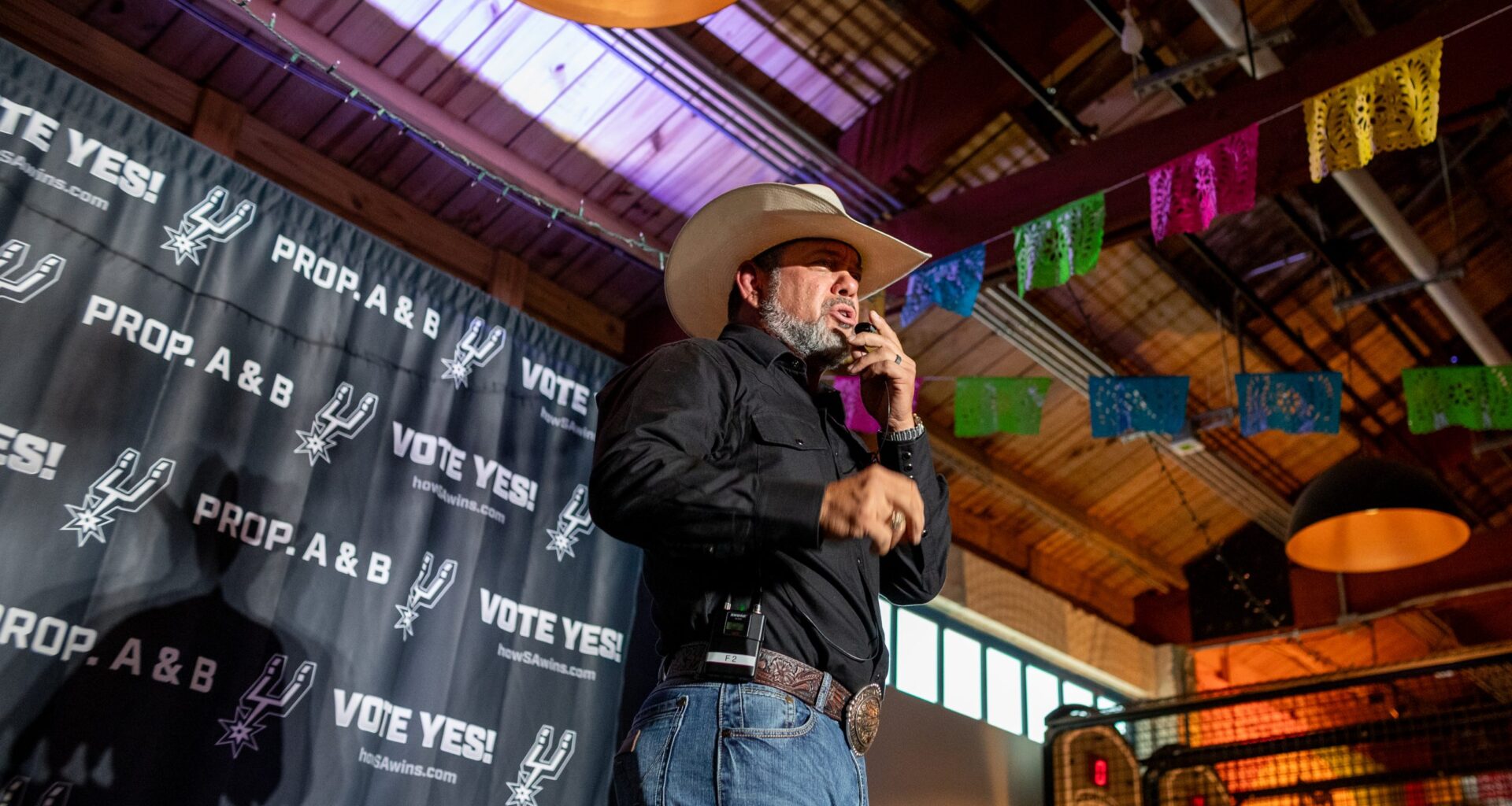
The San Antonio Stock Show and Rodeo is making its case for $191.8 million of venue tax dollars from Bexar County.
Voters will decide whether or not to approve Proposition A in November, which would raise the county’s hotel occupancy tax to pay for $191.8 million in renovations around the Freeman Coliseum and the Frost Bank Center on the East Side.
Rodeo CEO Cody Davenport shared what voters would get for their investment at a town hall event Tuesday evening next to the Freeman Coliseum.
“We want to take this massive industry that we have spent years earning respect in, earning our reputation in, and we want to work year-round,” Davenport said. “We want to give these grounds down here an identity. We want to take what we’re good at and expand.”
Davenport highlighted the rodeo’s current economic impact — $330 million each February and $37 million throughout the rest of the year — as well as the youth activities and volunteer opportunities the rodeo has added since the pandemic.
Bexar County residents would consider Prop A alongside Prop B, which would grant $311 million in venue tax dollars to the San Antonio Spurs to build a new arena downtown. The propositions ask voters to approve raising the county’s hotel tax from 1.75% to 2% and extending its rental car taxes.
What do you get for $191.8 million?
Using the county funds, the stock show and rodeo grounds would add two new “flex” buildings that could be used for stables and other expo events. The current expo halls would be modified, one would be outfitted as a production arena with a bar area.
There would also be an additional entrance and bridges added in the parking area to improve traffic flow. Building exteriors would be renovated and greenspace would be added to improve attendees’ experience.
Those improvements would be entirely covered by the $191.8 million from Bexar County and allow the San Antonio Stock Show and Rodeo to compete with other rodeos on a national stage by holding events year round, Davenport said.
“If we’re going to go across the nation and we’re going to try to bring in events here, we can’t do it in the facilities we have right now,” he said. “There’s no way. We have to have competitive facilities.”
Davenport said higher quality facilities would allow him to bring in events from bigger venues, like Fort Worth and Las Vegas, as well as other cities in Texas, like Abilene and Lubbock.
Who would be new at the rodeo?
The San Antonio Stock Show and Rodeo’s new events could include youth rodeos for middle and high school-age kids plus events, like 4-H and Future Farmers of America (FFA). Davenport also noted the opportunities to connect with an audience in Mexico.
“We’ve talked to the charreadas about how we could put a giant charreada on here,” Davenport said. “I go to the border crossings down in Eagle Pass all the time and work with them down there. We [could] bring teams up out of Mexico and hold an international competition.”
Charrería, or jaripeo, is an equestrian sport similar to rodeo competitions and is considered Mexico’s national sport.
Davenport added that professional bull riding, barrel racing and other individual rodeo events could come to the area throughout the year.
“Our industry is plenty big for it. We have a very distinct ability here. San Antonio is still a tourist city, people want to come here. We have the weather in the winter and then proximity to Mexico,” he said. “Fort Worth has a good advantage. They’re up north. They can pull across the nation. They’ve got Oklahoma, they’ve got their thing going. But being in South Texas, we also could have our thing going.”
Rodeo officials estimated that the economic impact from renovating the buildings and grounds and adding more events could mean an additional $384 million annually — up to an estimated $750 million.
Does this connect to Project Marvel?
Davenport said Prop B, which would set aside $311 million for the Spurs new arena, does not need to pass for the rodeo to get its money.
“They do not both have to pass,” Davenport said Tuesday. “I will say this, [Prop] B is going to make our life much easier. If the Spurs go downtown and we all work together as an entire community, it’s going to work better. It’s going to be more efficient.”
Davenport anticipated the Spurs leaving San Antonio if Prop B doesn’t pass.
It would also make it more difficult for the rodeo to make its desired updates, he said.
If the Spurs stay at the Frost Bank Center, Davenport said, the San Antonio Stock Show and Rodeo might not have permission to do renovations unilaterally.
“If this Prop B does not go through, it will kill all plans going forward,” Davenport said. “I can’t do anything here on these grounds for buildings and things like that without their cooperation and their approval, just based upon the contract.”
That’s why the stock show and rodeo has joined the Spurs’ campaign for Prop B, Davenport said. He praised the Spurs as partners, but said they have outgrown a shared footprint around the Frost Bank Center.
Opposition to the Spurs new arena has been focused on Prop B, arguing against using public funds for the Spurs arena. If Prop B passes, it would also ensure the City of San Antonio’s $489 million contribution would kick in, beginning construction on a $1.3 billion arena and further mixed use development downtown.
Opponents of Project Marvel have been more neutral toward the rodeo and Prop A.