
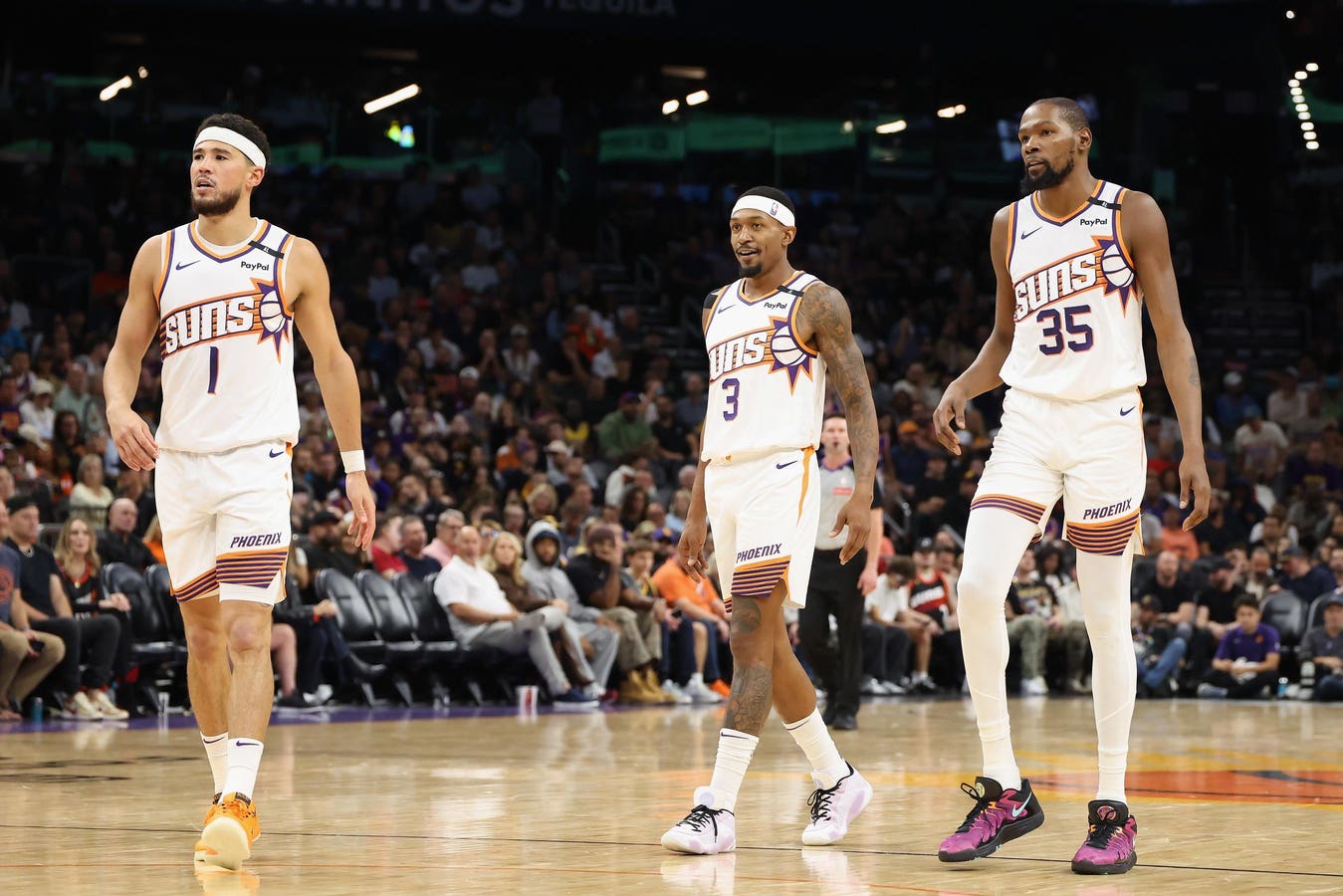
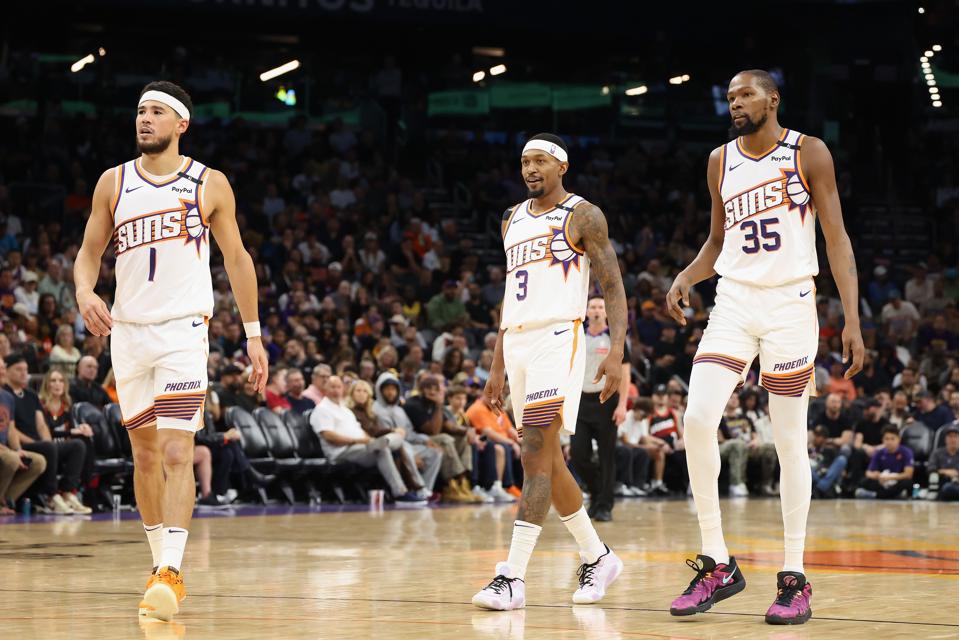
PHOENIX, ARIZONA – OCTOBER 28: (L-R) Devin Booker #1, Bradley Beal #3 and Kevin Durant #35 of the Phoenix Suns walk on the court during the first half of the NBA game against the Los Angeles Lakers at Footprint Center on October 28, 2024 in Phoenix, Arizona. The Suns defeated the Lakers 109-105. NOTE TO USER: User expressly acknowledges and agrees that, by downloading and/or using this photograph, user is consenting to the terms and conditions of the Getty Images License Agreement. (Photo by Christian Petersen/Getty Images)
Getty Images
The Phoenix Suns are giving new meaning to being “all-in.”
On Wednesday, the Suns traded Josh Okogie and their three remaining second-round picks to the Charlotte Hornets for Nick Richards and a 2025 second-round pick from the Denver Nuggets. That Nuggets second-rounder is now the only second-round pick they have between now and 2031.
The Suns also don’t have control over a single first-round pick until 2031. They owe fully unprotected first-rounders in 2025, 2027 and 2029 to either the Houston Rockets or Brooklyn Nets, and they gave up first-round swap rights to their 2026, 2028 and 2030 first-rounders in their trades for Kevin Durant and Bradley Beal.
The Suns signed Okogie to a two-year, $16 million above-market balloon deal this past offseason for this exact reason. Since they’re well above the $188.9 million second apron, they can’t take back more salary via a standard trade exception than they send out, nor can they combine two or more salaries to acquire someone on a bigger contract. Okogie was effectively an $8.25 million trade exception for them.
Now that they’ve traded him, they’re even more stuck than they already were. If Richards doesn’t help them right the ship this season, they’ll soon be facing some existential questions about the core of their roster.
The Beal and Nurkić Dilemmas
Bradley Beal and Jusuf Nurkić are the Suns’ two biggest issues at the moment. Head coach Mike Budenholzer recently moved both to the bench because he felt like the team “needed to make a change” after a dismal 1-7 stretch. Nurkić has since fallen out of the rotation entirely.
Nurkić is averaging only 8.6 points per game on 45.4% shooting, both of which are his worst marks in nearly a decade. He’s earning $18.1 million this season and is under contract for $19.4 million next year. It’s tough to imagine any team forking over anything of real value for him in a trade.
The Suns might be even more stuck with Beal, who’s earning $50.2 million this year, $53.7 million next season and has a $57.1 million player option in 2026-27. He also has a no-trade clause in his contract that allows him to scuttle any potential deals. His agent recently told ESPN’s Brian Windhorst that they’ve had “no talks” about waiving it.
Disgruntled Miami Heat forward Jimmy Butler and the Suns appear to have mutual interest in one another, but the Suns are a long shot to actually land him. The Heat reportedly have zero interest in taking back Beal, which means Phoenix would need to find a third team willing to acquire him—and one that he’s willing to go to. Given their lack of tradable draft picks, it’s fair to wonder how the Suns would be able to pull that off.
Nurkić might have slightly more trade value as an expiring contract next season, provided the Suns were willing take on long-term salary in return. But given Beal’s age, injury history and the size of his contract, the Suns might be stuck with him for the next few years.
So… What Now?
At 19-20, the Suns are tied with the San Antonio Spurs for the 11th-best record in the Western Conference. They’re a half-game behind the Golden State Warriors for the final spot in the West’s play-in tournament. That presumably isn’t what team governor Mat Ishbia had in mind when he assembled the league’s most expensive roster.
Richards might help the Suns regain their footing, but it’s tough to imagine them going on a deep playoff run this season. If they do fail to win a playoff series for the second straight year—or, worse yet, miss the playoffs entirely—that could raise some larger questions about the long-term direction of the franchise.
Durant, who becomes eligible for a two-year, $123.8 million extension this offseason, is turning 37 in October. Ishbia told ESPN’s Shams Charania in November that he expected Durant to sign an extension this summer, but it’s fair to wonder if the Suns’ trajectory will cause him to develop a wandering eye. As Michael Pina of The Ringer recently wrote, the Suns might be better off preempting a potential Durant trade request by proactively moving him.
If the Suns do eventually go that route, they might have to reconsider Devin Booker’s long-term future in Phoenix as well. Unless they get an unexpectedly massive haul of draft picks and/or prospects for Durant, they’ll still be largely devoid of assets with which to improve their roster. They’d be poised to have cap space again once Nurkić and Beal’s contracts expire, but stars rarely reach free agency these days.
The more that the Suns try to salvage what’s left of the Booker-Durant-Beal era, the larger of a hole they’ll eventually have to dig their way out of. The 2026 second-round pick from the Nuggets that they gave up for Richards figures to be in the 50s, but there’s no telling where the 2031 picks (their own and Denver’s) will wind up. Those could have been valuable assets to help them either retool around Booker or rebuild in the post-Big Three era, but they’re now more bereft of picks than any other team in the league.
If the Suns can’t flip Beal or Nurkić for better-fitting pieces next to Booker and Durant, they’re going to face an existential roster crisis sooner than later. The trade for Richards on Wednesday only further cemented that.
Unless otherwise noted, all stats via NBA.com, PBPStats, Cleaning the Glass or Basketball Reference. All salary information via Spotrac and salary-cap information via RealGM. All odds via FanDuel Sportsbook.