
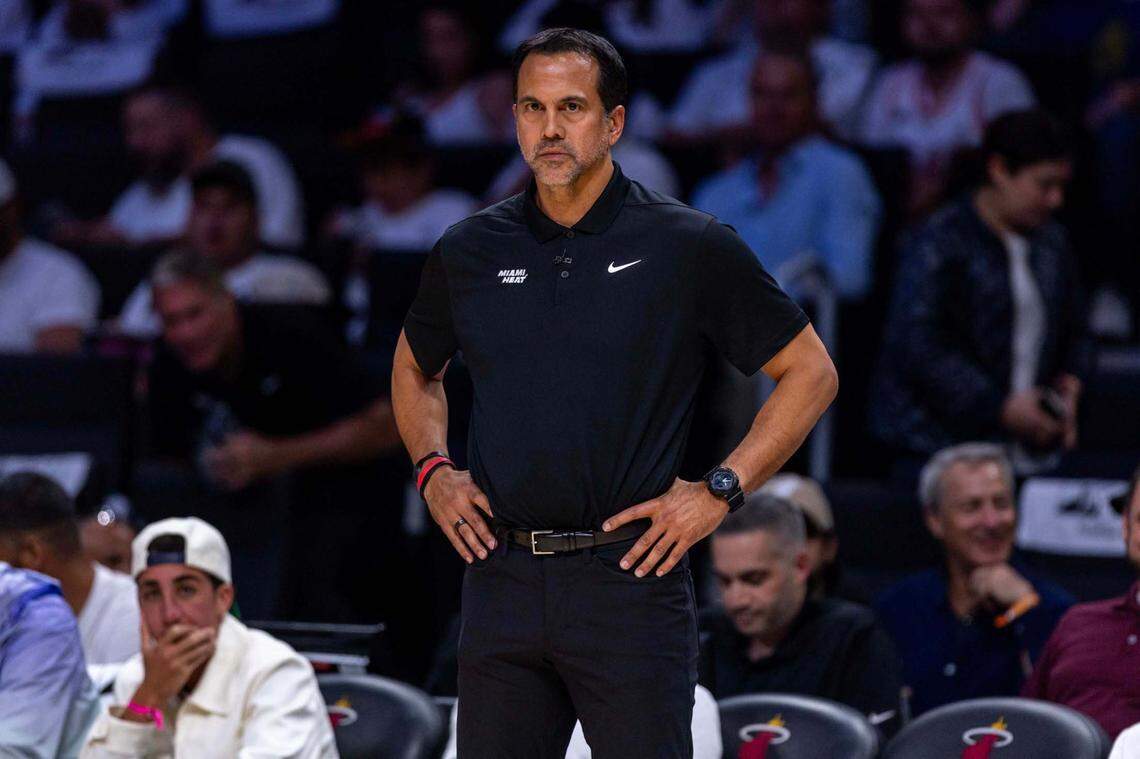
For the first time since 2018, the Miami Heat will begin a season without Jimmy Butler on its roster. For the first time since 2019, the Heat is coming off a losing regular season.
All of that plus an injury to Tyler Herro and four new faces on the Heat’s standard roster has coach Erik Spoelstra and his staff with plenty to figure out.
Advertisement
The Heat will begin to provide some answers to those questions in the coming days, as the team is set to hold its annual Media Day on Monday at Kaseya Center before opening training camp on Tuesday at Florida Atlantic University in Boca Raton.
Here are five of the biggest questions surrounding the Heat entering media day and training camp:
How will the Heat’s offense survive without Herro?
Herro, who is expected to miss at least the first month of the regular season after undergoing surgery on his left ankle on Sept. 19, is arguably the Heat’s most important offensive player. He led the team in scoring (23.9 points per game) and usage rate (27.1 percent) last regular season. The Heat scored 8.6 fewer points per possession when Herro wasn’t on the court last season. That drop-off contributed to the Heat’s subpar offense, as it ranked 21st in the NBA in offensive rating last regular season to finish with a bottom-10 offensive rating for the third straight regular season. While Herro is out, the Heat will need to rely on newcomer Norman Powell to help fill the void. Powell, who the Heat acquired in July through a three-team trade, is expected to slide into Herro’s spot in the starting lineup. Powell was among six NBA players who averaged at least 21 points per game while shooting better than 48% from the field and better than 40% from three-point range last regular season. Other guards on the Heat’s standard roster for this upcoming season are Kasparas Jakucionis, Pelle Larsson, Davion Mitchell, Terry Rozier and Dru Smith. Miami will lean on that guard depth while Herro is sidelined.
Advertisement
Who will start in the Heat’s frontcourt alongside Bam Adebayo?
The two obvious candidates are center Kel’el Ware and forward Nikola Jovic. After beginning the season out of the Heat’s rotation, the 21-year-old Ware started 33 games alongside Adebayo last regular season and the Heat posted a 14-19 record in those games with that double-big frontcourt. Ware also started alongside Adebayo in each of the four games during the Heat’s first-round playoff sweep at the hands of the Cleveland Cavaliers last season. The Heat outscored opponents by 4.6 points per 100 possessions in the 541 minutes that Adebayo and Ware played together last regular season, as the defense produced impressive results with this duo on the court. Meanwhile, the Heat went 3-7 in the 10 games that Adebayo and Jovic started together last regular season. The Heat opened last season with the Adebayo-Jovic frontcourt, using this tandem to begin the first eight games before Spoelstra pulled Jovic from the starting group. The Heat was outscored by 2.9 points per 100 possessions in the 688 minutes that Adebayo and Jovic played together last regular season. The results were better with the Adebayo-Ware pairing, but will Spoelstra go back to the Adebayo-Jovic look to begin this season after Jovic’s impressive summer? That decision will be made in the coming weeks.
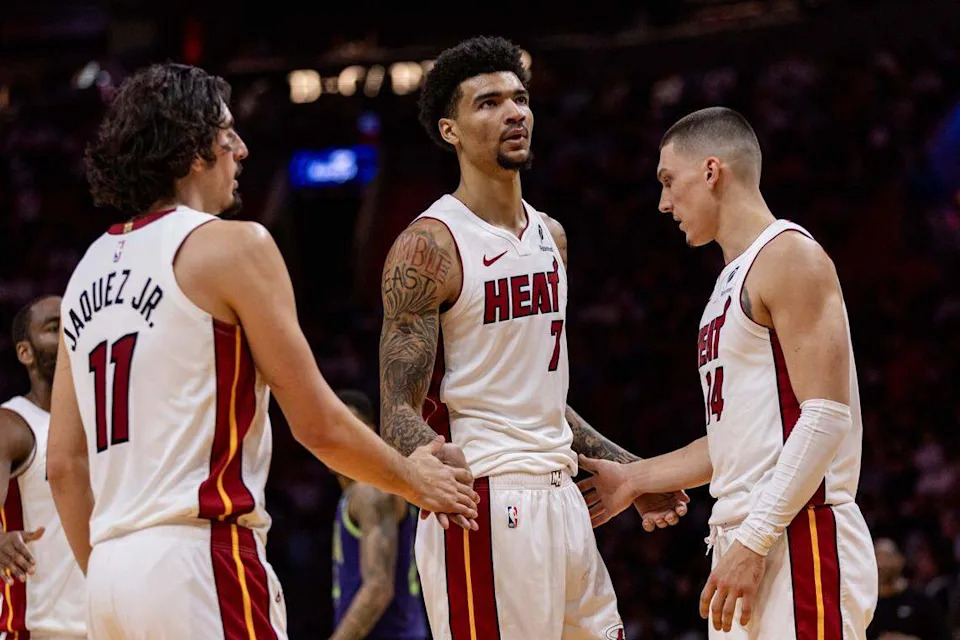
Miami Heat center Kel’el Ware (7) interacts with teammates Jaime Jaquez Jr. (11) and Tyler Herro (14) during the second half of an NBA game against the New Orleans Pelicans at Kaseya Center on January 1, 2025, in Miami.
What will the Heat do with Rozier?
Despite speculation that the Heat could part ways with Rozier this offseason after a brutal year for the 31-year-old guard last season, Rozier is set to begin training camp on Miami’s roster. Rozier is due $26.6 million this season in the final year of his current contract. The Heat has been and is still open to trading Rozier, but it has been hesitant to sacrifice future draft capital or salary cap flexibility just to dump his expiring contract. It doesn’t help that Rozier remains linked to an ongoing federal gambling investigation. The Heat could also just simply waive Rozier to create an additional $1.7 million of room below the luxury tax line because only $24.9 million of Rozier’s $26.6 million salary for this upcoming season is currently guaranteed, as his full salary doesn’t become guaranteed until Jan. 10. For now, though, Rozier remains with the Heat. And with Herro expected to miss at least the first month of the regular season, Rozier will have an opportunity to earn some early-season playing time. But Rozier has plenty to prove, as he’s coming off arguably the worst season of his NBA career. Rozier began last season as a Heat starter and was expected to be one of the team’s top offensive players, but he instead completely fell out of the Heat’s rotation toward the end of the season.
Advertisement
Will the Heat sign Herro and/or Jovic to an extension?
This will be a big question all the way up until the start of the regular season, as the Heat has until Oct. 20 (the day before the start of the regular season) to sign Herro and/or Jovic to an extension. Starting Wednesday, Herro is eligible to tack on a three-year, $149.7 million extension to the two seasons ($31 million for the 2025-26 season and $33 million for the 2026-27 season) he already has left on his contract. If an agreement is not reached on an extension by Oct. 20, Herro would be eligible to sign a four-year, $206.9 million extension during the 2026 offseason. Herro, 25, is supermax eligible (five years, $380 million) if he is selected for an All-NBA team during the 2025-26 season. As for Jovic, the Heat has been eligible to sign Jovic to an extension this offseason since July 1. Like Herro, that window to sign Jovic to an extension closes on Oct. 20. Jovic, 22, is eligible to sign a rookie-scale extension up to the max, but any potential extension for Jovic would be far less than the max. If the Heat doesn’t sign Jovic to an extension before the start of the season, he’ll be eligible to become a restricted free agent next offseason. Jovic is due $4.4 million this upcoming season in the fourth and final year of his rookie deal. The 32-year-old Powell, who is on an expiring $20.5 million salary for this upcoming season and is set to become an unrestricted free agent next offseason, is also currently eligible to sign an extension worth up to $80.6 million over three seasons with the Heat. But Powell’s extension window doesn’t close until June 30, 2026.
Who will get the Heat’s final two-way contract?
The Heat enters media day and training camp with two of its three two-way contract slots filled. The Heat’s two current two-way contract players are forward Myron Gardner and center Vlad Goldin. Two-way contracts, which pay half the NBA rookie minimum and do not count toward the salary cap or luxury tax, allow for players to be on their NBA team’s active list for as many as 50 regular-season games with other game action having to come in the G League. The two-way contract candidates on Miami’s preseason roster are forward Dain Dainja, guard Trevor Keels, guard Ethan Thompson and guard Jahmir Young, who are all signed to Exhibit 10 training camp invite deals. The Heat could also turn to an outside option to fill its third and final two-way contract spot. Only players with fewer than four years of NBA experience are eligible for two-way deals.