
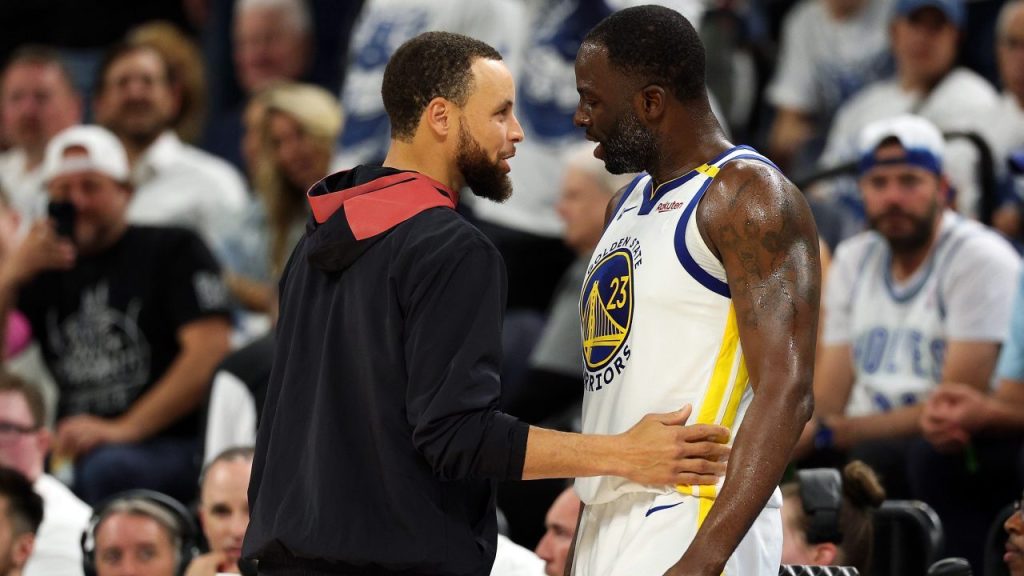
From a ratings perspective, duration is everything, as the deeper a best-of-seven series run extends, the bigger the audience gets. For the Golden State Warriors, however, the importance of maxing out their second round goes well beyond boosting the NBA’s postseason deliveries; at the very least, securing a seventh game may be the only way anyone gets to see Steph Curry play basketball again this season.
After straining his left hamstring in last week’s opener against the Minnesota Timberwolves, Curry is expected to sit through at least Game 5 on Wednesday night. If the Warriors can hold down the fort for another two outings, Curry will have had 12 full days in which to recover from his injury. In which case … well, who knows. We’re deeply in the realm of the speculative here, and there’s no telling how effective a rehabbed Curry might be, as this particular injury is terra incognita for the 37-year-old superstar.
More to the point, there’s no telling if Golden State can manage to hang around for a sixth game in Curry’s absence. While Jimmy Butler did his part to keep the season in play, scoring 33 points Saturday night, with seven rebounds and an equal number of assists, the Warriors couldn’t close out Anthony Edwards & Co., falling behind in the series 2-1 with a 102-97 loss. Pushing Curry to suit up before he’s ready could have disastrous consequences, and Steve Kerr isn’t one to play with fire. But without the four-time champ in the lineup, it’s unlikely that his team gets past Minnesota.
While Curry’s injury has yet to put a damper on the series’ TV ratings—Thursday night’s 117-93 loss averaged 4.96 million viewers on TNT/truTV, down just 3% from Tuesday’s opener—an early exit by Golden State would likely stall the NBA’s forward momentum. Through Game 2 of the series, the league’s media partners are averaging 3.86 million viewers per game, good for a 6% boost compared to the year-ago 3.65 million. Given a concomitant 7% decline in overall TV usage this season, any year-to-year gain is encouraging, but a vanishing act by the NBA’s last remaining big draw would likely drive the Nielsen numbers down in a hurry.
In dispatching the Lakers in five games, the Timberwolves already scared off the league’s top TV draw, and a similarly tidy resolution of the Warriors series would erase another big portion of the audience. (Yes, these are casual fans we’re talking about here rather than diehards, but advertisers don’t necessarily care about such distinctions. People who only tune in for the playoffs buy as much deodorant and Pepsi as somebody who mainlines 82 regular-season games every year.)
If the Warriors are handed their walking papers, the networks’ best shot at a ratings juggernaut lies Back East. Thus far, the Knicks-Celtics series has beggared belief, with New York rallying from two 20-point deficits to take a 2-0 lead before Boston stormed back Saturday afternoon with a convincing 115-93 road win. The rekindled rivalry is doing numbers, averaging 4.74 million viewers through the first two games, as the home markets have helped boost the cable deliveries. Together, the combined reach of the New York DMA (7.49 million TV households) and No. 9 Boston (2.58 million) translates into a local rooting interest for 8% of all U.S. TV homes. And TV viewing is particularly robust in the Eastern time zone, which is where you’ll find 48% of the TVs that are in use.
For all the agita about Curry and his hammy, the strength of the NBA’s deliveries is testament to one of the more unpredictable postseason periods in recent memory. Since the second round tipped off last week, the road time has won nine of the first 12 meetings, and the advantage in each of the four series is two games to one. It would not be inconceivable if each of the remaining sets extends through at least six frames; again, the longer a series lasts, the happier the advertisers are.
While the NBA may still wind up with a must-see title tilt on its hands, an already challenging NHL bracket is getting hairier with each passing day. With three Canadian teams vying for a trip to the Stanley Cup Final, stateside ratings are faring about as well as can be expected, as the second-round deliveries are down 33% with an average draw of 1.14 million viewers per telecast.
With eight clubs still in the mix, only one series features a pair of American combatants; not surprisingly, the Capitals-Hurricanes pairing is putting up the biggest numbers. Washington’s 3-1 win on Thursday night averaged 1.43 million viewers on ESPN, and while that marks the biggest turnout for the round so far, the audience was still 20% shy of the analogous Capitals-Hurricanes telecast of a year ago.