
By Sean Gentille, Shayna Goldman and Dom Luszczyszyn
It’s difficult to find a team in a more demoralizing place right now than the Los Angeles Kings.
Four straight first-round playoff exits at the hands of the same team is nightmare fuel. And it doesn’t feel like there’s an end in sight, considering how much daylight there is between Los Angeles and the top two teams in the Pacific Division. The (spoiler alert) nine-point gap between second and third is the largest of any division. It’s just not close.
With how little the Kings have to show from an accelerated rebuild, the state of the aging veterans they accelerated the rebuild for, and the current direction after a disastrous summer … demoralizing might even be underselling it.

The projection
It’s not all bad. The Kings sit just outside the top 10 and are a likely playoff team with a 95-point forecast. It’s just not good enough after four straight seasons of disappointment.
While it is true that we’ve consistently underestimated the Kings during the regular season in each of those four seasons (average forecast of 90.9 points, actual retail price of 101.8), we’ve gotten it right each time when it counts: in the playoffs.
That’s the balancing act that needs to be struck here between a Kings team that probably deserves more regular-season love, but is arguably getting the exact right amount of postseason respect. It’s a representation of how far they are from being a true contender worthy of a 100-point forecast.
Los Angeles’ depth approach may be enough to squeeze out a few extra wins during the season, but the playoffs are a whole other ballgame. Unless something changes drastically at the top of the lineup, expect more of the same in 2025-26.
The big question
Can Quinton Byfield and Brandt Clarke take the torch from Anze Kopitar and Drew Doughty?
At some point in the not-too-distant future, the Kings will ice a roster that doesn’t include Anze Kopitar or Drew Doughty. That sounds weird and wrong, but it’s also inevitable — Kopitar has already announced that this season, his 20th, will be his last, and Doughty, effective as he remains, turns 36 in December.
In the Kings’ perfect world, two cornerstones will give way to two more. Byfield and Clarke are both trending upward, but there’s work to be done before anyone should pencil them in as replacements for a pair of Hall of Famers.
Byfield is the better bet to emerge as an elite player, thanks to some accelerated growth that began in 2023-24. Playing nearly all his minutes at left wing on a line with Kopitar and Adrian Kempe, he increased his offensive impact overall, helping the Kings generate plenty of shots and chances and showing signs of a more fully rounded game.
His task last season — to build on that breakout while moving back to center — was tall, and he succeeded on a few fronts. He started slow, with three goals and eight assists in his first 29 games. The Kings were winning his minutes, though, and he was on an unlucky streak — in that span, he was third on the team with 8.24 expected goals.
From mid-December to March 3, the shots began to fall, and he began to dial up his production; in those 30 midseason games, he led Los Angeles in points (31), expected goals percentage (58.5) and goals percentage (67.6).
On March 5, though, he started a six-game goal streak — and a run of high-end production that lasted through the end of the regular season. In that span, he scored as many goals as Alex Ovechkin (14) and more than anyone in the NHL outside of John Tavares, Tage Thompson and Sidney Crosby. His underlying numbers at five-on-five held steady, too.
That finishing kick resonated. “He drives every line he’s on,” a scout said. “His work ethic is at the highest level. His size and his strength and his length. If you watch him, he’ll out-work everybody.” One coach floated the idea that Byfield is more ready to level up than Connor Bedard.
The next step for Byfield is turning all that effort, skill and substance into consistent, high-level production. In 2024-25, he managed 2.0 five-on-five points per 60. That’s good enough to land him with players such as J.T. Miller and Bo Horvat — extremely useful players who, all things considered, should not be the best forwards on true contenders. The shortcut for Byfield, though, is that he’s shown signs of having more defensive impact than the Millers and Horvats of the world, which makes it less necessary to produce points by the truckload. Kopitar knows something about that.
Clarke, like Byfield, spent a couple of pro seasons figuring things out. In 2024-25, he popped a bit, putting up 33 points in 78 games and flashing plenty of skill. The way the Kings used him — 16:17 per game in sheltered minutes – carries a bit of an asterisk, but that seems set to change this season. Jordan Spence, a similarly situated player, was traded to Ottawa, and another non-Doughty option on the right side is Cody Ceci.
The model loves Clarke’s offensive outlook for 2025-26. That’s understandable; the Kings’ performance improved with him on the ice across the board, most notably in the 0.6 more goals per 60 they scored. His contributions to shots and scoring chances have shown signs of being high-end, and his work in transition may already be. The idea of him moving up to second-pair minutes, with Doughty still around to do first-pair dirty work, makes plenty of sense as both a means of maximizing the current roster and laying the groundwork for whatever comes next.
The wild card
Can Darcy Kuemper do it again?
Pierre-Luc Dubois’ glow-up in Washington seemed to get more attention, but Kuemper — the other half of the Kings’ and Caps’ distressed-asset swap ahead of the 2024-25 season — deserves credit for his own impressive bounce-back.
Kuemper finished last season with a .922 save percentage and nearly 27 goals saved above expected in 50 appearances for the Kings. That earned him a spot as a Vezina Trophy finalist for the first time in his career. It wasn’t totally unexpected; Kuemper, outside of a messy 2023-24 season in Washington, has long been an effective goaltender when healthy. He gave the Avs exactly what they needed during their Stanley Cup run in 2022 and could be relied upon to put up above-average numbers in a 1A workload. Still, the Capitals offloaded his salary for a reason — $5.25 million is a lot to pay an aging goalie coming off an .890 save percentage.
For Kuemper and the Kings, the hope has to be that he’ll once again avoid nagging injuries, that their new-look defensive core holds up ahead of him and that Anton Forsberg is, once again, a competent backup. Forsberg played 30 games for the Senators last season and put up a perfectly cromulent .901 save percentage alongside a break-even GSAx.

The strengths
The Kings boast a deep forward group, with three lines that can push the pace of play on both ends of the ice.
Adrian Kempe leads the way as the Kings’ best offensive threat. He shoots the puck a ton, gets to the quality areas of the ice and tends to have a direct impact on his team’s offense with primary scoring. And most importantly for a team that has had some issues finishing its chances, he converts at a high rate on his shots. With 35 goals last year, he was L.A.’s leading goal-scorer for the third time in the last four seasons.
Kempe’s shoot-first mentality pairs perfectly with Kopitar’s passing. And Kopitar’s elite defense has boosted his winger’s all-around game. They combined for almost 961 five-on-five minutes last season, and in that time, the Kings scored at a clip of 3.40 GF/60, while only giving up 1.79 per 60.
With Kopitar and Kempe driving that line together, the Kings don’t need another heavyweight to complete the combination. Instead, last year’s trade deadline acquisition, Andrei Kuzmenko, was an ideal fit.
Kuzmenko isn’t a puck-mover or a play-driver. At his core, he’s a goal scorer who needs help playing to his strengths, which is why he hasn’t been able to replicate his 39-goal, 73-point 2022-23 season. The Kings are one of the few teams that have the two-way chops to maximize what he brings to a lineup, since he is the only top-nine forward with a negative Defensive Rating. With that line on the ice last year, L.A. earned a 53 percent xG rate and outscored opponents 16-5.
With Kempe leading the winger depth, it puts Kevin Fiala in a more fitting role as the No. 3 best forward in Los Angeles.
Two things are true with Fiala, as our insider panel explained in this year’s Player Tiers.
“Fiala is just unbelievable, he can change a game in one shift,” one executive said.
But where he slots is important. “He just can’t play on a top line,” one analyst explained. “So he’s the guy that always produces in the two spot.”
Last season, he had an awfully slow start. He ended the season with 35 goals, scored at one of the highest paces of his career; his primary assists just paled in comparison to seasons past. It wasn’t for a lack of trying, especially at five-on-five. Fiala was a dual threat who added a spark with his playmaking and shot-making. Plus, he was one of the best at generating chances in transition.
Behind Fiala and Byfield on the second line, Phillip Danault leads a disruptive third line.
Danault is a reliable shutdown center who can also play the matchup game — giving L.A. three options to go head-to-head with the opponent’s best. The Kings allowed 0.42 xGA/60 fewer in Danault’s minutes relative to his teammates, and his wingers likely played a role in that.
With Trevor Moore and Warren Foegele, the third line has a plus-5.7 Defensive Rating. Add in Foegele and Moore’s offense, and it helped the Kings earn a 56 percent expected goal rate in their minutes. Even more impressive was that L.A. only gave up eight goals in their 365 minutes together (and scored 22 in that time).
Speaking of shutdown talents, Mikey Anderson is a force in his own zone. He is super stingy at five-on-five, with the Kings only giving up 1.97 xGA/60 in his minutes, and an even lower rate of goals against (1.45). Anderson’s zone entry defense is sound, with few rush chances getting past him. And he can help the Kings exit their own zone efficiently with his puck retrievals. Anderson’s plus-8.0 Defensive Rating is the best in the league, and his growth has helped Doughty shoulder the burden of top-pair minutes in recent years.
The weaknesses
Two philosophies are thrown around in hockey.
“Center depth wins championships,” and “defense wins championships.”
If those were the only keys to success, this Kings team would probably have won a Stanley Cup with this forward group.
But recent champs, from the Lightning and Avs, to the Golden Knights and Panthers, show teams need at least one more necessary component: a dynamic offense from a deep forward group, led by stars.
The Kings have depth. Nine of 12 forwards have an above-average rating relative to their respective roles. No other team comes close to that and that surplus value can help compensate for gaps lower in the lineup. But one area in particular holds the Kings back: the top of the lineup.
Kempe is an ideal No. 2 forward, with a plus-10.2 Net Rating. But the average team is closer to a plus-12.6; a contender generally rates even higher. Not every team can have a Connor McDavid with a plus-29.1 Net Rating, or even a Kirill Kaprizov (plus-20.8). But the Kings should at least want someone in that Jack Eichel (15.6) range.
Kempe likely has already peaked at 29 years old, so he isn’t going to grow into the role. Someone such as Byfield could, if he continues to progress. If he can fully embrace his star power, he could be the offensive weapon this team craves. If not, management needs to find a star to take this playoff-caliber team to true contender status that can compete with the best in the West.
Having a stronger offensive presence on the blue line would also help elevate the team. Only Clarke (plus-5.9) and Doughty (plus-0.4) carry a positive Offensive Rating, which isn’t enough to cancel out the rest of the top six. The Kings’ six defenders add up to a projected minus-9.8, which is 29th in the league.
And unlike last year, this defense may not be stout enough to make up for it — not after management signed Brian Dumoulin and Cody Ceci this summer.
The Kings needed to replace Vladislav Gavrikov, whose shutdown presence added another layer of support in the top four. Or, at least, find a lefty partner who could help negate some of Clarke’s weaknesses in his own zone. That was never going to be easy in free agency.
That doesn’t mean that Ceci and Dumoulin were the answer, though. These signings are redundant for a Kings team that already has a one-dimensional defender in Joel Edmundson on the roster. His rush defense was a weakness in L.A. last year, and contributed to a team-high 0.40 relative xGA/60.
Ceci’s best asset is that he can absorb tough minutes to help maximize other defensemen. But what happens in those minutes can be a problem, especially when he gets matched up against top competition. Dumoulin, at this point, isn’t meant to play that kind of role anymore. If he is sheltered, he can be fine enough defensively and help break the puck out. It just doesn’t move the needle enough, even with the Kings’ usual structure in mind.
With the clock ticking on LA’s aging core — the team lost 16 goals from age adjustment heading into the season, the worst mark of the league — a misstep like this could be crushing.
The best case: 107 points
Kopitar and Doughty have one more in them while Byfield and Clarke prove their future stardom, linking two eras. The Kings’ vaunted depth remains a strength and Kuemper keeps up last year’s excellence. It’s enough to finally beat the Oilers in the opening round.
The worst case: 82 points
Kopitar and Doughty fall off and the emergence of Byfield and Clarke isn’t enough to mitigate it. A defense led by Ceci, Edmundson and Dumoulin struggles mightily each night, limiting the Kings’ possession advantage. Add Kuemper falling back to Earth to that cocktail and the Kings miss the playoffs.
The bottom line
The Kings have reason to believe that at least some of the star power they’ve lacked in recent years could be on the way, but their position both in the Pacific Division and the Western Conference makes it tough to see an easy path to true contender status.
References
How the model works
How the model adjusts for context
Understanding projection uncertainty
Resources
Evolving Hockey
Natural Stat Trick
Hockey Reference
NHL
All Three Zones Tracking by Corey Sznajder
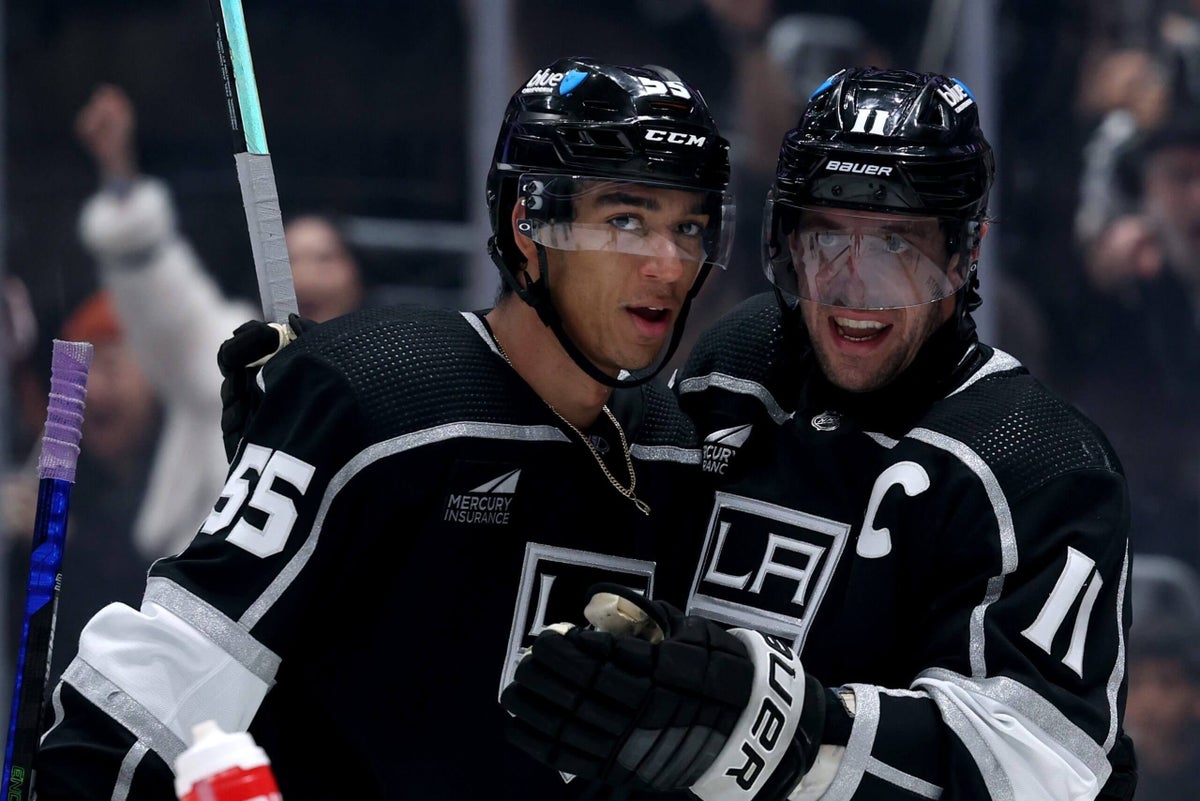
(Photo of Anze Kopitar and Quinton Byfield: Harry How / Getty Images)