
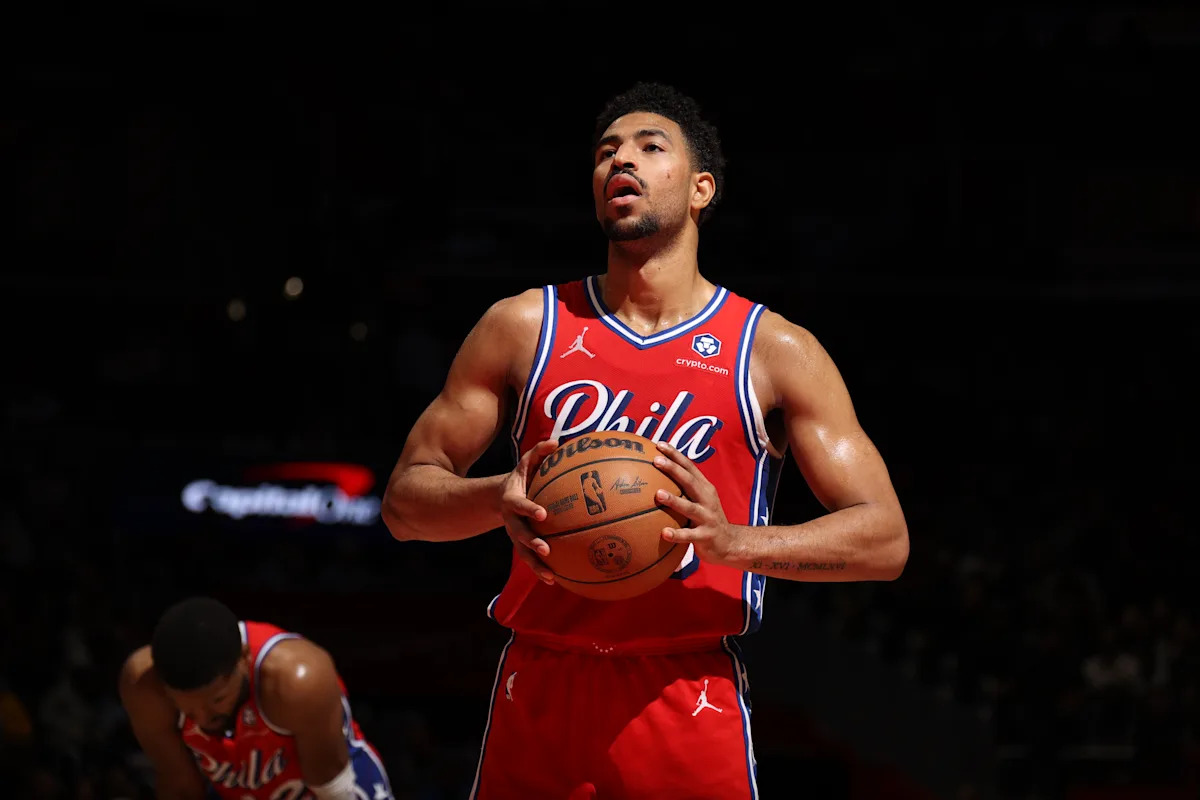
The nearly three-month saga is finally over. Restricted free agent Quentin Grimes has signed his $8.7M qualifying offer, closing the door on a lingering storyline. He’ll now play the upcoming season on a one-year deal with the Sixers — a decision with plenty of consequences.
But let’s be clear: nobody won here.
Advertisement
For the Sixers, Grimes’ choice essentially signals there’s no long-term future with the team. Whether or not his production late last season was inflated by a tanking stretch, he still proved he’s an NBA-level contributor. The Sixers, a franchise notorious for mishandling major signings, actually pulled off a rare win on the margins last deadline, flipping the remnants of Caleb Martin and his long-term deal to Dallas for Grimes. For a moment, it looked like the Sixers had stumbled into a rotation piece without much cost. Now, that move may simply go down as a fleeting bright spot in an otherwise forgettable season.
Grimes accepting the qualifying offer creates ripple effects for both sides. He now holds a no-trade clause, meaning he can veto any deal this year. That dramatically lowers the Sixers’ chances of “winning” a future Grimes trade, and limits their flexibility moving forward.
The Sixers’ process here is quite puzzling. Daryl Morey stated on the record that they were limited in what they could pay Guerschon Yabusele in free agency while trying to resolve Grimes’ new contract. The Sixers failed to do that, which means Yabusele walked for nothing when they could’ve kept him if they knew all along that they weren’t going to offer big money.
It’s also unclear how aggressive Philadelphia actually was in negotiations. Reports suggest they dangled a one-year balloon offer, but beyond that, the details are murky. Some will see it as another case of the team ducking the tax. The reality is the new CBA aprons are going to hover over the Sixers for as long as Paul George and Joel Embiid are on the roster. Were they being cheap? Or just hesitant to commit long-term money to someone who might end up their fourth guard? The truth probably lies somewhere in between.
Advertisement
Then there’s the Grimes side of things, which has featured some of the most puzzling negotiating tactics I’ve seen in a decade of following the NBA. His agent went on the record with multiple outlets, offering a rotating list of reasons why Grimes wasn’t pursuing a long-term deal with the Sixers. At various points, it was tied to concerns about Embiid and George’s availability, frustration with the team’s lack of serious negotiations, and even the presence of newly drafted VJ Edgecombe. All of this played out within just the last week or two of his restricted free agency, which only added to the confusion.
Let’s set the noise aside for a moment, because at the end of the day this came down to money. According to the latest reports, Grimes’ agent, David Bauman, was pushing for a deal worth upward of $20 million per year. To be blunt, that’s unrealistic for a fourth-guard type who has already been on four different teams, and especially so for a restricted free agent still unsigned in late September.
From Grimes’ perspective, the argument may be about a crowded backcourt. If the concern is simply that there are too many guards in similar roles, that’s at least a valid point. But that makes the negotiating strategy even more questionable, since this reasoning didn’t surface until September. Edgecombe, who was cited as part of the logjam, was drafted back in late June.
Advertisement
If Bauman (or Grimes) decided they wanted a fresh start, that’s their right. An agent’s job is to do what’s best for their client. Still, taking the qualifying offer may have been the worst move possible for securing long-term money, even if they wanted to move teams.
Here’s why: if Grimes is traded this season, the acquiring team won’t inherit his Bird rights. Any team already over the cap — most legitimate contenders — would be limited to exceptions if they wanted to re-sign him. Bauman has pointed out that 10 teams currently have cap space, which is technically true. But once extensions start rolling in over the next few weeks, that number is almost certain to shrink. And outside of the true contenders, many of those teams with space are in early rebuilds. And keep in mind: this is all in an ecosystem that actively punishes teams for spending major money.
Long term, the most likely outcome is Grimes landing on his fifth team in five years while chasing a contract north of $20 million. He’ll be doing so after a season in Philadelphia where the Sixers have little incentive to prioritize his minutes over Jared McCain or Edgecombe. Fewer minutes mean reduced production, which in turn could hurt his potential payday. Grimes is undeniably an NBA player with a real career ahead, but I remain highly skeptical of the roadmap his camp is pursuing. At this point, it’s hard to see that there’s much of a plan at all.
It remains to be seen how Grimes and the Sixers navigate what is, at best, a temporary situation. What’s clear is that nobody came out ahead. The Sixers are likely to lose a real contributor for nothing, while Grimes’ path to a major payday just became far more complicated. Maybe he ends up betting on himself and cashing in, or maybe this becomes the next Nerlens Noel story — a cautionary tale of a bag fumbled. There’s even the possibility that the Sixers play him, make him feel welcomed, and work out a new deal next season. For now, though, all sides came away from these negotiations having lost significantly.