
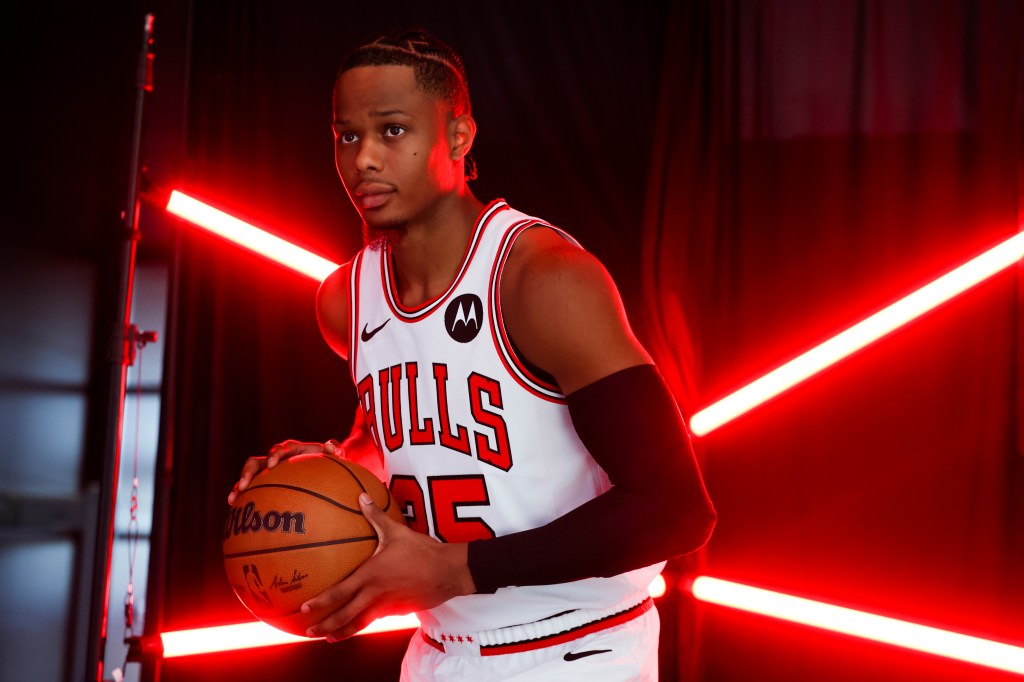
Isaac Okoro takes pride in taking charges.
By the end of the first day of Chicago Bulls training camp, that fact had been repeated a half-dozen times.
It didn’t seem to matter whether the forward was playing an informal game of pickup with teammates in the weeks before media day or leading a full-court drill at the Advocate Center. If Okoro saw enough space between the basket and the player with the ball in his hands, he slid over and stuck his body in the way, daring his teammate to crash into the contact.
This has always been Okoro’s style. His defensive engine propelled him to be a lottery pick in 2020 and defined him over his five seasons in Cleveland. And on a Bulls team desperate to toughen up, Okoro stands out as a symbol for improvement on the defensive end of the court.
“I take a lot of responsibility to bringing a lot of physicality to this team,” Okoro, 24, said. “I pride myself on the defensive side and being physical, just guarding the other team’s best player and trying to cause havoc on that end.”
The bulk of the Bulls’ defensive woes last season came down to their lack of hustle. The Bulls ranked in the bottom five in the league for most hustle statistics. They were notably fifth-worst at drawing charges (0.16 per game), fourth-worst at deflections (14.2) and second-worst at recovering loose balls (4.3).
Other defensive weaknesses are more difficult to track with statistics. Coach Billy Donovan felt the Bulls were too easily manipulated in the pick-and-roll last season, which led to the defense giving up the most paint points (54 per game) in the league. This season, Donovan has established ball containment off screens as a key area for both individuals and the team as a whole — an improvement that will rely heavily on players’ ability to establish physicality at the point of attack.
These defensive shortcomings bled into the offensive side of the game. The Bulls averaged roughly four fewer possessions than their opponents last season. The discrepancy was caused by a variety of factors, including turnovers and poor offensive rebounding, but Donovan believes the primary antidote is improving defensive disruptiveness.
“A lot of that stuff, quite honestly, is the physical stuff,” Donovan said. “Put your body into play, take a charge — that’s a possession we get back. A shot goes up, we offensive rebound — that’s a possession. It’s hard to win like that when the other team’s getting so much more opportunities than you are.”
Okoro is a natural source for several of the hustle statistics the Bulls lacked most last season — deflections, charges, loose-ball security. That’s the main reason the front office was willing to make a player-for-player exchange with the Cavaliers, trading Lonzo Ball for Okoro without any picks or other assets attached.
But Donovan doesn’t want the team’s newest addition to feel he has to shoulder the responsibility of the defense on his own.
Photos: Scenes from Chicago Bulls media day at the United Center
“There’s things that he’s really good at that we need to get better at,” Donovan said. “But to put all the physicality just on him — I think there’s no way he can do that.”
When the Bulls talk about defensive improvements, their focus is on the team — not the individual — with the understanding that many of the best scorers on the roster are considered to be weaker defenders at their position. And Okoro understands his place in that dynamic — elevating a standard that defensive specialists such as Ball and Alex Caruso previously set.
That’s not too difficult for Okoro. He has been this way since he was a 7-year-old kid who relied on his defense, not scoring, to secure a spot on the court during pickup games and recess battles. And bringing that edge to Chicago just brings an added layer of joy to training camp.
“If you see one of your teammates dive on the ground or go for a loose ball — they’re playing hard, so you don’t want to be the guy that is out there looking like they’re not playing hard,” Okoro said. “It’s kind of a contagious thing.”
There’s nothing uncertain about Okoro’s role for the Bulls — except for his status as a starter.
Donovan hasn’t tipped his hand regarding which player will fill the 3 spot in the Bulls starting lineup. Okoro is a definite front-runner, but the Bulls could favor guards such as Kevin Huerter or Tre Jones to lean into the up-tempo pace of the offense.
Okoro said he feels equally comfortable starting or coming off the bench. And his teammates competing for the same spot have echoed a similar sentiment. Donovan’s propensity to work with a deeper lineup provides plenty of opportunities for playing time, regardless of starting stature.
“In order to win, people have to take sacrifices,” Okoro said. “If I have to play my role of guarding the best guys, being the hustle guy, I don’t mind that. At the end of the day, I want to win. I know the team here, we want to win too.”