
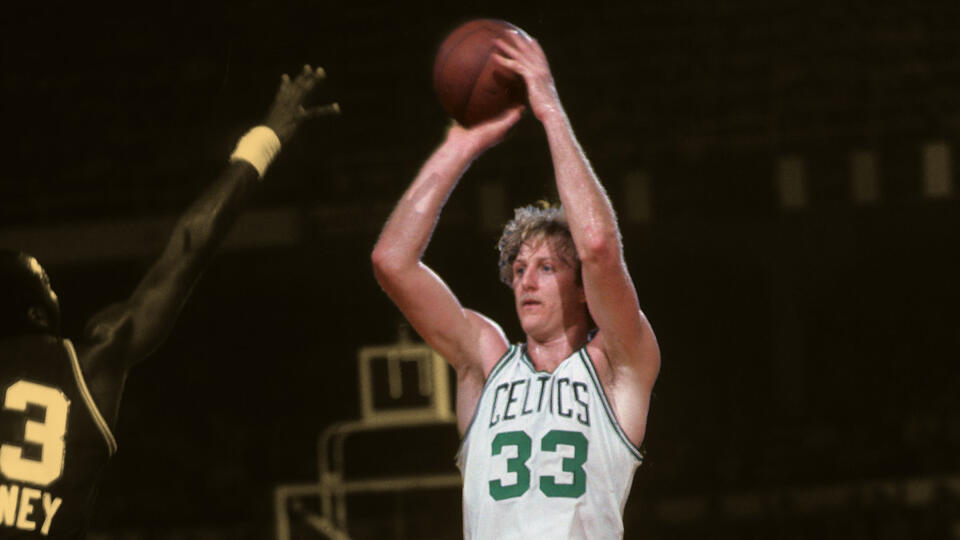
Larry Bird never shied away from a cold one but drew the line when he felt it was needed. Boston Globe reporter Dan Shaughnessy recalled offering him a second round of beer at a bar, only for the Boston Celtics superstar to shake his head after already finishing the first.
The rejection made Bird’s stance clear, but for Shaughnessy, Larry’s refusal turned into an awkward moment he never forgot. It was the kind of humiliation the journalist could never shake off as long as he was alive.
Bird refused to cease control
At the time of this interaction, it was still the 1981-82 preseason. Shaughnessy had just secured a job as The Boston Globe’s beat writer for the Celtics and the Boston Red Sox. He had spent two years covering the Baltimore Orioles for the Baltimore Evening Sun and another year as The Washington Star’s national baseball writer.
He knew he had to feel his way in as the new guy on the block. Dan introduced himself to Bird on media day and noticed that he was aloof with the media and visibly not at ease with strangers.
When Shaughnessy saw Bird and teammate Quinn Buckner at the far end of the bar of the Holiday Inn one evening, he knew better than to approach the pair. Both had the Indiana connection and played under the legendary Bob Knight (at least briefly in the case of Bird), so they had a lot of catching up to do.
Shaughnessy nodded to them as courtesy, but only Buckner reciprocated. Larry just looked straight ahead as if he did not exist, gulping out of his Budweiser.
So, Shaughnessy picked a spot and sat on a stool out of Buckner and Bird’s earshot, the one he calls “the loser end.” This was over two decades since the smartphone was created, so Dan only had a newspaper to keep him company. When the barkeep approached, he ordered beer for himself and for the two gentlemen at the opposite end.
Buckner acknowledged Shaughnessy’s gesture by raising his bottle, but Bird still had no reaction. When Dan decided to call it a night a little while later, he sent another round their way, but this time, the Celtics legend refused. It was only then that he realized the gravity of his actions.
Thirty-seven years later, Buckner revealed the real score, Bird wanted to always be in control. If he accepted that beer, he felt he owed Shaughnessy and did not want any part of that dynamic.
Shaughnessy wished he could take that moment back
At that point in his journalistic career, Shaughnessy had rubbed elbows with famous athletes, especially in baseball circles. “Mr. October” himself, the great Reggie Jackson, once requested to have lunch with him.
In addition to baseball luminaries, Shaughnessy conversed with Richard Nixon and John F. Kennedy’s younger brother, Ted, who was a Senator at the time. According to Dan, he was never awkward or starstruck around any of these personalities, primarily because he knew the proper etiquette when dealing with them.
Somehow, he committed that cardinal sin on Bird. One beer might pass as something polite, but sending another one in his direction? That signaled a kind of forced camaraderie that didn’t fit the relationship, and Shaughnessy knew it. For Shaughnessy, he considered his actions a violation of every social and professional drinking code known to man.”
“I haven’t thought about this in almost forty years and wish I could go back in time and change the moment, but I can’t. It was a moment of nervousness and insanity… My face turns crimson just thinking about it,” he admitted in his book “Wish it Lasted Forever.”
Why would Shaughnessy feel that way? First of all, he was a reporter, not a teammate or buddy, not to mention a new face around the Celtics. Buying players drinks risked appearing as if you’re trying to get on their good side, which compromises journalistic independence.
Moreover, Shaughnessy saw it with his own eyes how Bird kept his distance, sometimes even refusing to talk to reporters. That probably felt off for people like the Boston icon, who valued privacy and had little patience for unnecessary gestures.
Times have changed
What Shaughnessy thought was a colossal misstep back in 1981 might barely raise an eyebrow today. Reporters and players share flights, crack jokes on social media and interact far more casually than in Bird’s era. A drink sent across the bar now might even be seen as a friendly icebreaker rather than an ethical violation.
Today, the league has a clear set of rules that would allow players to have a more open, day-to-day rapport with reporters.
According to the 2013-14 guidelines, practices must be open to reporters for 15 minutes, locker rooms must be available for 30 minutes before games, and players must be available to speak with the media within 45 minutes after the game ends.
These formal rules have created an environment where access is less about personal favors and more about structured interaction. Reporters no longer need to rely on awkward gestures to build trust, as the system ensures that opportunities will be available.
Shaughnessy’s story may feel dated now, but it highlights a timeless lesson: Respecting boundaries matters more than gestures. Decades later, those lines remain part of the job. Players and reporters may interact differently today, but the balance between respect and intrusion must remain unchanged.