
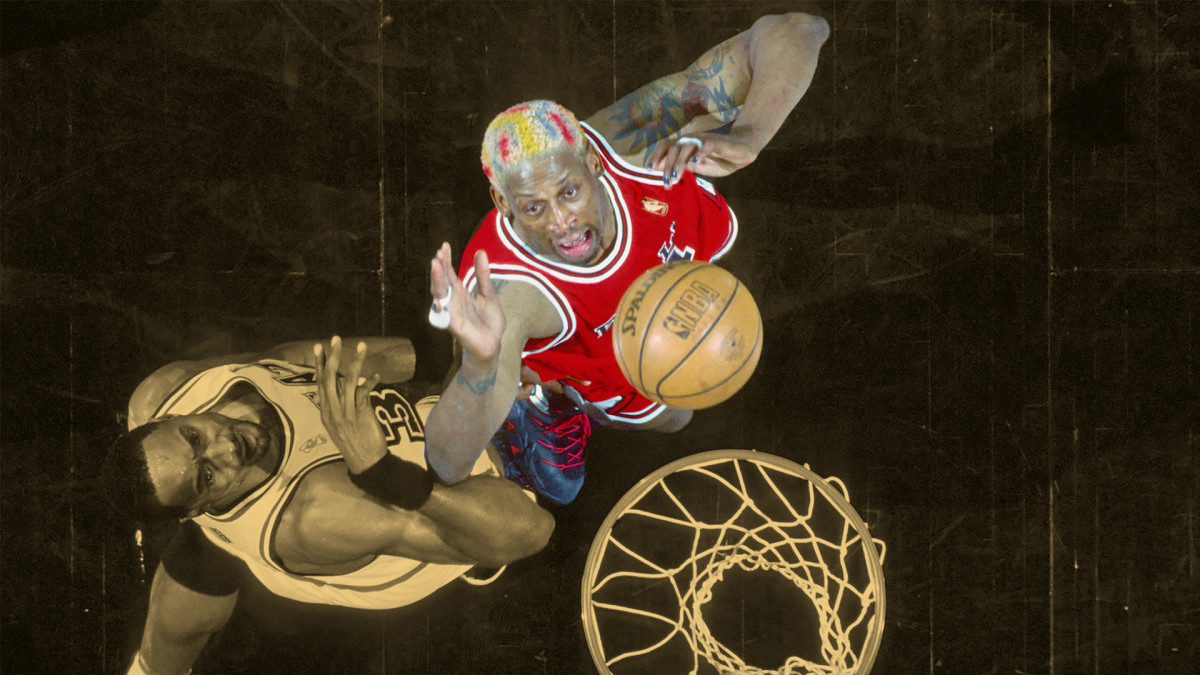
Dennis Rodman was on the verge of winning an NBA championship for two different franchises after the Chicago Bulls took a commanding 3-0 lead over the Seattle SuperSonics in the 1996 finals.
Just years prior, Rodman won a couple as the Detroit Pistons’ defensive Swiss Army knife. However, The Worm could feel the striking contrast in doing his thing for the Bulls compared with the Pistons.
Advertisement
“It feels different because I don’t really appreciate what it means to be appreciated as a world champion. Now, it’s totally different. Now, I know what’s going on, I know what it means and now, let’s go out there and do it,” Rodman told NBC’s Jim Gray.
The talk about winning a title was premature since the Bulls still needed one victory to cap off their record-setting 72-10 season with a ring. Nonetheless, history indicates it was all but a formality.
No team has ever come back from a 3-0 deficit and even though the Sonics rattled off two straight victories to make things interesting, it was just delaying the inevitable.
Advertisement
Mature Dennis was more dangerous than his younger counterpart
Rodman was not minimizing the achievements he had as a Piston. After all, he established himself as an extraordinary defender there, winning two DPOY awards.
What he meant by the difference was the timing, context and perspective of the titles.
Back in Detroit, he was younger, caught up in the grind and not fully aware of the bigger picture that comes with winning at the highest level. By the time he arrived in Chicago, Rodman was more mature in the basketball sense. He may have become more eccentric off the court, but within the game, he had a sharper understanding of his role and the magnitude of the stage he was on.
Advertisement
Moreover, he was playing with the universally loved Michael Jordan and for sure, the fans’ admiration for His Airness trickled down to his teammates. He must have felt the appreciation not only from the city of Chicago but from fans all over the world. The Bulls not only became national sensations, but also became a global phenomenon,
MJ was at the center of that solar system, but Rodman brought in a different type of star quality with him that entertained many aficionados.
Rodman walked the walk
The early championship talk may have fueled Seattle’s mini-run, but ultimately, Chicago won it all to jumpstart another triple-title run. Rodman did what he does best, grabbing rebounds left and right as if his life depended on it. He led both teams in total rebounds for the series (88), nearly 30 more than the next best guy, Shawn Kemp (60).
Advertisement
In the Game 6 clincher, Rodman corralled 19 rebounds, 11 of which were offensive. Those 11 extra chances at the bucket proved to be the biggest difference to mitigate the Bulls’ poor shooting (39.7 percent compared to the Sonics’ 42.5 percent).
Overall, Rodman averaged 14.7 boards over six games and a 23.9 percent rebounding rate, which means Dennis grabbed nearly one of every four rebounds available when he was on the floor.
If it was any consolation to Rodman, Sonics head coach George Karl felt he should have won the 1996 finals MVP over Jordan. Kemp, Rodman’s matchup at the 4-spot, also felt the same.
Advertisement
As much as the spotlight stayed on Jordan, Rodman’s fingerprints were all over that title. His rebounding and maturity were the glue Chicago needed to finish the job.
This story was originally reported by Basketball Network on Oct 5, 2025, where it first appeared in the Old School section. Add Basketball Network as a Preferred Source by clicking here.