
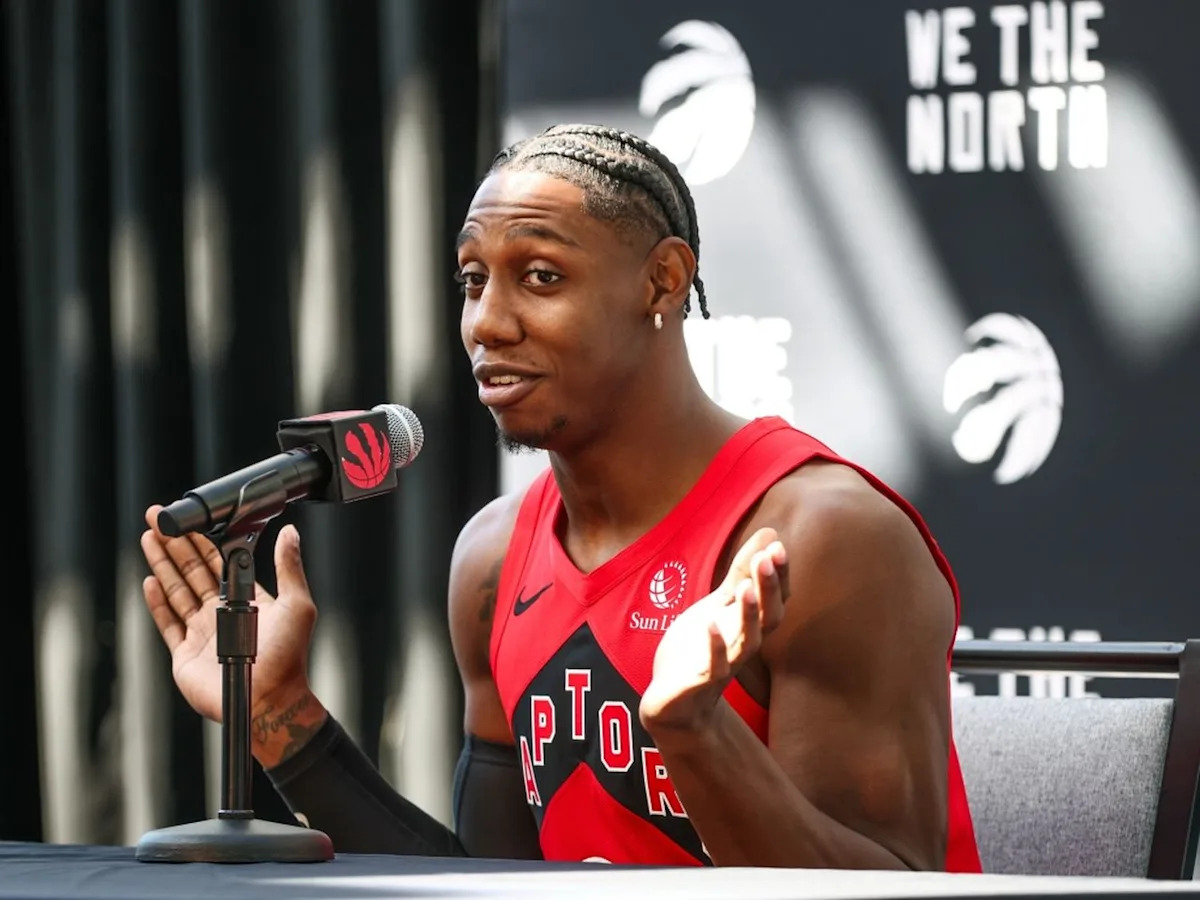
As Toronto Raptors training camp continues in Calgary, there’s little doubt the team will be working extensively on shooting.
Stephen Curry started a revolution with his three-point prowess and marksmanship has become the name of the game, whereas it was once the pivot play of the NBA’s true giants.
The Raptors have been bad in recent season for reasons including the removal of most of the team’s stars via trade or free agency, as well as injuries, but shooting problems also have been high on the list. The team was 23rd in three-point accuracy last season, 29th in makes and 27th in accuracy and 26th in threes made the year prior.
It hasn’t just been outside gunning that has been too far below league average for Darko Rajakovic’s group. The team finished dead-last in field goal percentage in the restricted area (the closest shots available) in 2024-25.
Good teams tend to be dangerous from three and make their easy buckets. The Raptors project to be a lot better from deep with Brandon Ingram and Immanuel Quickley on the court, but it’s unclear if they can make a jump inside, too.
Interestingly, only Denver took more shots than the Raptors in the restricted area. They were getting to the hoop, they just weren’t doing good things once they got there (the Nuggets shot 68.3% on those shots, ranking seventh in the NBA). Toronto also struggled in the paint, finishing 23rd in accuracy there.
Toronto also shot the fewest above-the-break three-pointers, so it will be interesting to see if Ingram and Quickley’s presence unlocks more of those types of shots.
In terms of individual Raptors, RJ Barrett has some cleaning up to do in couple of puzzling areas:
1. Barrett needs to sort out what happened to his free-throw stroke
Since shooting 61.4% from the line as a rookie, Barrett had jumped to around 74% the next two seasons with the Knicks, before inexplicably shooting 83% in his final 26 games before being dealt to Toronto in 2023-24. Barrett dipped to 62.9% to end that season and then shot only 63% in 2024-25.
An injury wasn’t to blame, so Barrett will need to figure out what was because he has shown himself capable of hitting a solid percentage of his free throws over the bulk of his non-Raptors career.
His game is built on getting to the basket and to the line. He needs to capitalize on that strength by connecting on his free throws.
2. He needs to solve one of the most jarring home/road shooting split discrepancies in the NBA.
Barrett probably is the most underrated Raptor and people tend to nitpick at his game far too much. That’s a fair statement.
It’s also fair that he can’t play like a near all-star level at home (23.4 points. 6.8 rebounds, 50.2% from the field, 37.2% from three, 68% from the free throw line) vs. below replacement level (18 points and 5.9 rebounds on 43.2% shooting, 32.7% from three and 58.2% from the line) in the United States.
Somewhere in between in any locale would be great.
More Raptors thoughts and takes
Sophomore Jamal Shead needs to do more than just star in the “eye test” department (as in he looks great and effective when you watch him).
Shead appears to be doing excellent things when he’s on the court. He’s an intense defender who gives no quarter to opponents. He’s extremely quick with the ball and makes flashy plays.
But his actual production didn’t match the eye test in his rookie season. Toronto actually was better with Shead off the court than on (even though Quickley, the point guard in front of him, only played in 33 games). His advanced defensive stats also looked a bit shaky for a guy who was the NCAA’s top defender.
This corner is a Shead believer, but it’s not that common for the eye test to differ so much from the analytics.
Scottie Barnes needs to take advantage of the extra room a better roster around him will provide.
Last year, Barnes hit only 37% of his wide-open shot attempts, 10% worse than either Ochai Agbaji or Gradey Dick (Quickley was at 44%, Barrett 42.9%). Last year, nine Raptors got at least two wide-open three-point attempts and Barnes ranked last in making only 30.2% of those looks (Dick, Quickley, Agbaji and Jamison Battle all hit between 42-43% of those attempts and Kelly Olynyk and Bruce Brown each 47% on fewer attempts before being traded for Ingram).
Nobody is expecting Barnes to shoot like the best marksmen on the Raptors, but even a simple jump closer to the rest of the pack (say 36%-37% on open three-pointers) would do wonders for the team.
He’s a great facilitator and inside scorer, but that usually starts with Barnes having the ball. If he becomes any kind of threat when the likes of Quickley, Ingram or Barrett are double-teamed, Toronto’s offence can surprise.
@WolstatSun