
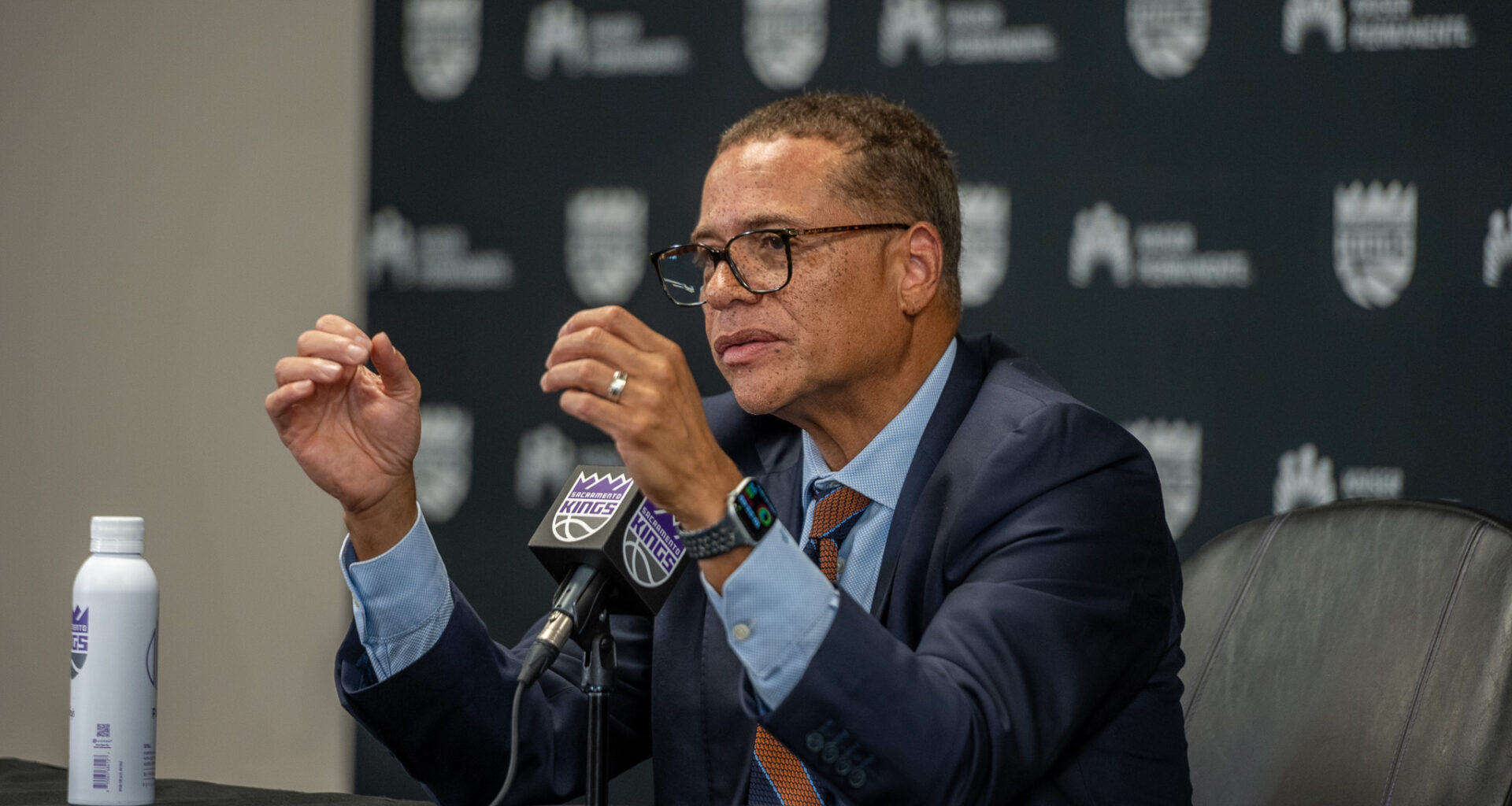
Lessons from his childhood in Detroit will anchor Scott Perry, 61, in his new role as general manager of the Sacramento Kings. Raised by Lowell and Maxine Perry, he learned to view challenges as opportunities.
Perry’s father was an African American pioneer and an all-America football player at the University of Michigan. The Pittsburgh Steelers selected him in the 1953 NFL draft, but six games into his rookie season, Lowell suffered a hip fracture that ended his playing career.
The devastating injury placed the football star in traction for 13 weeks. Being confined to a hospital bed for months was difficult, but it didn’t deter Lowell from building his legacy. He pivoted to coaching, rejoining the Steelers in 1957 as an assistant coach, becoming the first Black coach in modern NFL history. Watching his father navigate this challenge taught Scott the importance of perseverance.
Growing up, Perry played football, baseball, and basketball, earning a scholarship in the latter to the University of Oregon in 1981. He finished his college career at Wayne State University in 1986.
In 1988 Perry began his head coaching career at the University of Detroit Mercy. After five seasons, he joined the University of Michigan as an assistant and coached Jalen Rose, Juwan Howard and other players who made the NBA. His college coaching career ended at Eastern Kentucky University in 2000.
Perry’s first NBA opportunity came in his hometown of Detroit, where Hall of Famer Joe Dumars hired him as an executive. During his tenure the Pistons made six appearances in the Eastern Conference finals and won the NBA championship in 2004.
Perry believes his parents prepared him for his latest opportunity with the Kings. Growing up in a two-parent household taught him the value of structure and determination — characteristics he plans to implement as the team’s general manager.
The additions of Dennis Schroeder, Drew Eubanks, and rookies Nique Clifford and Maxime Raynaud exemplify the type of players Perry wants in Kings jerseys. These four players carry qualities he believes a team must have to succeed. Having Schroeder, who just led Germany to a Eurobasket championship and was tournament MVP, fills the gap at point guard that Perry considered a priority.
After a brief coaching search, hiring Doug Christie seemed like a no-brainer to Perry. When considering this season’s roster, it made sense to have someone respected who has played the game and been around the organization for decades. The front office surrounded Christie with veteran coach Mike Woodson, former teammate Bobby Jackson, Leandro Barbosa, and others to provide him with the support he lacked last season.
Similar to Christie, members of the returning core feel assurance with the transparency Perry and his staff have brought. Although trade rumors, contract extensions, and team roles are difficult conversations, Malik Monk, Keegan Murray, and others say these talks have been seamlessly handled. Open communication has helped the team focus on basketball.
The Kings plan to be defensive-minded, defend all 94 feet, and get out and run as often as possible. They also want to be considered the league’s toughest team. The team’s nightly three-point attempts might dip, but if Sacramento defends at a high level and plays with pace, Perry believes it has a chance to win any given night.
The OBSERVER talked with Perry about his upbringing, his career, and his vision for building a winning culture in Sacramento.
You’ve mentioned that you embrace challenges. Does this stem from observing your father’s perseverance through his career-ending injury?
My parents taught me that nothing in life is going to be given to you or come easy. So, at an early age, I always wanted to play in the upper division and play up in age, where I wasn’t the best player, and I would have to fight for every little bit that I had. So, I always ran towards struggle or adversity to improve. I think you learn about yourself more through struggle and adversity than you do through the best of times.
During your time as a coach at Michigan, are there any similarities between being part of that program and coming into your current situation here in Sacramento?
I think the biggest thing was the exposure. We were one of the preeminent programs in the country at that time. A lot of people wanted to be there, which comes with a lot of scrutiny and expectation. You had to drown out the outside noise, stay focused, and always keep your eye on what you need to accomplish today and tomorrow. That’s what you have to do at the professional level, whether it’s Sacramento, New York, or Detroit.
When was the first time you reached a level of success you felt you could be proud of?
I was fortunate enough to work in the front office, like I did in Detroit, and be an integral part of that. We had some success there, which ultimately led to a championship. And that was rewarding. A lot of fun, but not even then did I think, “I made it.” It’s always about how I can get back there. So that’s my mindset.
When you look at what you want to accomplish in Sacramento, what does the beginning look like?
The first thing we have to do is establish an identity. Six values will be extremely important to accomplishing this, and we all need to be a part of them, starting with me. These values include being competitive, tough, team-oriented, professional, accountable, and disciplined. That’s what I’m laser-focused on, not only for myself, but for our entire group. That has to be who we are. I want the community, opposing teams, media, and everyone to know what you can expect from us, win, lose, or draw.
Why did you bring in B.J. Armstrong as the assistant GM? How do you feel he will help you turn things around here?
I’ve known B.J. since I was a teenager. The great thing about bringing him here is that he has had extensive front office experience. He has had long-term agent experience and a long-established playing career. So he brings all those perspectives into the front office. And you’re talking about a guy that’s passionate about the game, and I think his ability to communicate with all those entities I just talked about, most importantly our players and our group, is invaluable.
Being one of the NBA’s few African American GMs, how important is it to you to hold this position and represent it well for children who look like you?
It’s extremely important. Regardless of race or color, we all need somebody to look to. Naturally, when it’s someone from your community, it hits harder and resonates more. I want kids who look like me to dream and aspire, and say, “He’s doing it, I can do it too.” I want to succeed for others just as much as I want to for myself. It goes back to the saying, “You make a living off of what you do, but you make a life out of what you give.”
My daughter, Chelsea, who’s 30 and owns her own photography and videography company, is my biggest motivation and inspiration. I want to do well for her so she can be proud, and hopefully that can help her accomplish some of the things she is striving to achieve.
With a job like this, how do you manage a work-life balance?
I may not be the best person to answer this, but I mean it when I say my wife, Kim, is my ride-or-die. Over the years, I’ve missed birthdays, holidays, and special events. However, as I’ve grown older, I’ve begun to gain more perspective. So, I tell my staff that I want us to be considered one of the hardest-working groups in the league. However, with that said, your family is the most important, so I want to ensure you don’t lose focus on them. When they want to attend some of those important events, I want them to be there, unless it’s unavoidable.
When it’s all said and done, what do you hope to leave behind?
If my name comes up and people say, “Man, that was a good guy. He poured [a lot of effort] into me. He took the time to share knowledge with me. He took time to help me when he could.” That’s all I would want. That’s the legacy that I would like. How many lives were you able to positively impact, perhaps allowing a young person to believe that they could accomplish more than they thought they could, or feel they could achieve, before meeting you, working with you, and interacting with you? To me, that’s what it’s all about.
Related