
The Oklahoman’s Steve Lackmeyer answers your OKC questions from what’s going on downtown. Submit questions for future mailbag columns to slackmeyer@oklahoman.com.
Q: How exactly did the Thunder get control of the Paycom site? That was definitely not part of the sales tax election discussion. The city just gave a private company an entire block to develop?
A: Congratulations. You have asked a question that City Hall sent through its attorneys, resulting in an answer that might not totally address your question — or my follow-up question — on a deal that you rightfully point out wasn’t discussed during the sales tax election to build the new $1 billion arena.
Let’s delve into their answer, written up by the city’s attorneys, sent to me via Kristy Yager, the city’s public information officer:

Shadows of a building and plaza can be seen where Paycom Center is located in this rendering of the new $1 billion arena will be built.
“The city did not give ownership of the existing arena site to the Thunder. Instead, as part of the consideration for the Team’s agreement to remain in Oklahoma City for an additional 25 years in the New Arena — outlined in the Use License Agreement — the city entered into a Preferential Rights Agreement for the existing arena site.
“This Preferential Rights Agreement, approved by city council on June 17 alongside the Use License Agreement, governs the relationship between the city and the team’s ownership group regarding the site. This agreement gives the Team’s ownership group the right to purchase the existing arena site for fair market value.
“Under the agreement:
“Exclusive Purchase Option: For five years following the opening of the new arena, the Team’s ownership group holds the exclusive right to purchase the existing arena site. During this period, they are required to pay $100,000 annually to maintain this exclusive option.
“Purchase Price Determination: If the option is exercised, the purchase price must reflect the fair market value of the property, determined by the average of at least two MAI-certified appraisals.
“Right of First Refusal: Before the new arena opens, if the City receives and wishes to accept an offer to purchase the existing arena site, which the City desires to accept, the Team’s ownership group has the right of first refusal to purchase the property on the same terms. However, the City is prohibited from soliciting, encouraging or negotiating third-party offers.
“Shared operating expenses: If the Team does not exercise its purchase option within 24 months of the new arena’s opening, they are obligated to reimburse the City for 50% of the operating expenses of the existing arena, up to $200,000 annually, for the remainder of the option term.”
More: New OKC Thunder arena name? Is Operation SAFE coming to OKC? Your questions answered
Did you catch the right of first refusal part of this answer? In the aftermath of Paycom ending its naming rights agreement with opening of the new arena, CEO Chad Richison indicated he wants to develop the current arena site. This would be an unsolicited offer — something the city can consider under its agreement with the team’s ownership group (led by Clay Bennett).
This could work out to the advantage of taxpayers if it results in a higher payment for the current arena site. But City Manager Craig Freeman at the time told me he would not consider any unsolicited offers. I followed up your question with the following:
The resolution passed by the city council prohibits the city from soliciting offers for the site, but it allows it to entertain unsolicited offers. Is the city manager choosing not to consider competing unsolicited offers? And if so, is this being done with approval from the city council?
After pressing further, Freeman replied “We are honoring the commitments made in the preferential rights agreement with the team’s ownership to keep the team in OKC.”
I sense they really don’t want to answer this question. One must wonder what would happen if Richison or a representative made an offer before the city council and in front of the public.
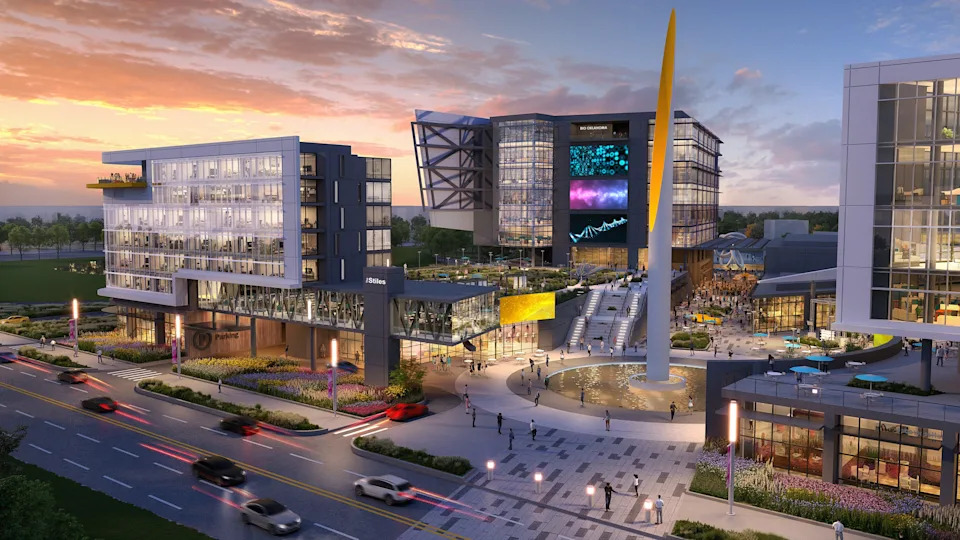
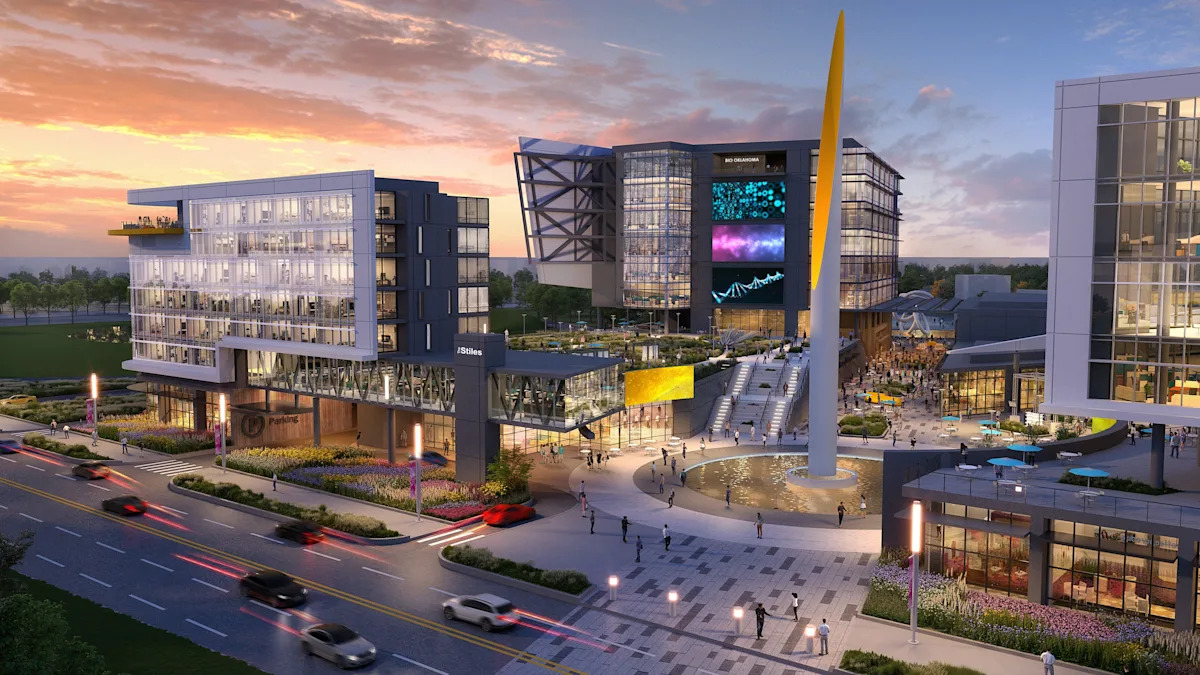
The original designs for Convergence, shown in these renderings provided in 2021, included a vibrant public space and colorful and angled building facades.
Q: What is a development that was proposed since you have been doing this that you think, if it was built as first presented, would have been a “game changer” for the city and why?
A: Several such developments come to mind. Most recently, consider what happened with Convergence at 308 NE 9, which overlooks Interstate 235 across from the downtown skyline. When I first saw the renderings, I asked if what I was seeing was really going to happen because the designs were first in class, something that would really stand out with active public spaces, grand stairways, large outdoor video boards and futuristic building outlines.
What we got instead was a perfectly nice glass office building, a rather forgettable looking taxpayer-funded innovation hall, underground parking and plans for a hotel that have yet to become a reality. The video boards, the lighting, the dramatic public space and daring building designs were all left on the drawing boards.
Escalating construction costs were cited for the changes. But when everything is said and done, an opportunity to make a huge statement about Oklahoma City aspiring to become a cutting-edge home for biotech has been lost.
We’ve seen similar let-downs in the past, most notably the original Spanish-themed drawings for Lower Bricktown that ended up a rather plain mix of brick and stucco buildings. In terms of Oklahoma City seeing an ambitious development built as envisioned, the best example may be OAK at Northwest Expressway and Pennsylvania Avenue.
Q: The west side of Scissortail Park (except for Social Capital) is dead and owned by a lot of different people. Do you think the city made a mistake in not acquiring those properties when planning for the park in order to promote development? We have a great park in the middle of downtown, bordered by a great convention center and then nothing across the way. What, in your mind, could have been done differently?
A: The city did buy some key adjacent properties, but funding was limited. And let’s keep in mind that even when the city or the Urban Renewal Authority has control of an important property, that doesn’t prevent a site from languishing without development — something we’ve seen happen the corner of Oklahoma City Boulevard and E.K. Gaylord where a plan to build an eight-story apartment building has been stalled for seven years.
We have a lot of splintered ownership to the west of the lower segment of the park, south of Interstate 40, and yet we’re seeing a growing number of homes being built to the point of seeing the emergence of a new neighborhood. Ultimately, the ability of the developer to deliver on projects trumps the role of the city itself.
Steve Lackmeyer started at The Oklahoman in 1990. He is an award-winning reporter, columnist and author who covers downtown Oklahoma City, urban development, real estate, transportation and economics for The Oklahoman. Contact him at slackmeyer@oklahoman.com. Please support his work and that of other Oklahoman journalists by purchasing a subscription today at subscribe.oklahoman.com.
This article originally appeared on Oklahoman: Scissortail Park, Paycom Center development future? Questions answered