
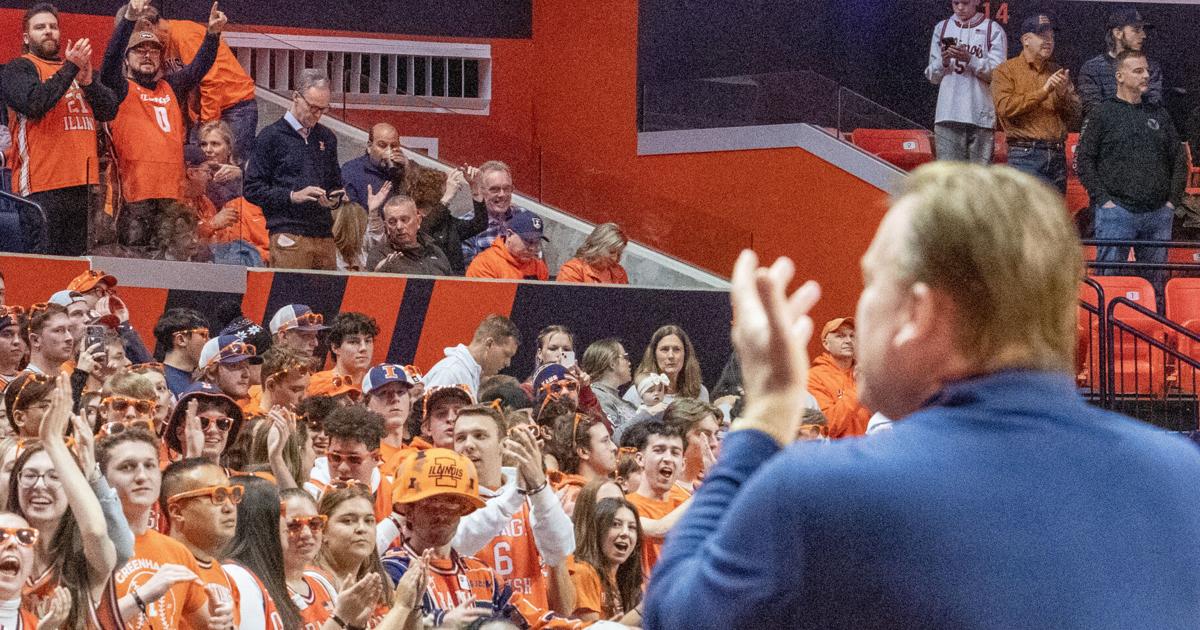

It won’t be long until the Orange Krush and Brad Underwood return to State Farm Center.
Robin Scholz/The News-Gazette
With the unofficial start to the men’s basketball season set for a week from Sunday, Editor Jeff D’Alessio pored over copies of Illini athletics’ contracts with the seven schools on the nonconference home schedule, obtained via open-records request. The top takeaways:
1. Among the differences in the fine print of Illini football and basketball contracts: For the latter, “no visiting team cheerleaders or mascots (are) allowed during (the) game,” per the compensation section. In football, they’re all welcome (the marching band too), provided they’re in uniform when they enter Gies Memorial Stadium.
2. Another difference: For so-called “buy games” against schools from lower-profile Division I conferences, the basketball pay day is far less lucrative than in football, where Western Illinois made $500,000 and Western Michigan $1.2 million for getting smacked around by Bret Bielema‘s team.
Jackson State‘s men’s basketball program will receive $110,000 from Illinois, Florida Gulf Coast $105,000, Colgate $95,000.
3. If capacity at State Farm Center is restricted “by any court or governmental authority, the NCAA, the Big Ten Conference or any other reason beyond the control of Illinois” — say, for instance, another global pandemic — the host will owe less (as little as 40 percent if the arena is less than a quarter full).
4. Given that its visit a week from Sunday is for an exhibition game, Illinois State doesn’t receive any cash compensation from Illinois. But the Redbirds will get 200 complimentary tickets — 100 more than any other opponent — “located behind the visiting team bench, or such similarly situated area as Illinois may designate, in its reasonable discretion.”
5. Host Illinois foots the bill for the officiating crews, defined for six of the seven regular-season home games as “three Big Ten officials as assigned by the conference.”
6. The outlier: For Texas Tech‘s Nov. 11 visit — and Illinois’ return game in Lubbock in November 2026 — the contract stipulates that officials “must have Sweet 16 tournament experience,” be “a blended crew” made up of Big Ten and Big 12 refs, and be “mutually agreed upon by two league supervisors.”
7. Given that both are members of top conferences, neither Illinois nor Texas Tech owes the other any compensation for either game. That changes only if either side backs out of the deal and a suitable replacement can’t be found. In that case, the penalty is $200,000.
8. The language in all but one of the UI game contracts reads similarly. The exception: pre-Thanksgiving games against Long Island (Nov. 22) and Texas-Rio Grand Valley (Nov. 24).
Rather than a two-way arrangement between two schools, an outside entity — Lexington, Ky.-based bdG Sports LLC — sets the terms for those games. It’s part of the convoluted “29+2” model, approved by the NCAA in March.
In a nutshell: Men’s and women’s basketball teams are allowed to schedule 28 regular-season games — plus an additional two or three in a two- or three-game, multiple-team event. (This isn’t like the old Illini Classic — in this case, there’s no round-robin format, just two Illini home games promoted by an outside firm).
Illinois pays bdG directly ($200,000) and bdG is on the hook for “general management services,” which does not include providing “lunch or dinner” in the media room or “drinks, cups, coolers, water, snacks, fruit, towels, shampoo, soap, etc.” for the locker room and benches.
9. Visiting teams are on their own when it comes to booking hotels — with the language in each contract noting: “Illinois shall reimburse visiting team for the expense of lodging for 0 nights, including room and tax.”
10. While the Illini’s neutral-site lineup is brutal (UConn in New York, Alabama in Chicago, Tennessee in Nashville, Missouri in St. Louis) and the road schedule includes trips to Purdue, UCLA and Michigan State, the State Farm Center docket is less demanding.
Of 17 home games, eight are against teams in ESPN bracketologist Joe Lunardi‘s early Field of 68 (16 seeds Jackson State and Long Island, No. 15 Florida Gulf Coast, No. 9 Maryland, No. 7 Oregon and Wisconsin, No. 6 Texas Tech and No. 2 Michigan).