
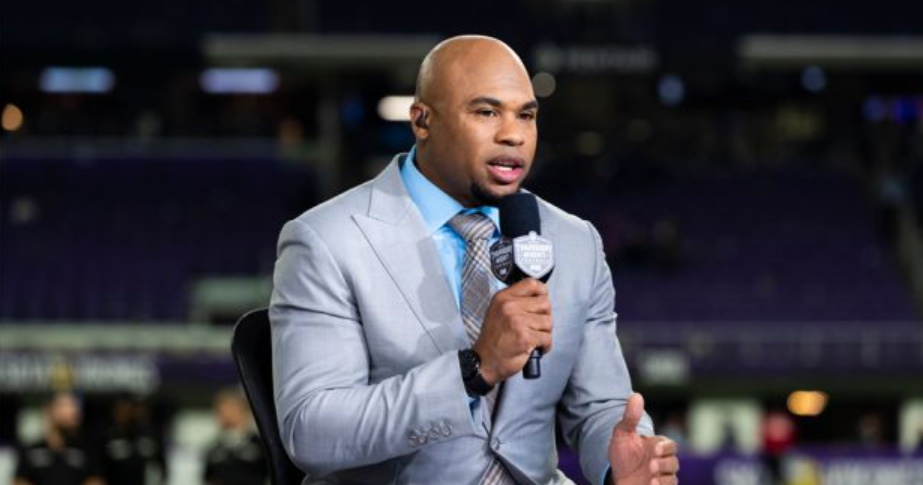

Former Panthers wide receiver Steve Smith Sr. talks on air during a previous broadcast.
Courtesy of Carolina Blitz
Carolina Panthers legend and former NFL wide receiver Steve Smith Sr. recently criticized Charlotte for its support and fan bases of teams during a Sept. 14 segment on 92.7 WFNZ’s Morning Radio Show. He referred to Charlotte as “a weak-ass city”, saying that “all fans do is b**** and complain” and are merely fair-weather supporters. But his remarks miss the bigger picture.
Charlotte sports have faced years of struggle, as both the Charlotte Hornets and Panthers have endured difficult playoff droughts. The Panthers haven’t reached the playoffs since 2017, getting knocked out by the New Orleans Saints in the Wild Card round. Meanwhile, the Hornets haven’t made it to the first round since 2016, losing a tight 4–3 series to the Miami Heat. That history matters when evaluating Smith’s comments.
His frustration seems less about fan loyalty and more about emotion, especially surrounding Panthers’ 2024 first-round pick, wide receiver Xavier Legette.
Smith’s frustration runs deeper
Smith’s comments stem from frustration with Legette’s slow start to his sophomore season. Through the first three games of the 2025 season, Legette totaled only 39 yards on six receptions while dealing with injuries. Although he has since regained his footing in Week 5 versus the Miami Dolphins, inconsistency remains an issue—and as a first-round pick, patience is limited.
Smith played his entire career with a chip on his shoulder. Having publicly endorsed Legette as a rookie, he may feel personally tied to the young receiver’s success. Instead of criticizing the organization’s shortcomings, he projected that frustration onto the city. He called Charlotte weak when, in reality, its fans have stayed strong.
Charlotte fans continue to show up
Since Smith left Carolina in 2014, the Panthers have maintained strong attendance, averaging over 70,000 fans per game and ranking No. 8 in the league for four consecutive years (including the 2015-16 Super Bowl run). Even after a 5-12 season in 2024-25, they still ranked No. 6 in home attendance—higher than during their 15-1 Super Bowl run.
The Hornets, too, have long been one of the NBA’s most supported franchises. They rank No. 2 for all-time in average attendance, and in the 1990s, they led the league nine out of 10 seasons.
Charlotte has been burned by bad contracts, poor management and not rewarding superstars for past contributions. The numbers show that even through all of this trial and error, people still care—they’re holding strong.
Charlotte fans have endured years of poor management, bad contracts and wasted talent, yet they still show up. This isn’t weakness—it’s loyalty.
Mismanagement, not weakness
Charlotte’s frustrations stem from the decisions of its front offices, not its fan base. Consider the Panthers’ revolving door of quarterbacks in the post-Cam Newton era:
Kyle Allen: Was not too long after he tried out as starter that his era collapsed.Teddy Bridgewater: A three-year, $63M contract in 2020—lasted one season before being traded.Sam Darnold: Two-year rental, now a Pro Bowler in Minnesota.Baker Mayfield: led Tampa Bay Buccaneers to the playoffs and threw 41 TDs in the 2024–25 season.PJ Walker: Now in the Canadian Football League.Bryce Young: Drafting him No. 1 overall cost wide receiver DJ Moore, the 2024 No. 1 overall pick (used by the Chicago Bears for Caleb Williams) and multiple future picks.
The Hornets have had similar issues:
Nicolas Batum: Five-year, $120M contract in 2016. Declined quickly—one of the league’s worst contracts at the time.Terry Rozier: Three-year, $56M contract in 2019. Solid player, but not worth losing Kemba Walker, a franchise cornerstone.Gordon Hayward: Four-year contract worth $120M in 2020. A large amount of money was given despite his injury history, as he was consistently hurt and barely moved the needle.
This is the same franchise that traded Kobe Bryant and Shai Gilgeous-Alexander on draft night, both of whom became stars elsewhere.
The pattern is clear that it’s not Charlotte’s fan base that is the problem.
Transplants are redefining Charlotte’s identity
Charlotte today isn’t the same city Smith once played in. Its population has grown from roughly 540,000 in 2000 to more than 910,000 in 2025, with the metro area containing over 2.7 million. Over 60% of current residents weren’t even born in North Carolina, and 87,000 of them come from New York alone.
People move to Charlotte for affordable living, career opportunities and quality of life. But these transplants bring with them their own teams and traditions. Many weren’t in the city for the Panthers’ 15-1 Super Bowl run or the Hornets’ ’90s heyday. But they are beginning to build new allegiances—one game and one memory at a time.
Charlotte is not New York, Philadelphia, Chicago, Boston, Pittsburgh or Seattle; the media would have already crucified its teams, but this city does not.
Philadelphia boos its own draft picks. New York papers shred their franchises daily. Boston expects championships. Charlotte is a community still finding its collective voice as a sports city—patient, loyal and steadily growing.
A city finding its voice, one game at a time
Sports have always brought people and cities together—in Charlotte, it’s no exception. They’ll give future generations something to root for. People will be there in the stadium or the arena because they want to be there, despite the years of disappointment.
Smith’s comments might come from a place of love and frustration, but they undervalue the commitment of a fan base that’s endured every rebuild and every false promise. A Panthers legend who has seen it all over the years can certainly express his opinion, but he also needs to look at the bigger picture.
Charlotte’s heart has never been weak, but it is just waiting for its teams to match the loyalty its fans have known for decades. Eventually, Charlotte will be a major sports city because passion is built—not bought.