
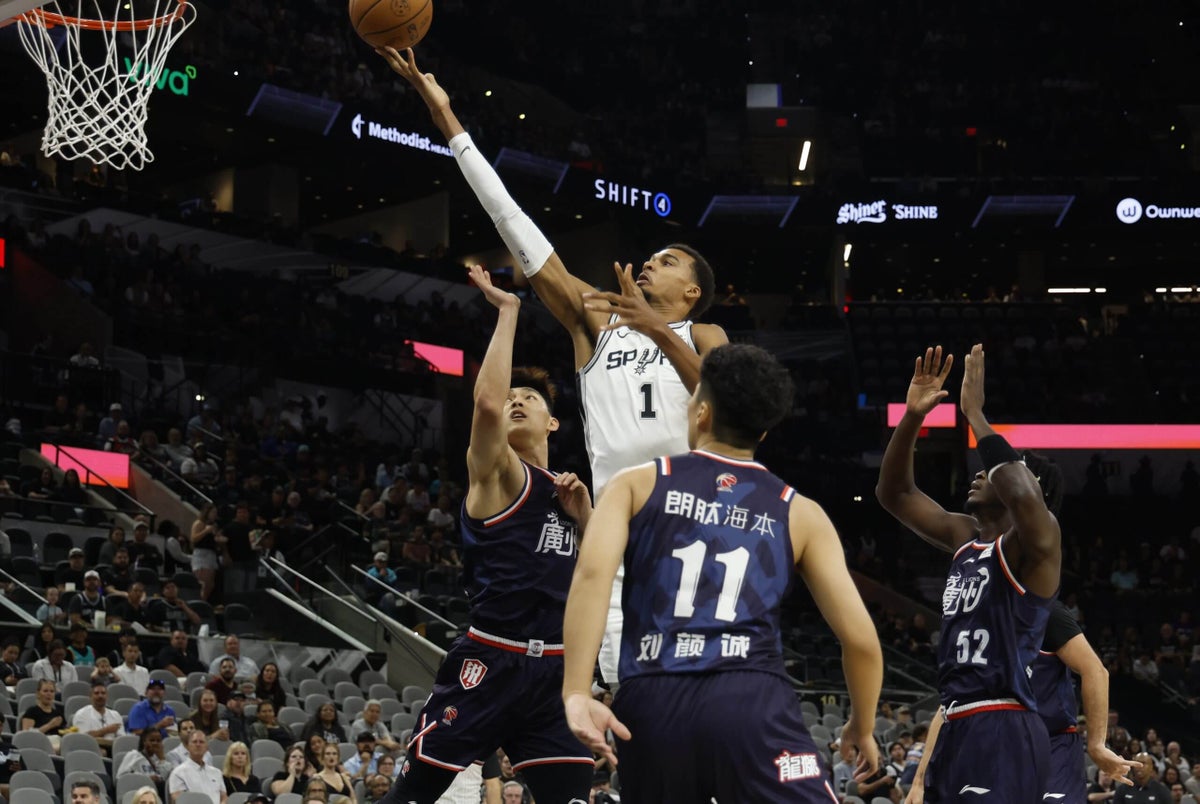
SAN ANTONIO — Peering around the media room at the Frost Bank Center Monday, things looked about the same as the last time Victor Wembanyama sat at the podium. A familiar collection of faces and cameras stared back at him for his first NBA game in eight months.
Wembanyama’s season ended last February when he was diagnosed with a blood clot in his right shoulder. He spent the ensuing time learning about his body, his mind and a different way of life on the other side of the world.
He returned to the United States in a different state of mind, training as he never had before. Or, as he put it, as nobody ever had before.
In his first preseason game Monday evening against Frank Kaminsky and the Guangzhou Loong Lions of the Chinese Basketball Association, Wembanyama showed the world he is not the same player anymore.
“It’s been a while,” he said with a wry smile.
Wembanyama, despite being the face of the team, is not introduced last when the Spurs announce their starting lineup before each game. He’s not even the penultimate player to strut out onto the floor. He goes right in the middle of the lineup, as if to shape the call sheet with an ebb and flow. Though he is listed at 7 feet 4, leads the league in blocks per game by a mile and was the only big in the starting lineup, he was laughably announced as a forward Monday evening.
As his first game in eight months unfolded, it all started to make sense. Wembanyama is not quite a center anymore — if he ever was. He is on the path toward something else. With nine points, 10 rebounds, three blocks and seven assists in just 16 minutes Monday, he showed the full breadth of his potential this season.
In his first action since February…
Wemby put up this statline in just 16 minutes 🤯
9 PTS
100% FGM
10 REB
7 AST
3 BLKpic.twitter.com/xr4EnpF1ms
— NBA (@NBA) October 7, 2025
Wembanyama has already reconfigured his game offensively to become more of a wing. It was apparent in the Spurs’ open scrimmage Saturday, and confirmed Monday, that Wembanyama will effectively play as an off-the-bounce creator quite often. That means he is going to be the fulcrum of the initial action on most Spurs offensive plays and will be attacking downhill. He will bring the ball up himself, and not just look to drive to the rack, but to draw a crowd and get rid of the ball early to initiate San Antonio’s ball movement.
If Monday is any indication, Wembanyama’s offensive approach will be even more in the mold of a wing like Kevin Durant than a versatile big like Anthony Davis, at least while De’Aaron Fox and Dylan Harper are still injured. The Spurs hope Harper will be back for the end of the preseason, next week, after having thumb surgery last month, while Fox’s hamstring strain is likely to see him miss opening night in two weeks. The absence of his two point guards leaves plenty of room for Wembanyama to find his footing running pick-and-rolls, organizing the Spurs’ offense in transition and focusing on passing, then relocating.
Wembanyama’s game was distinctly different from last season in that he was less focused on his own scoring. There were no calls for lobs after he got off the ball. Instead, he relocated to open space to make himself useful. He took just one 3-pointer, which he’s done in an entire game just once in his career. Last season, he had as many games with 15 3-point attempts as he did with five. He went from spamming 3s to spamming kick-out passes.
Relocation was a big focus in Wembanyama’s summer training sessions in Los Angeles, which helped him understand the ways he can use his gravity to create open space for his teammates instead of always taking it up himself. The drills he ran while working with Harrison Barnes and teammates over the summer were geared toward moving through any openings to keep the defense from locking in on his positioning.
Wembanyama recognized that while he can shoot the ball from anywhere, he has to make things easier for his teammates so they can, in turn, make things easier for him.
Those principles were on display early in the second quarter when Wembanyama made a decision that would have been a welcome surprise last season. Barnes fed him on a cut and he quickly passed it to Julian Champagnie in the corner, who then attacked a closeout. In the past, Wembanyama would usually get ready to rebound or try to post his own man up in this situation. This time, he instead relocated to the perimeter and Champagnie kicked the ball out to him.
What happened next showed how much Wembanyama is changing the way he views the floor.
Last season, this would have been a Wembanyama contested 3 or a drive past the closeout to try to attack the rim. This time, he easily got past his defender, took one dribble and fed the ball back to a relocating Champagnie for an uncontested 3.
It was the easier, more sustainable and more reliable play for a big man who must manage his physical workload throughout the season if he wants to maintain his performance level.
“I probably turned down a shot I could make with my eyes closed,” Wembanyama said. “But that was to get one of my teammates a shot he could make in his sleep. … We have three, four seconds to find the best solution offensively, and this is what we’re trying to do because this is what great teams do.’
Spurs coach Mitch Johnson said that for all the highlights Wembanyama will have this season, the team is reminding their star that these subtle decisions are the “wow” moments that must become the anchor of his identity. Year three is the stage when stars-to-be begin to understand that being great isn’t about the highs they can reach, but about how much they can raise their teams’ floor on each possession.
There will be chances for Wembanyama to blow minds, but the points are worth the same whether it’s a poster dunk or a pass to an open shooter. The best players pile up the right plays throughout the night. The more Wembanyama makes them, the more they become the conduits to his creativity, because, over time, they lead to more identifiable advantages.
As Wembanyama finds new ways to make his team better, they are doing the same for him. Center Luke Kornet was brought in from Boston not just to alleviate the center workload, but also to provide a different type of playmaking dynamic to aid Wembanyama’s evolution.
Their partnership already is off to a good start. Kornet is one of the better connective centers in the league. He makes good decisions on when and how to set up dribble handoffs, allowing Wembanyama to play off him as a cutter. Together, they can pull off pick-and-rolls in which Wembanyama sets up easy Kornet layups.
Last season, Wembanyama averaged 6.0 potential assists per game and he completed 19.8 percent of the Spurs’ assists, per Synergy Sports. (Potential assists include every pass to a teammate who then shoots, capturing the playmaking volume without caring about whether the teammate actually made the shot.)
On Monday, Wembanyama had eight potential assists in just 16 minutes and had 46.7 percent of the team’s assists. That assist rate wouldn’t just be higher than last season’s mark from Nikola Jokić’s, perhaps the greatest point center ever, it would have just edged out Trae Young for the league lead among all players.
Wembanyama also committed six turnovers in 16 minutes, which is terrible. His first turnover came on a wraparound drive when he and Keldon Johnson weren’t on the same page about the timing of the cut and pass. He also had a few off-target transition passes — one a cross-court dish just behind Johnson — a charge, a bad dribble move and then another lost drop-off pass on a good drive.
But it’s the preseason, and these are the kinds of mistakes Wembanyama needs to work through early. They are signs of him getting used to his higher usage, more up-tempo ballhandling and getting on the same page with his teammates on floor spacing.
“We each try to find our piece of the puzzle, and mine happens to be pretty big,” Wembanyama said. “So it’s a lot to take care of, and it’s no better time than now to start doing it.”
This performance was against a CBA team featuring a bunch of new players, so regular-season NBA defenses will put Wembanyama under much more pressure. But he showed a commitment to playmaking that is rare for any player entering their third year, especially a center or forward (or whatever he is). He made a statement beyond just being back on the court, making it clear he is not the same player anymore and nobody knows what he can become.
Even his own team isn’t quite sure. No matter the course, they are charting toward some discernible framework. The challenge for the Spurs is to keep him on a purposeful path and for everyone else to understand how they fit into it.
“There is a creativity and level of potential for him to do anything,” Johnson said. “With that being said, we still want him to have an identity of how he wants to play. Because when you play (with) four other teammates, there still has to be a level of connectivity, too.”
The potential for Wembanyama is unmistakable. His willingness to get there is apparent. He may not get there this year, but the learning process for him and his team begins now.