
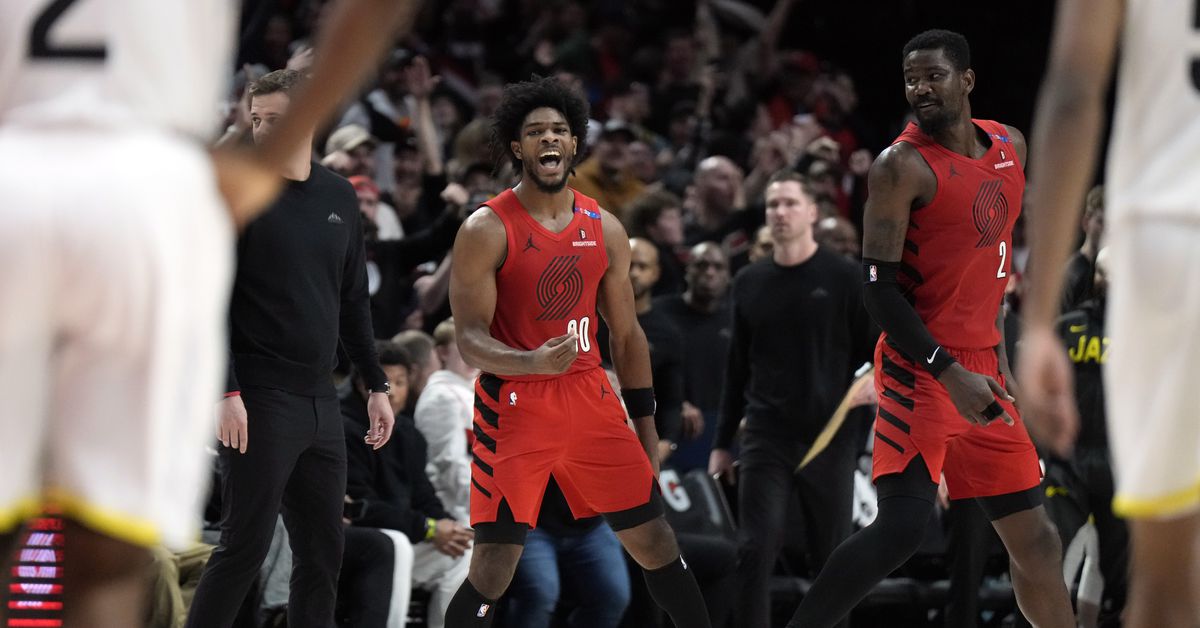
Welcome back to the countdown of my favorite reporting moments from the Portland Trail Blazers season, a digital scrapbook of my first season on the job as the Blazer’s Edge beat writer.
Part 1 of the series covered Nos. 15-13 in the countdown. The installment looked back on a memorable Toyota Half-Court Shot, the Blazers’ biggest win in franchise history, and the night the Moda Center hosted the most dedicated fans from Germany.
Today’s installment will go over the next two moments on the list.
As a reminder, “favorite” doesn’t necessarily mean “positive” for the Blazers or even for me. Rather, the countdown is a list of the most interesting or memorable moments to be a part of over the 2024-25 campaign, spanning from September’s Media Day to the Blazers regular-season finale in April. Let’s jump back in!
No. 12: The UConn Practice Controversy
My most viral reporting moment of the season happened at the Blazers’ first training camp practice on Oct. 1, my second day on the job. The moment was also an eye-opening introduction to the severe disapproval a faction of the Blazers fan base feels toward Head Coach Chauncey Billups. That was something I was aware of heading into the season, but it becomes more apparent and impactful when you’re providing day-to-day coverage of the team.
At the reporting scrum that day with Donovan Clingan, I recorded a short clip of the rookie center saying that practices at the University of Connecticut were “definitely harder” than NBA practices so far.
“[Danny Hurley’s] intense, man. It’s two-and-a-half hours of getting yelled at,” Clingan said about practices at UConn with head coach Danny Hurley.
I thought the clip was interesting, albeit a little innocuous. It’s common for college practices to be harder than NBA practices. Not that NBA practices aren’t intense, but there’s a different culture and style to them compared to college. For one, NBA head coaches are working with professional players who are full-grown adults, so the power dynamic and relationship is different. Secondly, NBA players are expected to come into the season with their conditioning already in good shape. There are some other reasons too, but this is all to say that college practices typically run players more ragged than NBA practices, especially when those college practices are led by Hurley, who is infamous for his militaristic style.
Without all that context and nuance, I posted Clingan’s response to X, formerly Twitter, and left the Tualatin practice facility. By the time I drove home, the clip was already unleashing a small social media firestorm against Billups. For Billups opponents, it was ammo to criticize the coach, proof he’s not doing what he needs to do if college practices are easier than his practices. As it stands today, the clip has over 179,000 views and 90 reposts, consisting mainly of negative reactions toward Billups. The other bulk of the reactions came from UConn fans, pleased to point to the clip as proof of their program’s greatness. (The Hartford Courant in Connecticut also picked it up for a story).
While the social media moment was peculiar — my Tweets usually got around two likes at the time — it felt tainted because in this case the criticism was unfair and Clingan’s words got blown out of proportion. Of course, there are valid criticisms of Billups. However, in this microcosm of journalism in the social media world back on Oct. 1, the criticism was misguided, and it felt a little slimy that it sparked from my account.
No. 11: The Bjorkgren Era
In late December, Billups stepped away from the team for two games to mourn the death of his grandmother. (I would just like to pause and make it clear that family, especially the loss of a loved one, is more important than work or basketball. Blazer’s Edge offered condolences in our article covering this news back when it happened, but before I go back over this period in the season, I’d like to offer condolences once more to Billups and his family for their loss).
From a reporting perspective, Billups’ absence was an interesting period to cover. Not only did it give the press corps a new personality to interview for a few games, but it provided a small glimpse into what games might be like with a different head coach managing the team, even one on Billups’ staff. In this case, that coach was assistant Nate Bjorkgren, who can usually be seen moving up and down the sideline during games, feeding intel into Billups’ ear.
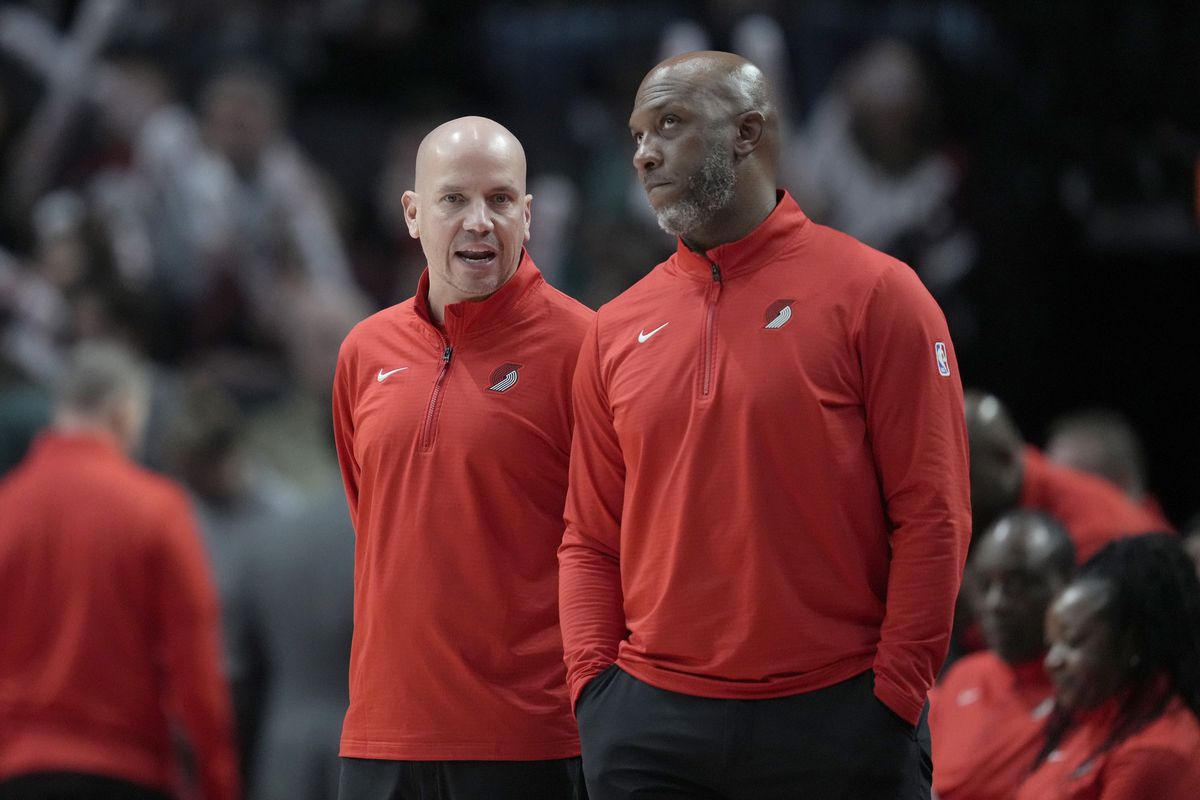
Photo by Soobum Im/Getty Images
The first game came against the Utah Jazz at home on Dec. 26. For the most part, the gameplan and decisions played out as usual, until the fourth quarter happened. Entering the fourth, Blazers reserves Scoot Henderson and Deni Avdija were in the midst of great performances and the score was tight. Meanwhile, starter Anfernee Simons was 1-9 from the field through three quarters and fellow starter Jerami Grant was playing fine, but not at the same level as Avdija.
At that point in time, Billups had often been reluctant to close with Henderson or Avdija, even on nights they had outplayed the starters at their position (it’s almost hard to remember that was ever the case with Avdija, considering how much he blossomed in the second half of the season). In this instance though, Bjorkgren rode with the hot hands, keeping Avdija in for all of the final quarter and Scoot in for the final 6:05.
The move paid off in spades. Avdija scored 14 fourth-quarter points on his way to 27 points, eight rebounds and six assists. Henderson rewarded the trust by delivering his first signature NBA moment: A turning, fadeaway mid-range jumper that went through the net with 0.1 seconds left. The shot gave Portland a 122-120 win, as Henderson backpedaled to mid-court, celebrating with his tongue out.
In the postgame press conference, multiple reporters asked Bjorkgren about the late-game lineup decisions.
“I did just exactly what Coach Billups would’ve done,” Bjorkgren responded like a good second lieutenant. “Some of those guys that were in there late, that group was just playing really well, so I decided to run that group longer.”
Bjorkgren served as head coach for one more game two days later at home. The Blazers defeated the Dallas Mavericks, 126-122. They finished the Bjorkgren Era with an unblemished 2-0 record, but the Dallas game was much more ordinary. Then Billups returned and things returned to business as usual. The Blazers’ defining stretch of the season — where they won 10 of 11 games — revitalized the atmosphere less than a month later.
Still, that Utah win felt like a turning point for Henderson and part of a larger turning point for Avdija. Avdija, who had picked up his play beginning in December after a bit of a rocky start, reclaimed his starting spot in that next game against Dallas and never gave it back up, cementing himself as one of Portland’s most important players by the end of the season.
Henderson never became a full-time starter, but he raised his play after that game-winner and took some valuable developmental steps during the second half of the season that lend optimism for his future in Portland.