
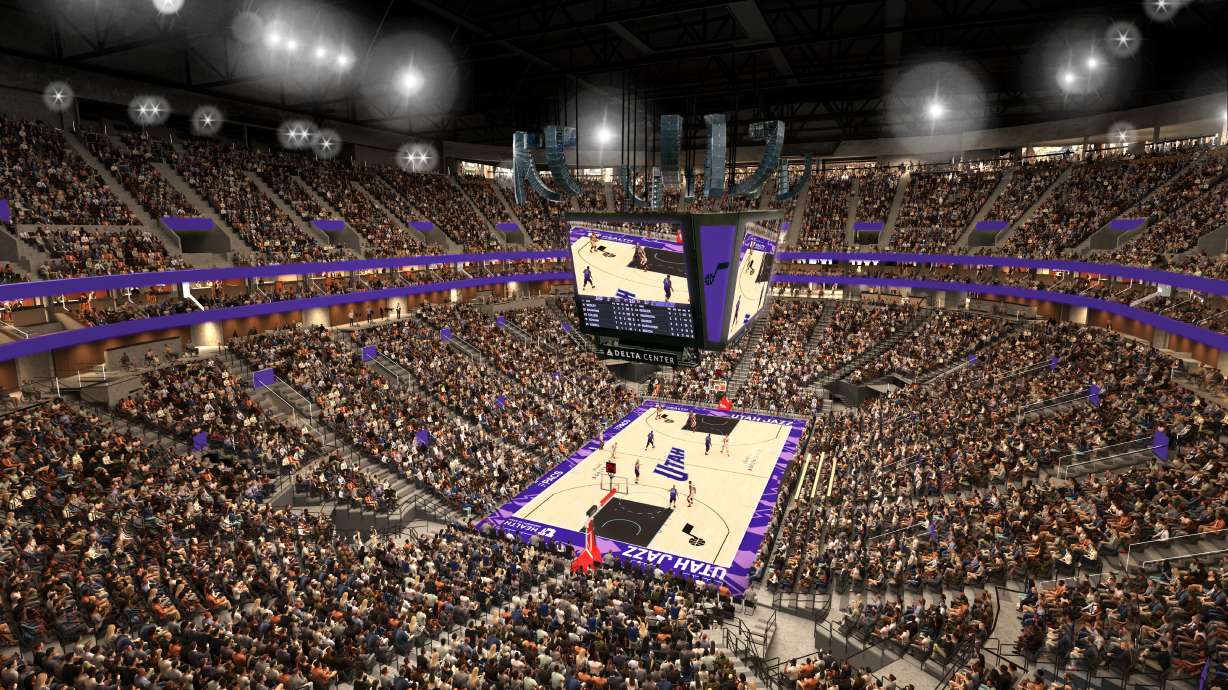
SALT LAKE CITY — Whenever Ryan Smith went to an arena, hoping for some inspiration on how to renovate the Delta Center for both hockey and basketball, he kept getting the same advice: build a new arena
“I’m gonna be honest with you,” the Utah Jazz and Utah Mammoth owner said. “Every single time we went somewhere, it was just start over.”
The Delta Center has long been one of the loudest venues in the NBA. Opposing teams feel the pressure of 18,000 fans stacked nearly on top of the floor as the noise funnels down to the court.
But hockey? Well, there’s a reason why the popular Salt Lake Golden Eagles were sold off to a Detroit ownership group.
Most dual-use arenas are built out, not up — with the seating bowl planned out for hockey and with rows of seats then added for basketball events.
The Delta Center, though, was designed to be a basketball cathedral. How do you make that work for both sports?
“I was pretty convinced we were going to have to create a new arena,” Smith said. “And that’s not just hyperbole — we were staring that right in the face.”
But Smith — and the city (which approved a half-a-percentage-point sales tax increase that will funnel $900 million into a new sports and entertainment hub) — weren’t willing to give up on the arena that for over three decades has served as the beating heart of Utah professional sports.
Instead of moving out, Smith and his team at Smith Entertainment Group doubled down.
They dug — literally — into the Delta Center’s foundation, removing 5 million pounds of concrete, raising the floor, and reengineering the lower bowl. The result? One of the most ambitious dual-use arena transformations in U.S. pro sports history.
“If you had told me that we could add more seats, fill in the bowl, and stay in the Delta Center — and go from 11,000 (hockey seats) to dual-use for both sports — I would have said, ‘No way.’ And then I would have said, ‘Sign me up,'” Smith said.
On Oct. 2, Utah fans got their first glimpse of the changes when the Mammoth hosted their first preseason hockey game. Behind each goal, the walls had been pushed back about 12 feet, replaced with steeply raked seating sections designed specifically for hockey sightlines.
Those sections — once dominated by large blackout curtains — now provide some of the best ice views in the building.
The Utah Mammoth plays the Los Angeles Kings in an NHL preseason game at the Delta Center in Salt Lake City on Thursday, Oct. 2, 2025. (Photo: Rio Giancarlo, Deseret News)
But Smith was clear from the beginning: The basketball experience couldn’t suffer.
The solution? A custom riser system that adjusts the seating configuration between games. It allowed the steep end zones required for hockey without compromising the close, intimate feel of Jazz games.
“It was kind of like one idea and one option — and there really wasn’t a Plan B,” Smith said. “If that riser system didn’t work, it would have been tough.”
The final result is a lower bowl that’s been reshaped, but not weakened.
The Delta Center does look different. Smith said the upper rows of the lower bowl have been widened to fill in the corners. But the feel? That’s still the same.
“If you’re in the first four rows under the hoop, your feet are actually touching the floor now,” Smith explained. “Rows four through 11 — it’s like an eight-inch difference. It’s basically the difference between leaning forward or not.”
Despite the retrofitting for hockey, SEG says they’ve preserved what makes Jazz games special: the sound, the slope, and the sense that the crowd is right on top of the action.
“We literally have the steepest pitch for basketball and hockey in all of dual-use professional sports,” SEG executive Mike Maughan said.
The Delta Center project is far from over. This summer’s redesign was only phase one — the heavy lift that enabled dual-sport conversion, floor raising, and bowl reconstruction.
“The second phase is where we get into the new club space in the upper bowl,” Smith said.
Current plans include reimagined suites and communal “pod”-style seating, designed to keep the same basketball viewing experience while also providing views of the ice.
“We want to keep the same pitch somehow that we’ve got up top, with the challenge of, if you’re on the second row, you can’t see the goal or the ice,” Smith said. “How do you do that?”
They asked a similar question for the lower bowl — and figured that out.
“That’s the kind of innovation and ingenuity that I think we’re known for in Utah. I think this is an incredible example of who we are as a state, the kind of people we are in the entrepreneurial spirit that permeates all of Utah,” Maughan said.
So yes, the Delta Center is different now. The bowl has changed. The riser system is real. The walls have moved. But the essence of the arena — steep, loud, proud — remains.
“It’s going to be different,” Smith said. “But I think it’ll be super unique as well.”
And still downtown.
The Key Takeaways for this article were generated with the assistance of large language models and reviewed by our editorial team. The article, itself, is solely human-written.