
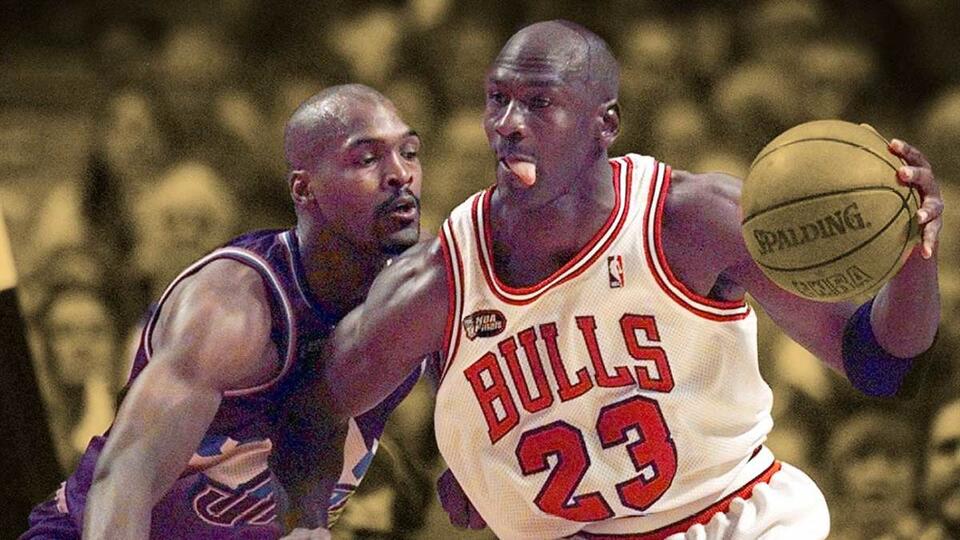
Michael Jordan knew Game 6 of the 1998 NBA Finals was a must-win for the Chicago Bulls. Determined to secure the championship, he shouldered the burden down the stretch — capping it off with a massive defensive stop on Karl Malone that set up his game-winning, series-clinching shot.
Asked about his thought process on his steal on Malone, Jordan pointed out that a simple defensive read made that play possible.
“We’ve been trying to double-team Karl Malone and Hornacek was trying to set a pick on Karl Malone, but never really cleared,” he explained in the postgame press conference. “That gave me the opportunity to go back, and Karl never saw me coming, and I was able to knock the ball away.”
Phil Jackson’s perfect game management
Hornacek was not quick enough to clear the area and still lingered in the vicinity near the basket. Malone was posting up Dennis Rodman on the left low block and already had his eyes set on the opposite side of the court.
As Jordan surveyed the situation, he crept behind Malone’s back and successfully came up with a steal.
After that fine defensive play, Jordan came up with the most iconic shot of his illustrious career. He waited for the right moment to put Bryon Russell in a precarious position, and then elevated for an 18-footer.
As brilliant as Jordan was in the final moments of Game 6, it wouldn’t have been made possible without Phil Jackson making all the right decisions on the bench. The game was slipping out of the Bulls’ hands, but Jackson’s calming presence, while pushing the right buttons, was not talked about enough.
“When Stockton made that three to give the Jazz a three-point lead with 41 seconds to play, I called time and told the players we had a two-for-one situation: if we stopped them and scored twice, we’d win,” the legendary coach recalled, showing exquisite game awareness at such a crucial moment.
After that timeout huddle, Jackson allowed Jordan to go one-on-one at the top of the key while spreading the floor with Steve Kerr and Toni Kukoc. The Bulls guard wasted little time attacking the rack and converted a layup with 35.9 seconds left.
The Shot
Almost every Utah Jazz possession down the wire went through Malone. For the most part, he delivered, knocking down two huge buckets to give his team a four-point lead, 83-79, and the crosscourt pass to Stockton for a 3-pointer at the right wing.
But unfortunately for him and the Jazz, Jordan happened.
After he stole the ball with over 18 seconds left, the stage was set for an epic finish. Jordan calmly pushed toward their frontcourt and settled the troops. At this point, Jackson planned to ride Jordan until the end and was not going to call for a timeout.
“I was waving for him to go down court. I think he saw me out of the corner of his eye waving off a timeout,” Jackson said.
With enough time left for a good look, Jordan remained patient. As he settled near the left wing, he claimed he could see every action on the floor as well as where his teammates were positioned. Russell, his defender, was not blinking, so he had to make a move very soon.
“I was going to the right because I knew I could get a shot off,” Jordan explained his thought process on the game-winner. “Any time I needed to make a shot, I went to my right as long as the defense didn’t make a mistake and open a lane to my left. When you go to your right, the defensive player has to come across your body to get to the ball.”
Using a slight push, Jordan broke free from Russell and found himself open. He elevated and knocked down the bucket.
“Once it went in, I knew we had been hanging around long enough. That was the game-winning basket,” he said.
Much has been said about Jordan’s clutch shotmaking and not nearly enough about his equally steady defense. The final sequence in Game 6 of the 1998 NBA Finals showcased both sides of his brilliance. Jordan created the chance, then finished it himself, a fitting capstone to his untouchable legacy.