
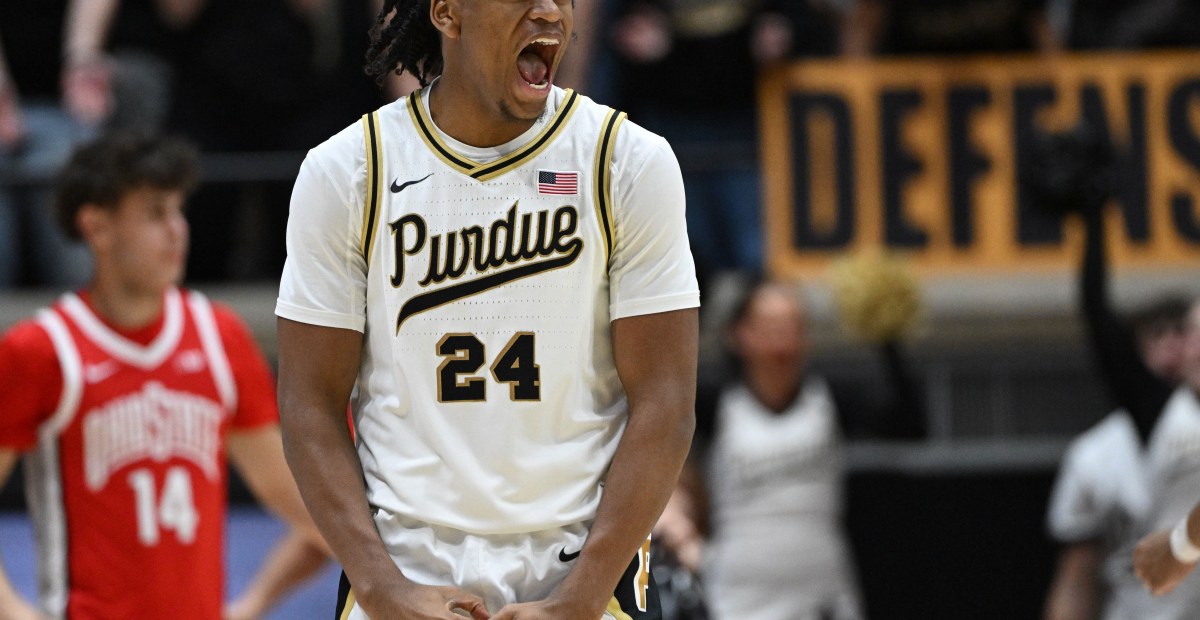
On November 4th, Purdue will host Evansville in Mackey Arena to kick off the 2025-26 season. That means we are a Gicarri Harris (#24) number of days away from the season starting in earnest.
Harris is one of the most intriguing options for Purdue headed into his sophomore campaign after an up and down true freshman campaign last season.
Harris surprised some, and was surprised himself learning last minute that he was set to start the season in Purdue’s starting lineup. He started five games for Matt Painter before relinquishing the starting role to more experienced Myles Colvin.
Harris spent the year from there coming off the bench as one of Purdue’s vital wing pieces. His departure from the starting role was mostly do to a cold shooting slump from three – 3 for 13 from three as a starter – and defensive lapses at the other end.
Harris will serve an even more integral role off the bench this season. He is Purdue’s main defensive-minded, big guard that can still guard wings. CJ Cox and Omer Mayer will be asked to do that out of necessity, but Painter has frequently stated that Harris has the size to defend wings compared Cox who is going to get guard duty.
But still off season buzz has been circulating about Gicarri Harris potentially taking back the starting role this season. Harris, after starting off cold from three, finished the season with encouraging numbers from three.
Harris was 7 of 16 (44%) in his final seven games of the season.
Harris remains the highest potential defender on the perimeter for Painter and has shown improvement through the summer. Harris isn’t just knocking down open three-pointers, but has shown more aggression getting to the hoop while looking more familiar and comfortable with PJ Thompson’s offense and the defensive principles that guide Purdue at the other end.
Still, Harris’s production last year was not consistent. He finished the season averaging 3.8 points, 1.9 rebounds, and 0.8 assists but averaged five rebounds a game in the NCAA Tournament over three games. Harris’s role is as varied as it is uncertain. Harris will probably never be a top scorer for Purdue, but instead looks to be a potential glue guy, filling in whatever role is needed while taking a heavy burden on defense, and being good at most aspects on the offensive end.
His biggest issue in terms of starting, that as improved as Harris has looked, his sophomore counterpart, CJ Cox, who finished the season as Purdue’s third starting guard, has looked just as, if not more, improved as well.
Regardless of where he starts the game, Harris is a pivotal, must have player for Painter. If Purdue has one weakness on the roster, it’s that it lacks heft and size on the perimeter. Talented wings who can handle the ball, shoot, and drive will have their time picking on smaller defenders except for Harris, who alongside Jack Benter, are the only true size at the three. Harris is the far superior defender of the two coming off a year of playing experience after his class mate Benter redshirted last season.
Harris will not be asked to do more than knock down open shots, but he has flashed intangibles and transition prowess that makes him dangerous on a team that should defend much better this season. Harris is a weapon on the move and that should lead to more confidence on the offensive side. He’ll also get a lot of open looks playing next to the offensive firepower Purdue has all around him on the roster.
Harris, whether starting or not, should look to emerge as one of the premier defensive players in the Big Ten if he can lock up some mental miscues from last year. His ability to play bigger than his size, shoot the ball, make high IQ plays, and present much needed quickness, strength, and athleticism, should make Harris one of the nation’s best glue guys.