
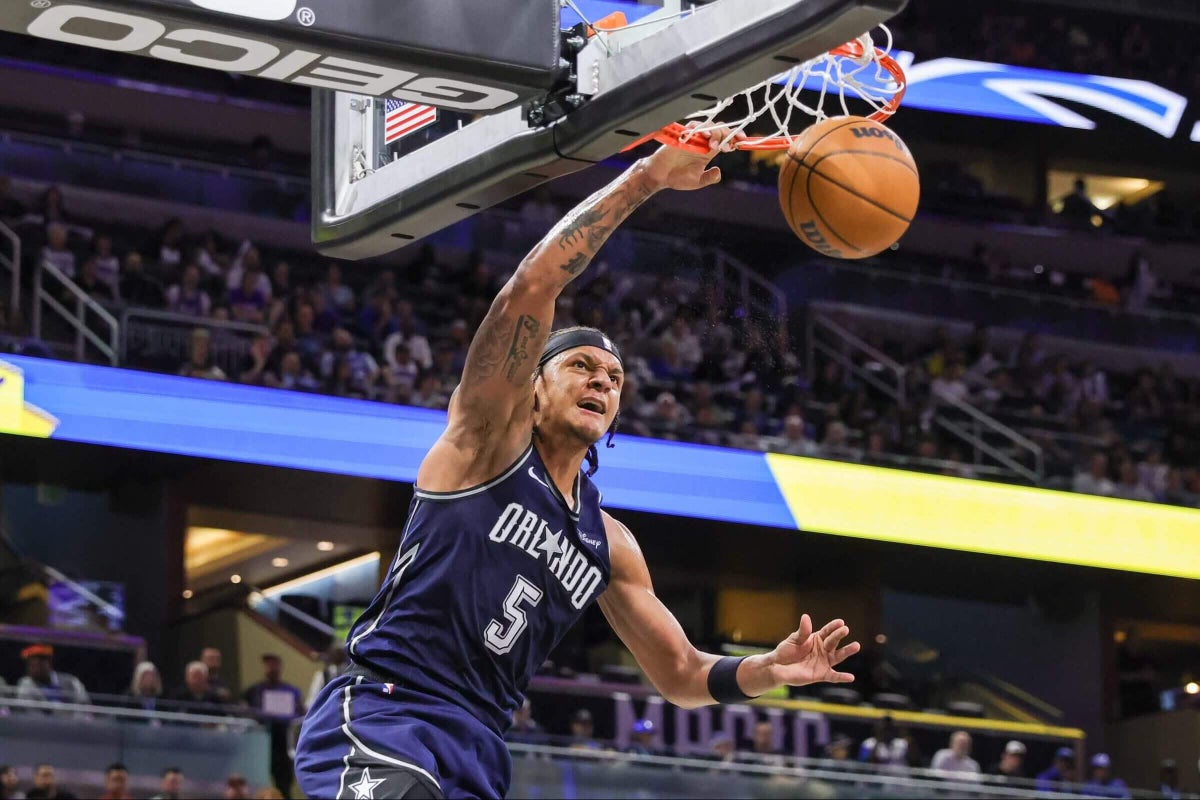
From the Play-In to an extended playoff run.
That’s the evolution the Orlando Magic expect from themselves in the season ahead.
“I think we should be a deep playoff team,” said Paolo Banchero, the team’s best player. “Hopefully, that means [NBA] Finals. But if it’s anything shorter than that, then Eastern Conference finals.”
The last time Banchero and his teammates played games that mattered, a national audience saw the Magic fall in five games to the Boston Celtics in the first round of the 2025 playoffs. Despite its tough, physical defense, Orlando could not overcome its own weaknesses: its league-worst 3-point shooting, its humdrum half-court offense and season-ending injuries to guard Jalen Suggs and sixth man Moe Wagner.
The Magic have reasons for optimism following their busy offseason. They added two accomplished long-range shooters and capable playmakers, trading for wing Desmond Bane and signing point guard Tyus Jones. They watched Suggs and Wagner make strides in their recoveries from knee surgeries. And they hope for improvement from the rest of their returning players, most notably Banchero and wing Franz Wagner.
“I feel that we have a team that’s capable of accomplishing big things,” Magic president of basketball operations Jeff Weltman told reporters in Orlando.
How reasonable are the heightened expectations?
To answer that question, I spoke with five NBA talent evaluators who work for rival teams and asked them to assess the Magic. The Athletic granted them anonymity because teams almost never allow members of their front offices to discuss opposing clubs and opposing players publicly. Without granting anonymity, articles such as this one could not exist. Anonymity allows the scouts to be completely honest, without fear of reprisals.
It’s no surprise that the experts I spoke with — called Scout A, Scout B and so on — regard the 2025-26 Magic as the franchise’s best team since Dwight Howard’s heyday. It’s also no surprise that, on balance, the scouts consider the Eastern Conference more wide-open than it’s been in years, largely because the Celtics’ Jayson Tatum and the Indiana Pacers’ Tyrese Haliburton are recovering from Achilles tendon ruptures that they suffered last spring.
“They’ll be one of the better teams in the East,” Scout A said. “They’ve got a chance if they hit the ground running.”
Scout B said: “I think they’re poised to take a bigger jump than they probably expected just because the landscape in the Eastern Conference changed, although now, if Boston ends up where Tatum ends up coming back at some point in the season, then that changes the landscape again.”
How Bane and Jones should impact Orlando
A lack of 3-point shooting bedeviled the Magic over the last three seasons. Orlando made 34.6 percent of its 3s in 2022-23 and 35.2 percent in 2023-24 — ranking 24th leaguewide in both years.
Last season, however, Orlando’s 3-point shooting cratered further, plummeting to 31.8 percent, which ranked as the worst percentage by any team in any regular season since the 2015-16 Los Angeles Lakers made only 31.7 percent of their attempts.
The 2024 offseason addition of wing Kentavious Caldwell-Pope was supposed to improve the Magic’s outside shooting and floor-spacing. Instead, Caldwell-Pope struggled on offense for much of the regular season, making only 34.2 percent of his 3-point attempts, and, like most of his teammates, he faltered from long range during the playoffs.
The depth of the Magic’s shooting struggles still astound. Last regular season, the league-average 3-point shooting percentage was 36.0 percent, per Basketball Reference. Only three Magic players met or exceeded that threshold: wing Caleb Houstan (40.0 percent), point guard Cory Joseph (36.4 percent) and big man Moe Wagner (36.0 percent). Houstan, Joseph, Wagner and rarely used wing Trevelin Queen were the only Magic players who shot at least a league-average 3-point percentage relative to players leaguewide at their respective positions, per Cleaning the Glass, an advanced analytics database that eliminates garbage-time stats and end-of-quarter heaves from its compilations.
Opposing defenses tended to sag off from many of the Magic’s perimeter shooters, electing to give up chances for wide-open 3s to the likes of Franz Wagner, guard Anthony Black, forward Tristan da Silva, big Wendell Carter Jr. and big Jonathan Isaac if the tactic helped close driving lanes for Banchero, Wagner and others. No team shot a lower percentage during the regular season on wide-open 3s (35.1 percent) and on open 3s (29.8 percent) than Orlando did. The errant shooting continued during the playoffs on wide-open 3s (28.9 percent) and on open 3s (25.5 percent).
“The biggest thing is they’ve struggled shooting the 3 and having a legit floor-spacer,” Scout C said. “Caleb Houstan, Jett Howard — they were supposed to fill that role. KCP was signed to fill that role. And they weren’t able to.”
One of the biggest criticisms of Weltman had been that he didn’t make any trades prior to the 2024 and 2025 trade deadlines to address the roster’s shooting deficiencies. (Another criticism — that the team’s front office didn’t even make calls to find potential deals — was factually inaccurate, team and league sources said.)
But something had to change for the Magic to boost their chances of earning home-court advantage for the first round of the 2026 NBA playoffs and advancing to the second round.
In June, Weltman made the kind of all-in move that so many of the team’s fans had craved. Orlando acquired Bane from the Memphis Grizzlies by trading the 16th pick in that month’s draft; unprotected first-round picks in the 2026, 2028 and 2030 drafts; the swap rights to a 2029 first-round pick (top-two protected) and Caldwell-Pope and guard Cole Anthony.
In July, the Magic signed Jones to a one-year, $7 million free-agent contract.
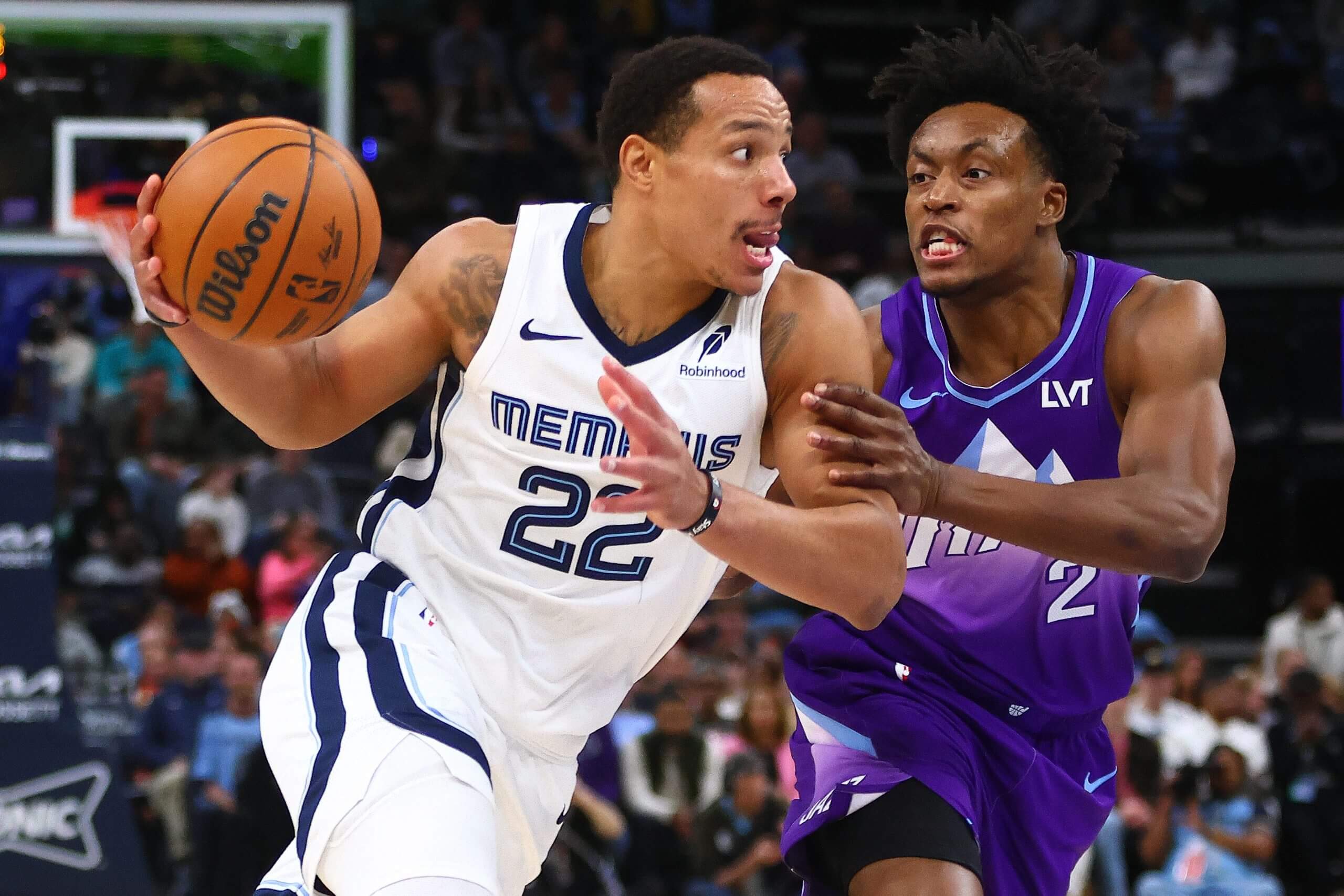
Desmond Bane averaged 19.2 points and made 39.2 percent of his 3-pointers last season for the Memphis Grizzlies. (Petre Thomas / Imagn Images)
Bane, 27, is a career 41.0 percent 3-point shooter. Jones, 29, shot 41.4 percent from 3 in each of the last two seasons.
“They finally addressed their shooting, and they addressed it coherently and skillfully and efficiently with the two guys,” Scout D said. “… (Jones) is not perfect, but he never makes a mistake, and he makes 3s, and he can run a team, and he is a true point guard, which they didn’t have.”
Scout D added: “KCP didn’t work out, and Bane is younger and better, maybe not quite the defender, not quite as big. But he’s a better playmaker. He’s a good playmaker. He’s got secondary ballhandling skills.”
The Bane trade carries risk in part because the 2026 first-round pick that Orlando will convey to Memphis has the potential to be especially valuable. Because of prior deals that don’t even involve the Magic, that 2026 pick going to the Grizzlies would turn into a lottery pick if the Washington Wizards and the Phoenix Suns both wind up in the lottery.
Adding Bane’s expensive contract also reduces Orlando’s ability to maneuver underneath the dreaded first apron. The Magic now have four players on the roster who will earn at least $32.4 million in 2026-27: Banchero, Bane, Suggs and Franz Wagner. The Magic have inked Banchero and Wagner to max-salary contract extensions, and the price of Banchero’s extension will balloon if he is named to an All-NBA team this season or wins the league Most Valuable Player award this season.
But apart from the 2026 pick and from the diminished payroll flexibility, the Magic are making an educated guess that, with Bane on the team and with improvement expected from Banchero and Wagner, they’ll be good enough to make their 2028 first-round pick going to Memphis land somewhere between 20th and 30th overall and also eliminate the possibility of swapping 2029 first-round picks with Memphis.
“They gave up a lot for Bane, but he fits them,” Scout A said. “They obviously think that they’re ready to take that next step, so I can understand it.”
Though considered forwards, Banchero and Wagner in recent years have functioned as initiators of the Magic’s offense, often gaining advantages off screens and driving to the basket. Too often, Banchero or Wagner would navigate into the paint and encounter defenses loaded against them, leaving them with a difficult decision: either attempt a difficult shot of their own or pass. The textbook correct basketball play would have been to hurl the ball to the open man, but as the Magic’s league-worst wide-open shot and open shot figures indicate, the Magic struggled to convert those perimeter shots. To put it another way: Banchero and Wagner had ample reason to attempt difficult shots of their own.
Bane and Jones should alleviate at least some of that pressure. Even when Banchero and Wagner continue to operate as de facto point guards, Bane and Jones ought to hit shots at a higher clip than Anthony, Caldwell-Pope or Markelle Fultz did in previous seasons. Meanwhile, having Bane and/or Jones on the court should help space the floor and open lanes for Banchero, Wagner and others.
Bane and Jones also have excelled as pick-and-roll ballhandlers, which should take some of the playmaking burden off Banchero and Wagner and, to a lesser degree, off Suggs and Black.
“Adding a guy like Desmond Bane, on the court and off the court with the pro that he is, that was a really good piece to add to grow with Paolo and Franz,” Scout B said. “A lot of times when you’re doing those kinds of things (to elevate a young team), you have to find a veteran guy who has to teach them but can’t be on the court with them at the same time because he isn’t necessarily good enough. But with Desmond, obviously, he’s good. He’s going to play alongside them, so he’ll be able to kind of pull them along on the court and off the court.
“Bane should address that (shooting issue), but also Caldwell-Pope was brought in to address the shooting and the defense,” Scout B added. “It wasn’t a total failure, but it didn’t go as well as I think they had hoped. So, a lot of it depends on Desmond and how he shoots and then the internal development with Paolo and Franz as well.”
Do the Magic have enough shooting?
Suggs and Black are Orlando’s best defenders on opponents’ primary ballhandlers — what coaches across the league often label as “the point of attack” — but when Orlando runs its half-court offense, Suggs and Black often have functioned as spot-up shooters or as secondary playmakers. Now that Bane and Jones are on the team, it’s reasonable to expect Suggs and Black to play off the ball on offense even more often than they did before.
And that, in turn, raises a fair question: Even with the additions of Bane and Jones, do the Magic have enough high-level perimeter shooters to play four-out and adequately space the floor, especially in the playoffs?
When fully healthy, Orlando’s starting five almost certainly will be Suggs, Bane, Franz Wagner, Banchero and Carter Jr. In that lineup, Bane is the only player who shot above league-average on 3s last season relative to other players at his position. Suggs made a gargantuan jump as a shooter two seasons ago, making 39.7 percent of his 3-point tries, but regressed last year to 31.4 percent as he dealt with his own injuries and with a bigger role on offense as Banchero and Wagner dealt with extended injury absences. Carter was an above-average long-range shooter as a center two seasons ago but dipped to 23.4 percent last season.
Wagner’s 3-point shooting is a concern. He played like an All-Star last season while Banchero dealt with an injury. But after Wagner returned from an oblique tear of his own, his 3-point shooting motion devolved, especially on attempts from above the break. Wagner’s struggles became a sensitive topic in Orlando, and for good reason. This miss in Game 5 against Boston in April illustrates the issue.
Has the problem been solved? Hard to tell. He helped lead Germany to the EuroBasket title over the summer, a huge achievement, averaging a team-high 20.8 points per game while he made 28.9 percent of his 3s. In the two preseason games he’s played this month, Wagner has gone 1 of 5 from beyond the arc. The shooting motion looks a bit smoother.
“The coach is good,” Scout D said. “Their defense has been solid. Their problem is they couldn’t make shots. They hope their defense will be at a similar level. Part of the problem is Banchero and Franz don’t make shots. They’re not shooters. They’re scorers. If one of them can improve their 3-point shooting, that would really help.”
From a team perspective, whether Orlando has enough depth to be able to play four-out consistently is more about the roster as a whole than it is about Wagner himself.
Isaac is an elite defender, but if he’s not generating turnovers or forcing misses that lead to transition opportunities, he’s a consistent drain on the half-court offense except for his offensive-rebounding ability. Black’s 3-point shooting dipped last season. And Goga Bitadze, who will be the backup center at least until Moe Wagner returns from a torn ACL, is a non-shooter.
It would help if second-year forward Tristan da Silva, a key contributor to Germany’s EuroBasket title, makes a leap. Rookie guard Jase Richardson has shown promise this preseason with his shooting, making seven of his 10 3-point attempts.
As the scouts noted, losing Moe Wagner’s scoring, shooting and energy off the bench after he suffered his knee injury in mid-December was a major blow. The elder Wagner had emerged as a legitimate Sixth Man of the Year candidate.
“They missed him,” Scout D said. “With health from Suggs, health from Moe Wagner, the addition of Bane, the addition of Tyus Jones, they should be much better. Plus, another year with Franz and another year with Banchero (is another reason for optimism). Banchero won’t have to do as much. Franz won’t have to do as much. Bane’s good. If he’s your third option, damn, that’s pretty potent.”
Reasons for optimism
The Magic’s strength remains its defense, which, under coach Jamahl Mosley, ranked third leaguewide in points allowed per possession two seasons ago and second last season. The Magic excel at forcing opponents into midrange shots; Orlando limited teams to the lowest number of 3-point attempts per game and the seventh-lowest number of shots per game within 5 feet of the rim.
Some of that outstanding combination has to do with Orlando’s slow pace on offense. After all, opponents tend to have fewer possessions per game against the Magic partly because the Magic’s half-court offense plays at a deliberate pace. But the real strength of Orlando’s defense is its physicality, positional size and outstanding individual effort.
“I like the coach,” Scout A said. “I think he does a good job. They’re a little different because of the way they play defensively; that’s different from most teams. I give them credit for that. That’s something that really helps them win games, just the way they are on that side of the ball.”
Suggs, 24, arguably is the team’s X-Factor. He is a known quantity because of his perimeter defense and his competitiveness. But he’s also an unknown quantity because, coming off knee surgery that included transplanting cartilage to repair the trochlear surface in his left knee, it’s unclear whether he will remain healthy once he returns. When Suggs does play, he brings energy that compounds the Magic’s strengths and is perhaps impossible to replicate.
Scout C said Bane is “a really good defender” and that Bane and Jones should provide insurance on offense in case Suggs misses extended time during the season. But having Suggs consistently available to play would be a significant bonus.
“They’ve had their identity based on their defense,” Scout C said. “So, having Jalen available, you can always have your defensive lineups where you feel like you’re not going to be giving up anything easy at any position. So, I’ll say I think he puts them in a different bucket and gives them a chance to really have a special year with Jalen available. But I think they could still be pretty good even if he’s not 100 percent.”
How far can Orlando go?
The consensus among the scouts is that the Magic’s optimism is well-founded.
“That center position is not at an All-Star level,” Scout B said. “But Paolo is. Franz is a borderline (All-Star). So, their wings are playing at an All-Star level if Bane can play at an All-Star level also. Jalen Suggs may be an All-Defensive guy. So, at just that one position (of center), if they can find an upgrade there, then all of a sudden it’s like they’ve got three guys kind of teetering at the All-Star level, another All-Defensive guy and then if they have a fifth guy who is in that mix also for some type of an award, then they have an unbelievable roster. But it’s tough to gain and keep five of those guys on the court, or even in an organization, at the same time.”
Scout E envisions Orlando as the East’s third-best regular-season team and, armed with home-court advantage in the first round, winning a first-round playoff series. The ceiling, that scout said, would be reaching the Eastern Conference finals, though the scout cautioned that he thinks the Magic have as much of a chance of being upset in the first round as reaching the East finals.
Scout D also expects Orlando to win a first-round series. “Their expectations, I assume, are quite high,” he said. “They should be.”
Again, the East is expected to be more wide-open than it was last season.
“If there’s a year to make a run in the East, this is the year,” Scout C said. “I think it’ll come down to how Tyus Jones fits in with the whole group. What’s the jump that da Silva makes after EuroBasket? Then, can Banchero stay healthy from the start to the end? With Franz’s shooting, it’s become clear that … once he gets in the playoffs, people leave him wide open. I’m not sure if he makes that huge of a jump there. But obviously having an outlet (such as Bane or Jones) that you know that if you move the ball he’s going to make an open shot gives you a little bit more confidence as well.
“They have enough. They have enough to make a run. And Tyus Jones is a good 3-point shooter. So, they addressed all the things that they needed to address on paper. Now it just has to come together on the court. And both of those guys are team guys, so it shouldn’t hurt the chemistry or their ability to bring it all together.”