
MIAMI — When Erik Spoelstra coaches his first game for USA Basketball, it will be at a prestigious, global tournament in which the Americans have not fared well lately.
The roll out of Spoelstra as the next coach for USAB is complete, from last week’s breaking news, to the formal announcement Tuesday, to a press conference Thursday at the Kaseya Center, where he holds a day job coaching the Miami Heat.
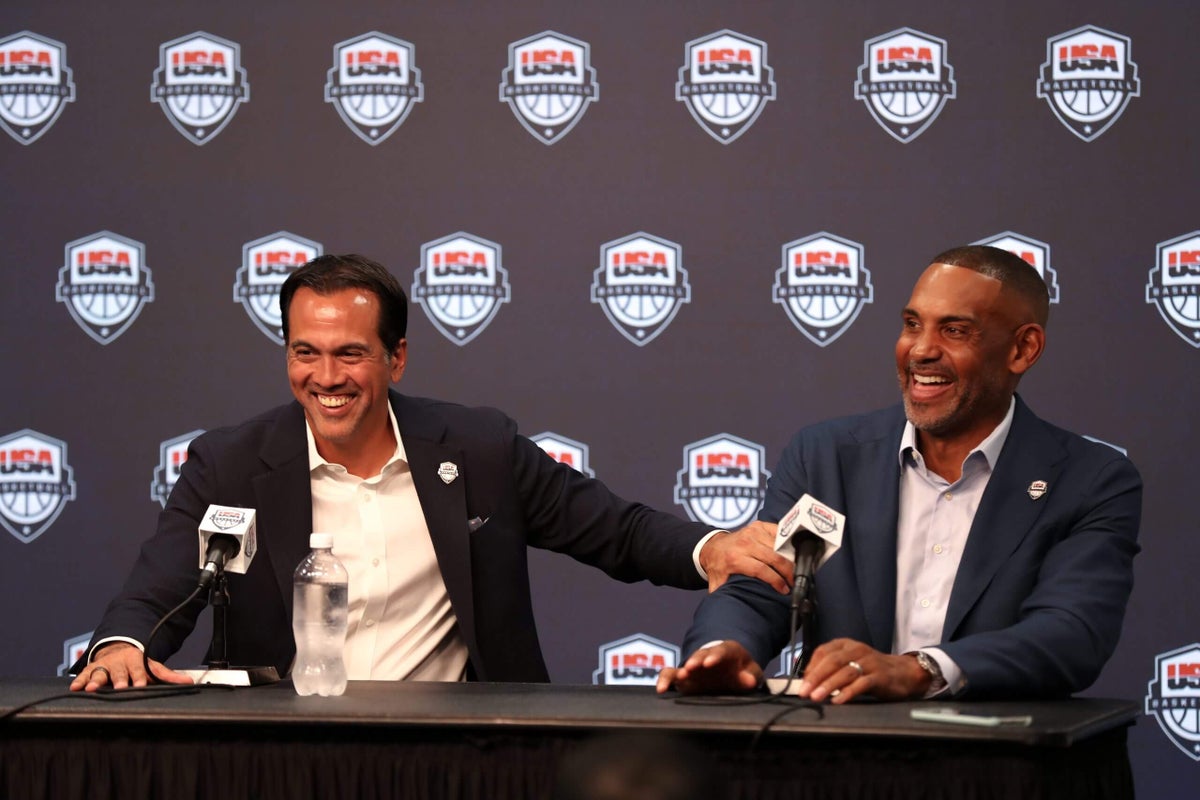
For the latest, and last leg of “Spo’s” introduction, he was seated at the dais in a sport coat and slacks with an American flag pin fastened to his lapel, next to Grant Hill, with all of the American program’s top brass in attendance, as well as Pat Riley, Spoelstra’s sister, and three children. The conference was briefly interrupted by the Heat’s players, who had showered and changed into street clothes after practice, barging into the room, waving little American flags and chanting “U-S-A,” among other things.
But not every Heat player is an American, and in fact, among the crowd of them was Andrew Wiggins, who is Canadian. As a matter of fact, Team Canada beat the U.S. in the last FIBA World Cup game for either country — in the third-place game in 2023 in Manila.
Wiggins wasn’t on the court for the Canadians then, but nevermind that. Spoelstra was on the bench for the U.S., as an assistant, while the Americans lost for the third time in four games to finish fourth at the World Cup. Four years prior, in 2019 in China, the U.S. actually finished seventh at the World Cup, the worst finish in program history.
So, yes, Spoelstra is taking over coaching duties for, by far, the most dominant men’s basketball program on Earth, with 17 Olympic golds (including the last five in a row) and five FIBA world championships. But when it comes to the World Cup — which is the “world championship” mentioned in the previous sentence — the Americans haven’t won that since 2014. It’s also true that the next one isn’t until 2027, in Qatar, so there are two full seasons of NBA games to play before the U.S. World Cup roster is selected.
But now that the salutations for the honor bestowed upon Spoelstra to take over for Steve Kerr as U.S. coach are finished, the next order of business for him, for Hill, and for Sean Ford, who oversees day-to-day operations for the men’s national team, is to stop the bleeding at the World Cup.
“We have not fared well,” Hill said. “Spo and I were together in Manila in ’23 and and went through the highs and the lows of that experience. I know I’ll do better in terms of putting together the best roster we possibly can. I’ve learned a great deal since that experience. But it won’t be easy and we’re in it to win, and we understand the rest of the world has grown. The game has expanded, as it should, and as I say, it’s great for the NBA – it makes it tough for us but we’re not afraid of tough and we welcome that challenge.”
Spoelstra added: “We have time to study that, study what happened in the last few World Cups, and you can be assured that we’ll get to work on that in due time.”
Something happened following the 2014 World Cup that was out of USA Basketball’s control that has greatly impacted how the Americans build their rosters for that event and has surely contributed to the consecutive, below-standard placings. FIBA, the international governing body for the sport, moved the World Cup’s placement from two years prior to each Olympics, to one year prior, beginning with the Chinese-hosted Cup in 2019. U.S.-born stars are less keen on playing in consecutive summers than their international counterparts, so for the past two World Cups the American rosters have not been loaded with established NBA superstars, but rather rising stars, potentially rising stars, and role players.
For instance, the Americans’ World Cup team in 2023 – the first Hill built in his role as managing director; he also constructed the wildly popular 2024 Olympic team loaded with stars – had just three current All-Stars and no players with any previous experience playing for the men’s national team. Their center was Jaren Jackson Jr., who is a forward in the NBA; Kerr ended up playing Josh Hart, who is 6-4, at power forward. That team lost three of its last four games, which sounds bad, but was 9-0 between preseason and World Cup early round games before the losing began.
And once the losing started, each game was close. A six-point loss to Lithuania. A two-point defeat to eventual World Cup champion Germany in the semifinals (the German roster had plenty of NBA talent), and then an overtime loss to Canada in the bronze-medal game with three American players out due to illness.
Thinking about it another way, the American Olympic team from last summer in Paris, one of the most celebrated U.S. basketball teams ever, trailed Serbia by 17 in the semifinals and was also nearly deadlocked with France late in the gold-medal game. The World Cup losses from 2023 could’ve broken the Americans’ way, and they could have easily lost at the Olympics, which would have confused both narratives entirely.
What won’t change is the U.S. likely won’t be sending many (if any) established, veteran All-Stars to Qatar. Think about Cooper Flagg and AJ Dybantsa, maybe Evan Mobley, who is the reigning NBA Defensive Player of the Year but hasn’t played for the men’s national team yet, and any other rising star or complementary player that may fit (paging Desmond Bane). Hill would likely also dangle the possibility of using a World Cup performance to earn one’s way onto the Olympic team for 2028 – a Games that will rival Paris in prestige because they will be held in Los Angeles. Anthony Edwards and Tyrese Haliburton were the two holdovers from the last World Cup team to play for the U.S. in Paris.
“We have some time, and one of the great things is to see who emerges,” Hill said. “You have two years before the World Cup, and it seems like every season there are players who take a step in their development and become better players, all star players, players whose games translate to international play.
“It’s great to get these players in the pipeline,” Hill continued. “The great thing is, yes, the world is getting better, but we are too. We still have some great players in this country, great young players. And you know, it’s on me to get out and recruit and you know, sort of share with guys the importance of doing this.”
Hill said there would be no mini camp for potential U.S. players next summer, and also said he expected Spoelstra’s coaching staff to be filled out next summer for a potential, short summit of the staff with Hill, Ford, and other USA officials. Spoelstra said he, after having served as an assistant under Kerr and before that, coaching the U.S. Select team for the the Tokyo Olympics at Gregg Popovich’s request, believes the head coach for the American team should first be an assistant in the program.
That’s part of the culture of USAB,” Spoelstra said. “It’s all about coming together for a greater goal and a greater good.”
Spoelstra, 54, the third-winningest active coach in the NBA, seemed to make the same pitch for potential World Cup players. He was preaching the value of gaining the experience of playing on the international stage ahead of the Olympics by suiting up at a World Cup. He knows the established American superstar, like a Jayson Tatum, or Devin Booker, or his own Bam Adebayo with the Miami Heat, or an Edwards, or even a Jalen Brunson or Donovan Mitchell – two superstars with past World Cup experience but no Olympic appearances of yet – likely would pass on playing in Qatar but will want to be selected for the L.A. games.
So this is about the next generation of potential stars, when Spoelstra said: “We feel our experience in these tournaments you know help us to learn and be better.
“It’s a culture of service,” Spoelstra added. “Where you have the best American players that raise their hand that say, I want to volunteer for this and represent our country at the highest level. There’s a culture of a competitive spirit to rise to the challenge and to not shy away from these expectations. There’s massive expectations when you put on that USA jersey. We’ve had incredible success over the years, and you want everybody to embrace that and not shy away from that.”
The next opportunity to, you know, not be shy as an aspiring American star, is at the World Cup.
“It’s not easy at all,” Hill said. “That’s the first order of business (winning the World Cup) and we strive to do better than what we’ve done in recent years.”