
TORONTO — Baseball isn’t big in Serbia. Apparently, Toronto Raptors head coach Darko Rajaković has picked up a thing or two since moving to North America more than a decade ago.
“We don’t have pitchers in our game,” Rajaković said before his team closed out its preseason schedule with a 119-114 win over the Brooklyn Nets. “It’s a little bit different.”
Nailed it. Rajaković has become interested enough to follow the Toronto Blue Jays’ playoff run. The Blue Jays are owned by Rogers Communications, which has majority control of Maple Leaf Sports and Entertainment, the company that owns the Raptors.
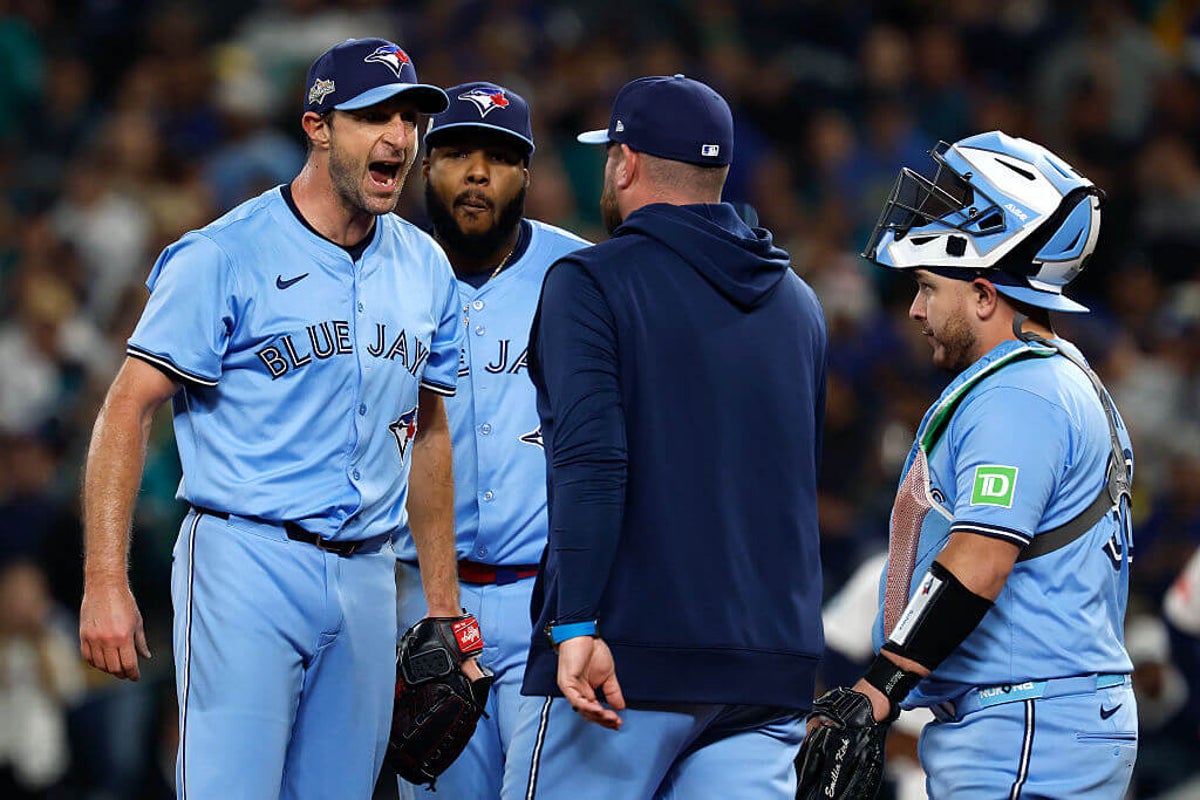
On Thursday night, he saw the dramatic scene on the mound in Seattle, when Blue Jays starting pitcher Max Scherzer barked at John Schneider as the Toronto manager went to have a conversation with the future Hall of Famer, debating a pitching change with a Mariners runner on in the fifth inning.
Scherzer escaped the inning, got two more outs in the sixth and picked up the win. It was the emotion, emanating from the pitcher and directed at his manager, that made an impression.
“I think … John Schneider, the pitcher and the whole team, they want the same thing. They want to win and they want to win badly,” Rajaković said. “I’m really glad and congrats to the Blue Jays for winning that game. That was awesome.”
The Mariners won Game 5 on Friday, one in which Blue Jays fans will rue Schneider’s pitcher management, taking a 3-2 lead in the series. Still, the moment with Scherzer and Schneider will live on regardless of the series outcome. It also had to be somewhat familiar for any type of coach watching the scene.
All sports are different, with the fascinating aspect of baseball being that once a manager takes a player out, that player cannot go in again. It’s very different in basketball, among other sports. There is also the pace and nature of the games. Baseball is a series of one-on-one matchups that invite real-time analysis and adjustment. There are way more opportunities for strategy implementation in baseball than in sports with a consistent stop-and-start to play.
That said, things can still get heated with players in other sports when you try to take them out of the game — especially an important one.
“It’s a very emotional game. It’s a very competitive game,” Rajaković said. “All of us, we want to win. We want to win every possession, win every game. Those clashes sometimes happen. I always find them very positive. There is always something good about those that you can take away, for you to learn as a leader, or for a player to learn, or for the whole team to learn how to approach those situations.”
Brooklyn Nets coach Jordi Fernández said that more often than not, he feels as if he has to save his players from themselves. Whether it is a player saying he can navigate foul trouble or has enough energy to play three or four more minutes, they will generally advocate for themselves.
That doesn’t mean Fernández would have pulled Scherzer had he been in Schneider’s position.
“I think that you’ve got to trust the guys with experience,” Fernández said. “If I would have a Hall of Famer or All-Star, multiple-time All-Star, on my team, I would trust those guys more based on relationships and so forth. But a lot of times, you’ll make the decision based on what you think is best for the team. No hard feelings. Nothing personal.”
In baseball, these decisions aren’t necessarily made in the moment, or at least exclusively based on information gained in the moment. The arrival of advanced statistics impacted baseball before most other sports. For a long time, managers have known that a pitcher tends to have less success the second time he pitches through the order than the first, and the third versus the second and so on. The information gets much more granular than that these days.
The debate of having a plan versus making decisions on the fly — obviously, most processes are a mix of the two — tends to come to a head with pitching decisions in the playoffs. On a big scale, the conversation peaked during the 2020 World Series, when Tampa Bay Rays manager Kevin Cash pulled ace starter Blake Snell after 5 1/3 innings with two runners on base in a must-win Game 6. Snell had allowed just two hits and struck out nine Los Angeles Dodgers. But he was about to deal with the heart of the order for a third time. Nick Anderson, who relieved him, quickly lost the lead for the Rays, and the Dodgers went on to win and clinch the series.
Rajaković said that in European basketball, coaches don’t have a set substitution pattern; instead, they know which players are going to be in the rotation, but do not even roughly map out the minutes.
“They look at coaches on this side of the ocean like, ‘How is that even possible? How do you know that?’”
In Europe, though, they have 40-minute games and more practices than games. In the NBA, there are 48 minutes in a game, and they usually play three or four times per week. Advanced statistics and data analysis have become an increasingly big part of the game, with teams through lineup data — which players play well together — to help measure the physical toll on players’ bodies. When combined with the monetary investment put into players and the length of the season, it would be negligence not to at least have a substitution outline going into a game.
“For me, I want to be able to take into account analytics,” Rajaković said. “I want to be able to coach the game by feel. I do go into the game with a plan, but a lot of times that plan changes. If a player catches fire and he’s feeling good and you see the body language is good, I like to keep him in the game. Sometimes I have to (take him out) because he’s needed in the second unit. It’s a very delicate job to measure all of that.”
He and Fernández seemed to be making the same points: When it comes to deciding when to deviate from a plan, it is both art and science.
“You have to have a feel for what things you can change on the fly. A guy gets in foul trouble, or a guy is underperforming, or a guy is performing very well — how do you put that into the plan you had before? Easier said than done,” Fernández said. “I think the best coaches in the league, there’s a reason they’ve coached for so long. Coaches like me, that’s how you want to learn. You are going to make mistakes. There is never a perfect plan, but you can’t go out there without a plan, if that makes sense.”